Budget 2026: As capex allocation slows, will govt continue public infra push?
/ 2 min read
Experts say the moderation reflects the government’s focus on fiscal prudence and rising debt servicing costs
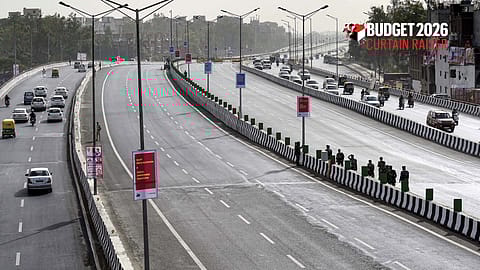
Experts stress that a renewed push is now essential to sustain economic momentum.
Budgetary allocation towards capital expenditure has slowed over the last few years. Data shows that year-on-year growth in capex allocation fell from 36% in FY23 and 33% in FY24 to 11% in FY25, before dropping sharply to just 0.9% in FY26.
In absolute terms, however, government spending on capital assets has steadily increased. Capex allocation has risen from ₹4.12 lakh crore in 2020-21 to ₹11.21 lakh crore in 2025-26, underlining the government’s continued focus on long-term asset creation despite tighter fiscal conditions.
Experts, however, have recommended a 7% growth in capital expenditure in budget 2026-27. “India’s Union Budget 2026 must sustain the infrastructure-led growth trajectory with a capex outlay near ₹12 lakh crore, reinforcing roads, railways and logistics to unlock economic multipliers,” said Jagannarayan Padmanabhan, Senior Director and Global Head, Consulting at Crisil Intelligence.
Crisil notes that capex growth is now slowing in line with fiscal consolidation. Budgetary capex is rising at a more normal pace, execution is getting harder, and actual spending has started to fall short of budget targets in recent years.
Capex remains growth driver, says EY India
EY India, meanwhile, has pointed out that government capital expenditure remains the main growth driver in the economy, especially at a time when global demand is weak and exports are under pressure.
“GoI’s capital expenditure continued to show a double-digit growth of 28.2% during April–November FY26, compared to a contraction of (-)12.3% during the corresponding period of FY25,” said EY Economy Watch January 2026.
EY highlights that higher public capex is directly supporting investment demand, reflected in stronger growth in gross fixed capital formation (GFCF). The report also underlines a structural shift in government spending, where the share of capital expenditure has steadily increased over the years while revenue expenditure has declined. EY describes this shift as the core of the government’s growth-supporting strategy.
Is PPP the way forward?
Infrastructure has, no doubt, been the mainstay for the economy in the last couple of years. But with the limited fiscal space due concerns on the direct and indirect tax growth and lower than anticipated nominal GDP growth, the government may tweak some strategy going forward in the budget.
More focus is likely to be seen on Public Private Partnership (PPP) and private sector participation for infrastructure creation rather than thrust towards public capital expenditure, which has been the strategy since Covid-19. In a hint of sorts, the government has already come out with a three year pipeline of PPP projects worth Rs 17 lakh crore earlier this month.
Follow Fortune India
NEXT STORY