Budget 2026 pushes for Orange Economy with focus on AVCG content creator labs
/ 3 min read
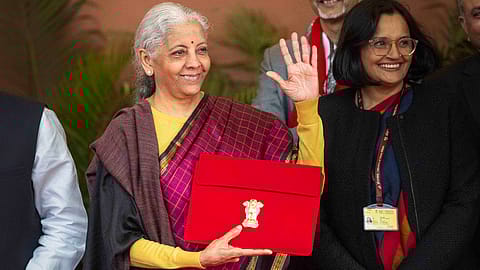
The budget also proposes a new National Institute of Design to address the designer shortage. | Credits: Narendra Bisht
Budget 2026 pushes for Orange Economy with focus on AVCG content creator labs
The 2026 Union Budget emphasizes the 'orange economy', focusing on creative industries as a growth engine. Finance Minister Nirmala Sitharaman announced plans to establish AVCG content creator labs in schools and colleges, aiming to meet the projected demand for two million professionals by 2030. The budget also proposes a new National Institute of Design to address the designer shortage.
This summary is AI-generated, and Fortune India is not responsible for its content or any associated copyright issues.
The government estimates the AVCG sector could require around two million professionals by 2030.
THIS STORY FEATURES
The budget also proposes a new National Institute of Design to address the designer shortage. | Credits: Narendra Bisht
Union finance minister Nirmala Sitharaman on Sunday signalled a strategic pivot towards India’s creative industries, positioning the ‘orange economy’, or the creativity-led sectors, as a new engine of employment and services-led growth in the Union Budget for 2026-27.
“India’s AVCG (animation, visual effects, gaming, and comics) sector is a growing industry projected to require two million professionals by 2030. I propose to support the Indian Institute of Creative Technologies, Mumbai, in setting up AVCG content creator labs in 15,000 secondary schools across the country and 500 colleges,” Sitharaman said. The government estimates the AVCG sector could require around two million professionals by 2030.
Sitharaman proposed to set up a new National Institute of Design to boost design education and development in the eastern region of India. India’s design industry is expanding rapidly, and yet there is a shortage of designers, she said. Currently, there are seven NIDs in India, recognised as institutes of national importance.
The Budget announcements build on the analytical framework laid out in the Economic Survey 2025–26, which argues that India’s creativity-led sectors, spanning culture, media, entertainment, and intellectual property, can emerge as significant contributors to employment, urban services, and tourism. Termed the Orange Economy, these sectors derive value primarily from ideas and cultural capital rather than physical production.

Concert economy in focus
The Economic Survey identified the concert economy as a particularly high-impact but underdeveloped segment of India’s services landscape. Live entertainment, it noted, generates economic value far beyond ticket sales by creating downstream demand across hospitality, transport, logistics, advertising, security, and local services.
Citing global benchmarks, the survey noted that live music accounts for roughly one-third of worldwide music revenues. In the U.S., live music generated over $130 billion in economic output and supported more than 900,000 jobs in 2019. In the UK, music tourism contributed £6.6 billion—about 0.3% of GDP—in 2022. More broadly, estimates from the United Nations Conference on Trade and Development (UNCTAD) suggest creative industries contribute between 0.5% and over 7% of GDP across countries.
The survey described concerts as “short-duration tourism multipliers”, intensifying spending on accommodation, food, transport, and city services over brief periods. It also underscored the labour-intensive nature of live events, which generate employment across event operations, stage management, logistics, hospitality, security, and media—sectors that tend to absorb younger workers and creative professionals.
Structural constraints remain
While India’s concert economy is expanding—supported by a young population, rising discretionary incomes, digital ticketing platforms, and improving urban infrastructure—the Survey had cautioned about bottlenecks. These include a shortage of large-format live-event venues, regulatory complexity, and constraints around payments to foreign performers. Event organisers currently require between 10 and 15 separate approvals to stage large concerts.
Taken together, the Budget proposals and the Economic Survey’s analysis mark a shift in how the government views creative industries—from peripheral entertainment to a component of a broader urban growth and tourism strategy. With targeted policy support, regulatory simplification, and sustained skills development—beginning with initiatives such as the AVCG creator labs announced in Budget 2026—the Orange Economy could evolve into a durable source of jobs and economic value in India’s services-led growth model.
NEXT STORY