The FAQs are AI-generated, and Fortune India is not responsible for its content or any associated copyright issues.
Floating solar with storage to be new renewable energy engine for India
/ 3 min read
Planned solar and wind capacity additions of about 270-300 GW are expected to require nearly 7 lakh acres of land and create a $10-15 billion market for land aggregation and acquisition by 2030, as per Colliers India report.
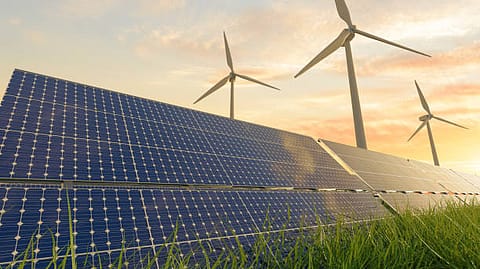
Estimates suggest that India’s floating solar potential could exceed 200 GW | Credits: Getty Images
India's renewable energy growth plans will soon get a new thrust area—floating solar—as the expenditure finance committee (EFC) under the finance ministry has approved a proposed ₹5,500 crore scheme focussed on floating solar projects integrated with battery energy storage systems (BESS).
The move is primarily aimed at reducing the demand for huge tracts of land required for renewable energy projects. A recent Colliers India report says the planned solar and wind capacity additions of about 270-300 gigawatts (GW) are expected to require nearly 7 lakh acres of land and create a $10-15 billion market for land aggregation and acquisition by 2030.
Floating solar, or Floating Photovoltaics (FPV), involves installing solar panels on structures moored on water bodies such as reservoirs, lakes, and ponds, thereby saving valuable land, increasing panel efficiency due to the water’s cooling effect, and reducing evaporation. However, only around 700 MW of floating solar projects have been commissioned in India so far, mainly due to a lack of data on potential sites and the absence of a clear framework for project execution.
Experts say floating solar is also an option for promoting solar projects in less-solarised states such as Odisha, Kerala, Tamil Nadu, and Karnataka, which have abundant water bodies including lakes, dams, and backwaters. Some rough estimates suggest India’s floating solar potential could exceed 200 GW.
In February, the Union Ministry of New and Renewable Energy (MNRE) organised a stakeholder consultation workshop to assess the potential of FPVs and draft a floating solar policy in association with the National Institute of Solar Energy (NISE) and Indian Institute of Technology Roorkee. Discussions focussed on providing innovative solutions such as plug-and-play models and allotment of water bodies with all necessary approvals to support developers and investors.
At an experimental scale, India is already home to some of the world’s most groundbreaking floating solar projects. Tata Power constructed the 126 MW Omkareshwar floating solar project across the Narmada river in Madhya Pradesh. Built over 260 hectares of water, it is considered one of the world’s largest floating solar projects based on inverter platforms. Commissioned by Tata Power Renewable Energy Limited (TPREL) and awarded by NHDC Limited, it supplies clean energy to the Madhya Pradesh Power Transmission Company.
At NTPC’s thermal project in Kayamkulam, Kerala, Tata Power also constructed a 101.6 MW floating solar project spread across a 350-acre backwater area.
The 100 MW Ramagundam FPV project in Telangana—currently the largest operational floating solar project in India, spanning 500 acres on the NTPC reservoir—was commissioned in 2022. Other major FPV projects include the 25 MW Simhadri project in Andhra Pradesh, the 33 MW Kawas project in Gujarat, and projects at Rihand Dam in Uttar Pradesh, according to industry sources.
Experts view FPV projects linked with BESS not only as opening up a new energy avenue in India, but also as creating fresh opportunities for renewable energy specialists across related sectors.
“This move will not only accelerate innovation in battery technologies and floating solar solutions, but also create significant opportunities for domestic manufacturing, greater energy security, reduced dependence on imported fossil fuels, and sustainable industrial growth,” says Anand Kabra, Chairman and Managing Director of Kabra Extrusiontechnik and Geon – Green Energy.
Ayush Misra, co-founder and CEO of AmpereHour Energy, says the government push also opens doors for companies in grid-side storage, mini-grids, and solar-plus-storage projects.
{{#most-powerful-women-snapshot-individual.slug}} {{/most-powerful-women-snapshot-individual.slug}} {{^most-powerful-women-snapshot-individual.slug}} {{/most-powerful-women-snapshot-individual.slug}} {{#showRanking}} {{current-rank}} {{/showRanking}} {{#photo.0.url}}
{{name}}
“Those kinds of projects were previously harder to finance and justify,” he says, noting that installation costs for floating solar projects are comparatively higher than those for conventional solar plants.
Floating solar installations demand thermally resilient, application-specific storage solutions, notes Kajal Shah, co-founder and CEO of Dreamfly Innovations.
“We make graphene and lithium-ion batteries in-house for drones, agri-tech, and aerospace applications, and schemes like these expand the ecosystem that makes deep-tech battery innovation in India viable and fundable,” says Shah.
Follow Fortune India
Frequently Asked Questions
NEXT STORY