Enough monetary, fiscal cushion to deal with global shocks: Finance Minister
/ 3 min read
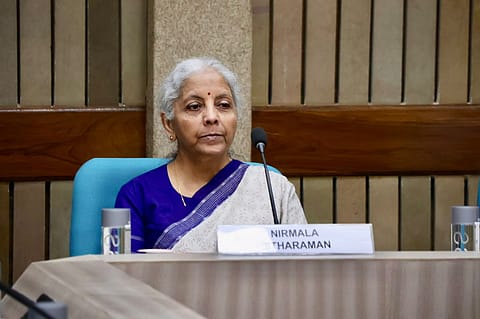
Finance Minister Nirmala Sitharaman
Enough monetary, fiscal cushion to deal with global shocks: Finance Minister
Finance minister Nirmala Sitharaman said a decade of fiscal prudence, investment-led budgeting and sound debt management has given India strong monetary and fiscal buffers amid a shift from global shocks to “permanent volatility”. With ample space for capex, rate cuts and targeted support, she argued India is uniquely placed to pursue its 2047 developed economy goals despite rising geopolitical and economic risks.
This summary is AI-generated, and Fortune India is not responsible for its content or any associated copyright issues.
FM Nirmala Sitharaman said the road to Viksit Bharat 2047 is long and fraught with challenges, but India is on the right path.
Finance Minister Nirmala Sitharaman
Finance minister Nirmala Sitharaman today said the slew of measures taken over the last decade, spanning budgetary discipline, thrust towards infrastructure and public debt management, and preference to productive investment-led fiscal management over erstwhile focus on consumption-led deficits, has helped India stand out as the world is moving from the state of “shocks to one of permanent volatility”.
Sitharaman said the decadal fiscal prudence and discipline, which has been a policy imperative, provides room for monetary easing. The FM said India is on the right path to the developed economy goals of 2047.
“The year 2025 was monumental in more ways than we initially thought. Trade fragmentation has introduced severe uncertainty into global supply chains. This led to sharp downward revisions in global growth forecasts, but the year ended more optimistically than previously perceived, particularly for India,” Sitharaman said in her address at the Golden Jubilee celebration of the National Institute of Public Finance and Policy (NIPFP) in New Delhi.
“This current year is even more challenging as we move from a landscape of shocks to one of permanent volatility. The escalation of the Middle East conflict has evolved from a regional security concern into a systemic tremor, threatening the vital arteries of global energy and hardening the lines of a new, multipolar world order,” she added.
The FM, however, pointed that the decadal macro management now provides both fiscal as well as monetary buffer to deal with the emerging situation. “India has fiscal space — room to maintain our capex programme, room for the RBI to cut rates, room to offer targeted support to affected sectors. This is the dividend of a decade of fiscal discipline. This is the strategic value of fiscal prudence that pays dividends across decades,” she said.
FM Sitharaman said the road to Viksit Bharat 2047 is long and the challenges ahead are climate finance, subnational fiscal reform, debt management, the fiscal implications of demographic change, the public investment return challenge, technology-led disruptions, etc., which are all formidable. “But I have no doubt that we have the intellectual resources, the institutional capacity, and the national ambition to complete it. India is not merely on the move. India is on the right path. India is all set to scale new heights that were hitherto unseen,” she said.
Sitharaman pointed out that India stands out on the public debt management front. “For a rapidly progressing economy like ours, sound fiscal management is a policy imperative. And in this front, we have undergone a massive structural transformation of public finance over the past decade. Under Hon’ble PM Shri Narendra Modi, we have credibly changed the course of the fiscal policy from consumption-led deficits (under UPA) to productive investment-led consolidation,” she said.
Sharing data on global public debt, Sitharaman said the global public debt has surged to approximately $106 trillion — exceeding 95% of global GDP. “As per the IMF, the United States has a debt-to-GDP ratio of 125% in 2025, with Japan at a staggering 235%. Many advanced economies that spent decades running expansionary fiscal policies now find themselves with severely constrained policy space precisely when they need it most,” she said.
“Against this backdrop, India continues to stand out. Our general government debt-to-GDP ratio (which includes States’ debt), at approximately 81%, is the lowest among major economies after Germany. More importantly, India is the only major economy where the IMF projects this ratio to fall significantly — to 75.8% by 2030 — while the debt outlook for the advanced economies such as US, China, Germany, and others is projected to worsen,” she added.
Sitharaman said India’s external debt-to-GDP ratio stands at just 19.1% (as of September 2025) — one of the lowest in the emerging market world and India's foreign exchange reserves, at over $688 billion (as of March 31, 2026), provide import cover of approximately 11 months — a substantial buffer.
“This is not an involuntary outcome, as many leaders wrongly believe. It is the product of deliberate, sustained, and sometimes politically difficult choices made over years of fiscal management. It was made possible because of the agile policies and stable leadership of this government, with a singular focus on ensuring India achieves godspeed progress,” she added.
Follow Fortune India
NEXT STORY