The FAQs are AI-generated, and Fortune India is not responsible for its content or any associated copyright issues.
Govt to review windfall tax on fuel exports every fortnight; diesel, ATF levy to fetch ₹1,500 crore in two weeks: CBIC chief
/ 3 min read
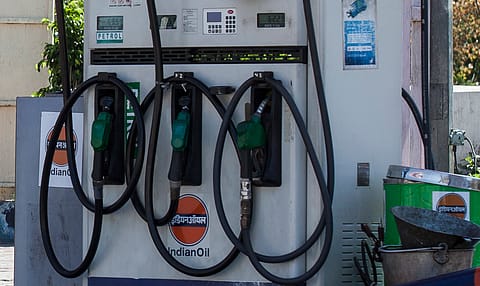
The government on Thursday imposed an export duty of ₹21.5 per litre on diesel and ₹29.5 per litre on ATF to discourage overseas shipments and prioritise domestic supply. | Credits: Sanjay Rawat
Govt to review windfall tax on fuel exports every fortnight; diesel, ATF levy to fetch ₹1,500 crore in two weeks: CBIC chief
The government will review the windfall tax on diesel and aviation turbine fuel every fortnight, aiming to generate ₹1,500 crore in two weeks. The tax is intended to boost domestic supply, while excise duty cuts on petrol and diesel aim to cushion consumers and reduce oil marketing companies' under-recoveries.
This summary is AI-generated, and Fortune India is not responsible for its content or any associated copyright issues.
Officials from the Ministry of Petroleum and Natural Gas said India has maintained adequate supplies of crude oil, petrol, diesel, LPG, and, PNG despite global disruptions.
The government on Thursday imposed an export duty of ₹21.5 per litre on diesel and ₹29.5 per litre on ATF to discourage overseas shipments and prioritise domestic supply. | Credits: Sanjay Rawat
The government will review the special additional excise duty (SAED), or windfall tax, on diesel and aviation turbine fuel (ATF) every fortnight, Vivek Chaturvedi, Chairman of the Central Board of Indirect Taxes and Customs (CBIC), said on Friday.
He said the export tax on diesel and ATF is expected to generate around ₹1,500 crore over a fortnight, even as the Centre has reduced excise duties on petrol and diesel to cushion consumers.
Chaturvedi said the excise duty cuts are aimed at reducing under-recoveries of oil marketing companies (OMCs) and ensuring that retail fuel prices do not rise. He added that the imposition of SAED on exports is intended to improve domestic availability of diesel and ATF.
The government on Thursday imposed an export duty of ₹21.5 per litre on diesel and ₹29.5 per litre on ATF to discourage overseas shipments and prioritise domestic supply.
The SAED, first introduced in July 2022 following the Russia's invasion of Ukraine to curb windfall gains by refiners, had been withdrawn in December 2024 before being reintroduced.
Revenue impact and excise cuts
According to the CBIC chief, the reduction in excise duty on petrol and diesel will result in a revenue loss of about ₹7,000 crore over the next 15 days.
As per a Finance Ministry notification dated March 26, excise duty on petrol has been cut from ₹13 per litre to ₹3 per litre, while diesel has been fully exempted. The revised rates have come into effect immediately.
According to reports, the total revenue impact from the excise cuts could reach ₹1.15 lakh crore, potentially forcing trade-offs in government spending, particularly on capital expenditure and welfare schemes.
Earlier, Petroleum and Natural Gas Minister Hardeep Singh Puri said the government has chosen to absorb the impact of rising global fuel prices rather than pass it on to consumers, noting a sharp increase in crude prices over the past month.
Supply remains stable
Officials from the Ministry of Petroleum and Natural Gas said India has maintained adequate supplies of crude oil, petrol, diesel, LPG, and, PNG despite global disruptions.
Sujata Sharma said domestic LPG production has risen nearly 40%, with supply prioritised for households and key sectors, while commercial LPG availability has been restored to about 70%.
RANK
COMPANY NAME
REVENUE
(INR CR)
(INR CR)
{{#current-rank}} {{current-rank}} {{/current-rank}} {{^current-rank}} {{rank}} {{/current-rank}} {{name}} {{#revenue}} {{revenue}} {{/revenue}} {{^revenue}} {{noi}} {{/revenue}}
“Government has reduced excise duty and absorbed the burden itself instead of passing it on to consumers. Since April 2022, petrol and diesel prices have either decreased or remained stable,” she said.
She added that PNG expansion has accelerated, with over 10,000 connections being added daily, while enforcement against hoarding has intensified through raids and strict action.
Shipping safety, misinformation concerns
Rajesh Sinha said there have been no reports of distress involving Indian vessels or seafarers in the Gulf region. “There are 20 Indian-flagged vessels in the Persian Gulf with 540 Indian seafarers onboard, and they are all safe,” he said, adding that 25 seafarers have been repatriated.
C. Senthil Rajan urged citizens to avoid rumours and misinformation, noting that earlier panic over LPG shortages had been contained, but similar concerns were emerging around petrol and diesel.
“There is no shortage, supplies are stable, and there is no need for panic buying,” he said, adding that states have been asked to act against hoarding, black marketing, and the spread of fake news.
India’s engagement with global partners continues
Randhir Jaiswal, spokesperson for the Ministry of External Affairs, said, "India’s engagement with global partners continues, with the External Affairs Minister visiting France for the G7 Foreign Ministers’ Meeting (March 26–27). On the sidelines, he held bilateral meetings with counterparts from France, Canada, South Korea, Japan, Brazil, the UK, Germany, and Ukraine, discussing bilateral ties and developments in West Asia."
He said at the G7 sessions, the minister underscored the need for reforms in the United Nations Security Council, streamlined peacekeeping, and stronger humanitarian supply chains while highlighting the concerns of the Global South on energy, fertilisers, and food security. He also flagged uncertainties arising from the West Asia conflict and called for more resilient trade corridors and supply chains, Jaiswal added.
Frequently Asked Questions
Explore the world of business like never before with the Fortune India app. From breaking news to in-depth features, experience it all in one place. Download Now