The FAQs are AI-generated, and Fortune India is not responsible for its content or any associated copyright issues.
Green steel transition may save India $1 trillion in coking coal imports: Report
/ 2 min read
Green hydrogen production costs in India could decline to around $3 per kilogram by 2030, enabling green steel production at nearly $562 per tonne, according to a report by the India Energy and Climate Center (IECC) at the University of California.
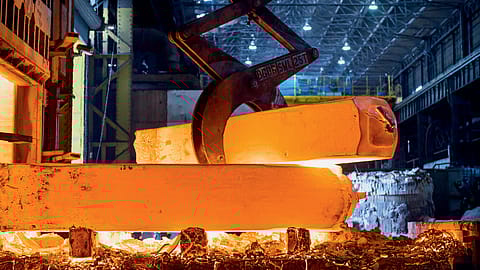
India’s steel growth may trigger 6 billion tonne coal imports worth $1 trillion | Credits: Photograph by Getty Images
India’s next phase of steel capacity expansion could expose the country to nearly $1 trillion in coking coal import costs over the coming decades if it continues to rely on conventional blast furnace-based production, according to a report by the India Energy and Climate Center (IECC) at the University of California.
The study said India is expected to roughly double its steelmaking capacity over the next decade. If most of the new capacity is built using traditional blast furnace technology, the country could lock itself into around 6 billion tonnes of coking coal imports over a 40-year period, exposing the sector to global commodity price swings and currency volatility.
“India is at a strategic decision point in steel,” said Neelima Jain, Director for Industrial and Trade Policy at IECC. She said dependence on imported coking coal would hardwire currency and price volatility risks into one of India’s most important industrial sectors.
“If future capacity is built around imported coking coal, the country would hardwire currency and price volatility risks into one of its most important industrial sectors. Green steel offers an alternative path,” she added.
The report argues that green steel production, using green hydrogen instead of coking coal in ironmaking, could provide a more resilient alternative. It noted that India’s low-cost renewable energy resources position the country favourably for domestic green hydrogen production.
According to the study, green hydrogen production costs in India could fall to around $3 per kilogram by 2030, enabling green steel production at roughly $562 per tonne. This would place green steel costs only around 5-10% above conventional steel produced from new plants.
The report added that green steel could become cost competitive with conventional steel by around 2030 when accounting for exposure to imported coal prices and foreign exchange risks. Unlike conventional steelmaking, which depends on imported coking coal priced in U.S. dollars, green steel production can be supported through long-term, fixed-price renewable energy contracts denominated in rupees.
“A static cost comparison misses the central economic point,” said Jose Dominguez, Research Manager at IECC. “Conventional steel depends on imported coking coal priced in dollars. Green steel can be powered by domestic renewable electricity under long-term rupee contracts.”
The study also warned that India’s carbon-intensive steel production could face rising trade risks as global markets tighten carbon-related regulations. It highlighted the European Union’s Carbon Border Adjustment Mechanism (CBAM), which already covers steel imports.
The report said green steel could create export opportunities for Indian producers while also improving competitiveness in downstream manufacturing industries such as automobiles and machinery.
“India’s green hydrogen costs are among the lowest globally,” said Nikit Abhyankar, Co-Faculty Director of IECC. “India could be one of the few countries where green steel becomes economically viable within this decade.”
RANK
COMPANY NAME
REVENUE
(INR CR)
(INR CR)
{{#current-rank}} {{current-rank}} {{/current-rank}} {{^current-rank}} {{rank}} {{/current-rank}} {{name}} {{#revenue}} {{revenue}} {{/revenue}} {{^revenue}} {{noi}} {{/revenue}}
The report called for policy support to accelerate commercial deployment of green steel projects, including long-term offtake agreements, emissions verification standards, reliable clean power access, and risk-sharing mechanisms for early-stage projects.
Amol Phadke, Faculty Director of IECC, said India’s experience in scaling renewable energy and battery storage demonstrated how public policy can help reduce costs, attract private investment and speed up deployment of emerging technologies.
Frequently Asked Questions
NEXT STORY