India needs ₹168-172 lakh crore infrastructure investment by FY31; ₹78-80 lakh crore yet to enter project pipeline: NaBFID-BCG
/ 2 min read
India’s infrastructure financing challenge is shifting from availability of capital to project bankability, with urban infrastructure, greenfield projects and stalled assets emerging as key pressure points.
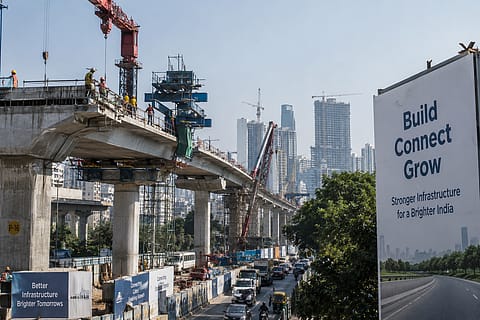
India is projected to require ₹680-770 trillion in infrastructure investment through 2047, with urban infrastructure expected to account for almost half of the requirement
India will require ₹168-172 lakh crore in infrastructure investment through FY31, but a substantial portion of that requirement has yet to translate into an announced project pipeline, according to a report by the National Bank for Financing Infrastructure and Development (NaBFID) and Boston Consulting Group (BCG).
Of the total requirement, ₹38-40 lakh crore has already been financed, while around ₹90-92 lakh crore is in the announced pipeline. However, ₹78-80 lakh crore has yet to translate into an announced project pipeline, while ₹31-32 lakh crore is awaiting financial close and ₹21-22 lakh crore is classified as stalled, the report, Channelizing Domestic and Global Capital for Infrastructure Financing, said.
The report puts India’s overall infrastructure requirement through 2047 at ₹680-770 lakh crore, highlighting the scale of financing required to support the country’s long-term infrastructure expansion.
NaBFID MD & CEO Rajkiran Rai G. stated that the government capex would need to be complemented by private capital, while stronger project preparation, commercial bankability, risk allocation and capital recycling could broaden participation from domestic and global investors.
Only 34-36% of long-term demand has proven financing models
A key challenge is the limited availability of established financing structures. Only 34-36% of the FY26-47 infrastructure requirement falls in sectors with proven, bankable financing models.
Meanwhile, sectors accounting for 55-57% of the requirement, including metro systems, water supply, irrigation and new rail lines, lack standalone financial viability and established financing models. Public funding therefore remains important, alongside efforts to develop reliable revenue streams and enforceable payment structures.
The demand mix is also changing. Urban infrastructure is expected to account for almost half of the requirement through 2047, although projects are often smaller, dispersed across municipal bodies and dependent on revenues from water, sanitation and transit.
Adding to the financing challenge, 80-85% of the forward pipeline comprises greenfield projects, exposing investors to land, construction and ramp-up risks.
₹2-3 lakh crore annual financing gap persists
Existing pools of capital can fund most of the FY26-31 requirement under current growth rates and regulations, but a residual annual financing gap of ₹2-3 lakh crore remains.
At the same time, domestic institutions have approximately ₹2-3 lakh crore of permitted but undeployed investment capacity. Deploying this capital would require stronger credit-assessment capabilities and greater alignment between investments, institutional risk appetite and long-term obligations, the report said.
The report identifies partial credit enhancement, Infrastructure Investment Trusts (InvITs), Alternative Investment Funds (AIFs) and private credit as financing channels that could be scaled up. It also points to global capital as a potential source of additional funding, with infrastructure assets under management within global alternative investments reaching about ₹15.3 lakh crore equivalent in 2025 and projected to grow at around 12% annually through 2030.
Follow Fortune India
NEXT STORY