India targets $100 billion gems and jewellery exports by 2040
/ 2 min read
The roadmap envisages the sector contributing 1.2% to India’s GDP and accounting for 14% of the country’s merchandise exports by 2040. It also aims to double employment in the sector to around 1 crore and increase manufacturing output to nearly ₹15 lakh crore
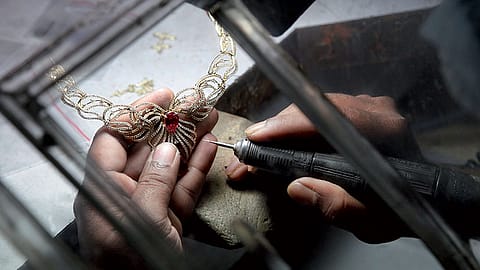
The government has set an ambitious target of raising India’s gems and jewellery exports to $100 billion by 2040 from around $28 billion in 2025-26, with innovation, design, branding and greater value addition identified as key drivers of growth.
The Department of Commerce, in association with the Gem & Jewellery Export Promotion Council (GJEPC), held the ‘Chintan Shivir – 2040 Roadmap for Gems & Jewellery’ on Thursday to chalk out a long-term strategy for the sector.
The roadmap envisages the sector contributing 1.2% to India’s GDP and accounting for 14% of the country’s merchandise exports by 2040. It also aims to double employment in the sector to around 1 crore and increase manufacturing output to nearly ₹15 lakh crore.
Commerce Secretary Rajesh Agrawal said India’s ability to scale exports from around $28 billion to $100 billion would depend on building an ecosystem centred on innovation, global design leadership and trust.
“India’s strength lies not in mining gold, silver or rough diamonds, but in its vast pool of skilled craftspeople,” Agrawal said, stressing that greater wealth creation would come from design, innovation and global branding rather than basic manufacturing.
He called for the industry to move beyond low-margin original equipment manufacturing (OEM) work and develop capabilities in original design manufacturing (ODM). He also highlighted the need for stronger partnerships between educational institutions and industry to address real-world challenges.
The Commerce Secretary also emphasised upgrading skills and making careers in craftsmanship more aspirational, while encouraging the use of artificial intelligence and 3D printing to drive product differentiation. He said India’s cultural heritage and stories could be integrated into jewellery designs to strengthen the country’s global brand.
The government and industry also identified five priority missions at the Chintan Shivir. These include global market access, MSME scale-up, faster export-import processes, building global recognition for “Crafted by India” jewellery, and developing next-generation talent and design capabilities.
Director General of Foreign Trade Lav Agarwal said India must move decisively up the value chain and position itself as a global destination for design-led and value-added jewellery.
GJEPC Chairman Kirit Bhansali said new free trade agreements, a 15-year tax exemption on rough diamond sales through Special Notified Zones and greater support for MSMEs have created a strong policy foundation for the sector.
The discussions also examined opportunities in midstream and downstream segments, lab-grown diamonds and the gold mining and refining ecosystem.
{{#most-powerful-women-snapshot-individual.slug}} {{/most-powerful-women-snapshot-individual.slug}} {{^most-powerful-women-snapshot-individual.slug}} {{/most-powerful-women-snapshot-individual.slug}} {{#showRanking}} {{current-rank}} {{/showRanking}} {{#photo.0.url}}
{{name}}
The roadmap aims to strengthen India’s position in traditional segments such as natural diamonds while expanding into emerging high-value markets. The government and industry intend to transform India from an OEM manufacturing base into a global ODM and jewellery branding hub, aligned with the vision of Viksit Bharat 2047.
NEXT STORY