India-Vietnam trade hits $18.3 billion, but deficit widens nearly 7-fold to $4.9 billion: Rubix
/ 2 min read
Bilateral merchandise trade has grown at a 7% CAGR since FY22, while Vietnam’s rising role in electronics and technology supply chains is widening India’s trade imbalance
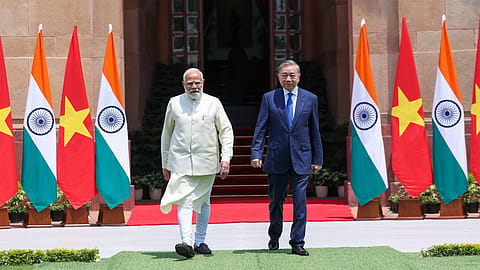
Prime Minister Narendra Modi and Vietnamese President To Lam in New Delhi earlier | Credits: PM Modi's X account
India’s merchandise trade with Vietnam rose to $18.3 billion in FY2026, up from $14.1 billion in FY2022, even as the country’s trade deficit with the Southeast Asian nation widened nearly seven-fold to $4.9 billion, according to an analysis by Rubix Data Sciences.
The report said bilateral merchandise trade has grown at a 7% compound annual growth rate (CAGR) over the four-year period. However, the growth has been uneven, with imports from Vietnam rising considerably faster than India’s exports.
India’s imports from Vietnam increased from $7.4 billion in FY2022 to $11.6 billion in FY2026, representing a 12% CAGR. In contrast, Indian exports to Vietnam, after declining consistently between FY2022 and FY2025, rebounded 23% in FY2026 to $6.7 billion, returning to their FY2022 level.
Electronics drive Vietnam’s export strength
Vietnam’s growing importance in India’s electronics and technology supply chains is a key feature of the trade relationship. Telecom equipment remained the largest identified import category in FY2026, although its share fell from 18% in FY2022 to 11%.
At the same time, flat-panel displays emerged as a significant category, rising from virtually zero share in FY2022 to 7% in FY2026. Cameras and recorders accounted for 6%, while computers and peripherals increased their share from 2% to 4%.
Rubix noted that the shift creates opportunities for Indian businesses through supplier partnerships, localisation and deeper supply-chain integration, particularly across electronics and telecom equipment.
India’s export basket becomes more diversified
India’s exports to Vietnam have also undergone a notable compositional shift. The share of flat-rolled iron and steel fell sharply from 20% in FY2022 to 5% in FY2026, while frozen bovine meat rose from 6% to 11%. Unwrought aluminium and crustaceans each increased their shares from 4% to 6%.
The combined contribution of India’s top five export categories declined from 37% to 31%, indicating a more diversified export basket.
Rubix said the expanding trade relationship is entering a more strategically important phase, particularly as Vietnam becomes increasingly embedded in electronics and technology supply chains. However, the widening deficit also highlights the need for Indian businesses to gain stronger visibility into Vietnamese counterparties, suppliers and associated financial risks.
The analysis comes against the backdrop of India and Vietnam elevating their relationship to an Enhanced Comprehensive Strategic Partnership and raising their bilateral trade target for 2030 from $25 billion to $30 billion.
NEXT STORY