The FAQs are AI-generated, and Fortune India is not responsible for its content or any associated copyright issues.
India’s private sector growth loses pace in May as manufacturing slows amid West Asia war: HSBC Flash PMI
/ 3 min read
Softer demand, weaker export growth and rising input costs weighed on factory activity, while the services sector remained resilient despite global uncertainties
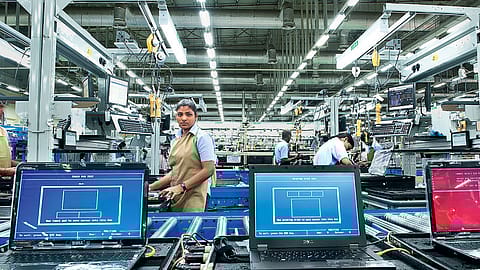
According to the survey, new business inflows across manufacturing and services grew at a slower pace in May, while export demand weakened significantly.
India’s private sector activity lost some pace in May as manufacturing growth weakened amid softer demand conditions, slowing export orders and rising cost pressures, according to HSBC’s Flash India Purchasing Managers’ Index (PMI) released on Thursday.
The HSBC Flash India Composite PMI Output Index, compiled by S&P Global, slipped marginally to 58.1 in May from 58.2 in April, indicating that business activity continued to expand but at a slower rate. A PMI reading above 50 signals expansion in economic activity.
The survey showed that the slowdown was more visible in manufacturing, while the services sector remained relatively stable and continued to support overall growth.
Manufacturing activity loses momentum
The HSBC Flash India Manufacturing PMI fell to 54.3 in May from 54.7 in April, marking one of the weakest improvements in operating conditions in nearly four years, barring March’s reading. Factory output growth also softened, with the Manufacturing Output Index easing to 56.6 from 56.9 in the previous month.
In contrast, the Flash Services PMI Business Activity Index edged up slightly to 58.9 from 58.8 in April, reflecting continued resilience in domestic demand and business confidence in the services economy.
Pranjul Bhandari, Chief India Economist at HSBC, said manufacturing activity moderated as growth in output and new orders slowed during the month.
“Manufacturing activity eased marginally as the rates of expansion in output and new orders moderated, while growth of new export orders softened markedly,” Bhandari said.
She added that the manufacturing PMI remained broadly aligned with its long-term average due to continued inventory accumulation by firms.
“Finished goods stocks rose for a second consecutive month and stocks of purchases increased at the fastest rate in three months. Cost pressures intensified, with input prices rising at the sharpest rate since July 2022,” she said.
According to the survey, new business inflows across manufacturing and services grew at a slower pace in May, while export demand weakened significantly. New export orders across the private sector expanded at the slowest pace in 19 months.
Goods producers reported one of the weakest rises in international sales since late 2024, with firms citing competitive pressures, subdued global demand, travel disruptions and the ongoing conflict in West Asia as key challenges.
RANK
COMPANY NAME
REVENUE
(INR CR)
(INR CR)
{{#current-rank}} {{current-rank}} {{/current-rank}} {{^current-rank}} {{rank}} {{/current-rank}} {{name}} {{#revenue}} {{revenue}} {{/revenue}} {{^revenue}} {{noi}} {{/revenue}}
Rising costs add pressure on firms
Input cost pressures also intensified during the month. The composite input price inflation index rose to its second-highest level in nearly three years, mainly driven by manufacturing companies facing higher prices for energy, fuel, gas, metals, plastics, rubber and transportation.
S&P Global said manufacturers experienced the steepest increase in input costs since July 2022.
Despite rising expenses, companies remained cautious in passing on higher costs to customers. Output price inflation slowed to its weakest pace since January, indicating that firms absorbed part of the increase in operating costs to remain competitive.
Business sentiment, however, stayed positive overall, although confidence slipped to a three-month low.
The survey also pointed to stronger inventory-building activity. Manufacturers increased purchasing activity at the fastest pace in three months, while finished goods inventories rose for the second month in a row, recording the strongest build-up in over a decade.
Hiring trends remained mixed across sectors. Services companies expanded their workforce at the fastest pace in nearly a year, while employment growth in manufacturing softened compared with April, though overall job creation stayed positive.
The flash PMI survey is based on responses from around 400 manufacturers and 400 service providers and serves as an early estimate ahead of the final PMI readings scheduled for release in early June.
Frequently Asked Questions
NEXT STORY