India's ‘Purple Economy’ can contribute $150 billion by unlocking disability inclusion: Deloitte-EnAble report
/ 2 min read
White paper says disability inclusion can unlock jobs, new markets and productivity, calling it a key pillar of India's Viksit Bharat 2047 vision
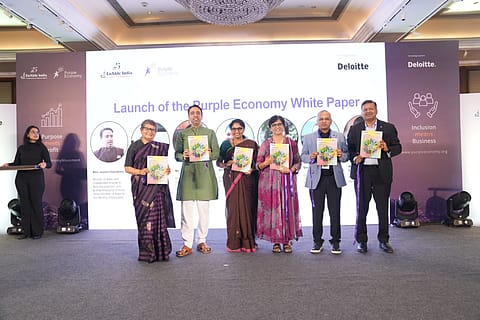
The report defines the Purple Economy as an economic framework that recognises persons with disabilities as consumers
India's "Purple Economy", centred on the economic participation of persons with disabilities, has the potential to contribute nearly $150 billion to the country's growth by unlocking an underserved consumer market, expanding workforce participation and driving innovation, according to a white paper released jointly by Deloitte India and EnAble India on Tuesday.
The report argues that disability inclusion should move beyond welfare, corporate social responsibility and regulatory compliance to become a mainstream economic growth strategy for governments, businesses and investors.
According to the study, workforce participation among persons with disabilities in India remains below 25%, compared with nearly 60% for persons without disabilities, highlighting a significant untapped talent pool. Globally, persons with disabilities and their households represent an estimated $18 trillion consumer market, making them one of the world's largest underserved customer segments.
The report defines the Purple Economy as an economic framework that recognises persons with disabilities as consumers, employees, entrepreneurs, innovators and taxpayers, while treating accessibility and inclusion as drivers of productivity, market creation and shared prosperity.
Launching the report, Minister of State (Independent Charge) for Skill Development and Entrepreneurship Jayant Chaudhary joined policymakers, industry leaders and disability advocates to discuss the role of disability inclusion in India's long-term growth strategy.
Romal Shetty, Chief Executive Officer of Deloitte South Asia, said businesses that design products, services and workplaces for inclusion will build stronger talent pipelines, create more resilient markets and gain a long-term competitive advantage.
The white paper recommends a National Growth Framework supported by Digital Public Infrastructure, Purple Economic Zones, inclusive market design and cross-sector partnerships to expand participation-led growth. It also introduces concepts such as the "Purple Delta", which measures the gap between current and potential participation, and the "Purple Economy Flywheel", which links accessibility, innovation, employment and market expansion.
The report identifies banking and financial services, healthcare, education, mobility, retail, tourism, technology, skilling and public service delivery as sectors with significant opportunities to benefit from disability-inclusive growth.
EnAble India said the Purple Economy movement has already begun through initiatives spanning accessible mobility, digital public infrastructure, financial inclusion, rural livelihoods, corporate partnerships and public service delivery. The report positions disability inclusion not as a parallel social agenda but as a national economic opportunity that can support India's goal of becoming a developed economy by 2047.
Follow Fortune India
NEXT STORY