India’s retail inflation rises to 3.21% in February under revised CPI series
/ 4 min read
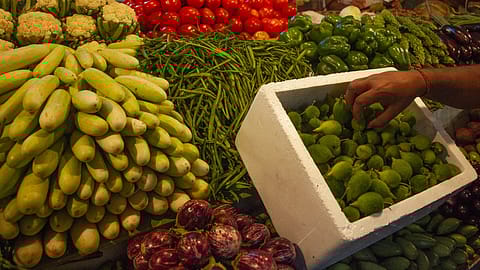
Food inflation under the revised series stood at 3.47% in February. | Credits: Fortune India
India’s retail inflation rises to 3.21% in February under revised CPI series
India's retail inflation rose to 3.21% in February, driven by a revised CPI series that updates the base year to 2024 and expands the item basket. The new series reflects current consumption patterns, with food items now accounting for less than 40% of the index. Rural consumption's weight has increased, highlighting its growing role in demand.
This summary is AI-generated, and Fortune India is not responsible for its content or any associated copyright issues.
The government has introduced a revised CPI series, updating the base year to 2024 from 2012 and expanding the item basket to 358 items from 299 earlier to better reflect current consumption patterns.
Food inflation under the revised series stood at 3.47% in February. | Credits: Fortune India
India’s retail inflation edged up to 3.21% in February from a revised 2.74% in January, according to data released by the Ministry of Statistics and Programme Implementation on Thursday. The February reading marks an increase of 47 basis points in year-on-year inflation compared with the previous month.
The government has introduced a revised Consumer Price Index (CPI) series, updating the base year to 2024 from 2012 and expanding the item basket to 358 items from 299 earlier to better reflect current consumption patterns.
The new CPI series indicates that prices have been rising sequentially over the past four months. The index rose to 104.57 in February from 104.46 in January, and from 104.10 recorded in both November and December.
Food now accounts for less than 40% of the index for the first time
A notable change in the revised CPI basket is the reduced weight of food items. Food now accounts for less than 40% of the index for the first time, while non-food categories make up more than 60%, compared with roughly 45% earlier. The revision also increases the effective weight of rural consumption, reflecting its growing role in overall demand.
Food inflation under the revised series stood at 3.47% in February. However, its contribution to headline inflation is expected to be lower than in previous CPI series due to the reduced weighting.
Housing inflation in February
Housing inflation in February was recorded at 2.12% on a year-on-year basis, with rural housing inflation at 2.43% and urban housing inflation at 2.00%.
Meanwhile, vegetable prices showed signs of easing during the month. The indices for tomatoes, peas and cauliflower declined by more than 10% in February compared with January.
The major items that saw a high pace of price hike were silver, gold, diamond, platinum jewellery, coconut-copra, tomato, and cauliflower.
On the other hand, there was disinflation in garlic, onion, potato, arhar, and litchi. Inflation rates for rural and urban areas were at 3.37% and 3.02%, respectively.
Aditi Nayar, Chief Economist, ICRA Ltd., said, ""The headline CPI inflation inched up to 3.2% in February 2026 from the revised 2.7% in January 2026, in line with ICRA’s estimate. As expected, the uptick was almost entirely led by the food and beverages (F&B) segment, which accounted for as much as 44 bps of the 47 bps rise in the headline print between these months. Core (CPI excluding F&B and electricity, gas & other fuels) remained unchanged at 3.4% between these months. ICRA expects the YoY inflation in the F&B segment to ease marginally in March 2026 from 3.4% in February 2026. However, the hike in prices of domestic (non-subsidized) and commercial LPG cylinder prices in early-March 2026 owing to global energy supply disruptions would exert upward pressure on inflation prints for the electricity, gas & other fuels, and restaurant & accommodation divisions in this month. These, along with continued hardening in average prices of precious metals such as gold would push up the headline CPI inflation to ~3.3-3.5% in March 2026."
Looking ahead, with a somewhat lower weight for F&B in the new CPI series (36.75%: 2024 series) vis-à-vis the old series (45.86%: 2012 series), the expected base-effect led uptick in the headline CPI print in FY2027 would likely be tempered, after the initial uptick, resulting in a flatter curve even as the average would likely remain around ~4% in our base case for FY2027.
{{#most-powerful-women-snapshot-individual.slug}} {{/most-powerful-women-snapshot-individual.slug}} {{^most-powerful-women-snapshot-individual.slug}} {{/most-powerful-women-snapshot-individual.slug}} {{#showRanking}} {{current-rank}} {{/showRanking}} {{#photo.0.url}}
{{name}}
Nayar said, "However, the ongoing geopolitical tensions in West Asia pose upside risks to the CPI inflation trajectory, if sustained for an extended period; as per ICRA’s analysis, every 10% increase in average crude oil prices increases the CPI inflation by 40-60 bps, assuming that a full transmission into retail selling prices (RSPs) of auto fuels takes place. Additionally, elevated crude oil prices would weigh on India Inc.’s profitability and household spending, posing downside risk to our GDP growth forecast of 7.1% for FY2027. Heightened uncertainty transmitting from geopolitics into India's growth and inflation outlook supports the case for a pause in the upcoming April 2026 MPC meeting."
The government said price data for the month was collected from all rural and urban markets in the sample, with reporting rates of 99.89% for rural markets and 99.78% for urban markets.
Vikrant Chaturvedi, Associate Director - Research, Brickwork Ratings, said, "India’s February 2026 CPI inflation at 3.21% on the 2024 base has edged up from 2.75% in January, reflecting renewed food price pressures. The Consumer Food Price Index rose 3.47% year-on-year, with vegetables such as tomatoes and cauliflowers still elevated despite sequential declines. Jewellery prices, particularly gold and silver, also contributed significantly, with gold-related inflation at 48.16% and silver jewellery at over 160%, underscoring the impact of the global bullion rally on domestic inflation. Core inflation, excluding food and energy, is estimated near 3.4%, signalling contained demand-side pressures in housing, health, and communication. This divergence between food and precious metals volatility versus relatively stable core highlights that while headline prints remain sensitive to supply shocks and asset price surges, underlying inflation dynamics are still benign."
Follow Fortune India
NEXT STORY