The FAQs are AI-generated, and Fortune India is not responsible for its content or any associated copyright issues.
Industrial output grows 4.9% in April under new IIP series; capital goods lead expansion
/ 3 min read
Among the four major sectors, manufacturing recorded the strongest growth at 6.2% in April.
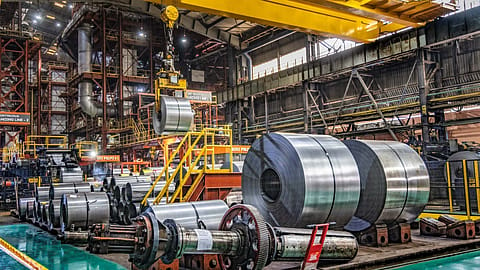
Intermediate goods, capital goods, and infrastructure/construction goods were the largest contributors to overall industrial growth during the month, the ministry said. | Credits: Narendra Bisht
India's industrial output grew 4.9% year-on-year (YoY) in April 2026, according to the first estimates released under the revised Index of Industrial Production (IIP) series with 2022-23 as the new base year, the Ministry of Statistics and Programme Implementation (MoSPI) said on Monday.
The ministry has revised the IIP base year from 2011-12 to 2022-23 to better reflect the current structure of the economy, incorporating an updated product basket, revised weightings and wider sectoral coverage. The Quick Estimate of the IIP stood at 118.9 in April 2026, compared with 113.1 in the corresponding month last year.
Manufacturing drives growth
Among the four major sectors, manufacturing recorded the strongest growth at 6.2% in April, followed by water supply, sewerage and waste management at 6.6%, electricity, and gas supply at 4.9% while mining and quarrying contracted 5.1%.
"The growth of capital goods at 16 percent is significantly strong and indicating an enhanced investment and strong aggregate demand in the country," said Nirmal Kumar Minda, President, ASSOCHAM. High growth of intermediate goods at 7.7%, infrastructure/construction goods at 7.1%, and consumer durables at 4.3% are expected to support the economic activity and GDP growth, going forward, Minda added.
The sectoral indices for April stood at 104.6 for mining and quarrying, 119.3 for manufacturing, 125.5 for electricity and gas supply, and 146.1 for water supply, sewerage and waste management. Within manufacturing, 17 of the 23 industry groups at the two-digit National Industrial Classification (NIC) level registered positive growth during the month.
"India’s industrial sector, over the years, has become more diversified, and technology-oriented. The revised IIP numbers provide a more current reflection of production patterns and will improve the quality of industrial assessment across sectors," said Rajeev Juneja, President, PHDCCI.
The manufacturing sector's growth was led by the manufacture of electrical equipment, which expanded 19.2% YoY in April, followed by machinery and equipment at 12.9% and motor vehicles, trailers and semi-trailers at 12.7%.
Growth in the automobile segment was driven by higher production of auto components, passenger cars and wheel rims. In electrical equipment, strong output was recorded in switchgear and circuit protection equipment, carbon-based electrical products, and transformers. The machinery segment benefited from increased production of firefighting equipment, cranes, and industrial engines.
Capital goods output surges 16%
Under the use-based classification, capital goods emerged as the strongest-performing category, posting growth of 16% YoY in April.
“Strong performance of capital goods, engineering products and manufacturing segments indicates continued industrial activity expansion and the broader sectoral coverage will enhance the usefulness of industrial data for investors and policy analysis says Dr. Ranjeet Mehta, CEO and Secretary General, PHDCCI.
Intermediate goods grew 7.7%, infrastructure and construction goods rose 7.1%, consumer durables expanded 4.3%, consumer non-durables increased 2.8% while primary goods recorded modest growth of 0.8%.
RANK
COMPANY NAME
REVENUE
(INR CR)
(INR CR)
{{#current-rank}} {{current-rank}} {{/current-rank}} {{^current-rank}} {{rank}} {{/current-rank}} {{name}} {{#revenue}} {{revenue}} {{/revenue}} {{^revenue}} {{noi}} {{/revenue}}
The indices for April stood at 112.2 for primary goods, 132.1 for capital goods, 119.7 for intermediate goods, 129.7 for infrastructure and construction goods, 119.1 for consumer durables, and 112.4 for consumer non-durables.
According to the ministry, intermediate goods, capital goods, and infrastructure/construction goods were the largest contributors to overall industrial growth during the month.
New IIP series aims to better capture industrial activity
The revised IIP series has been developed under the guidance of the Technical Advisory Committee for Base Year Revision of the All India Index of Industrial Production (TAC-IIP), whose report was released on May 25, 2026. The new series retains the six use-based categories of the previous series but updates the classification of individual products to better reflect current industrial patterns, as per PIB release.
MoSPI said the new framework also introduces a provision for replacing factories that have shut down or become non-operational during the currency of the series, helping maintain the representativeness of the index. The revised series continues to use the Wholesale Price Index (WPI) to deflate production data reported in value terms. The ministry said an Output Producer Price Index (PPI) would be considered once it is introduced and its stability assessed.
Frequently Asked Questions
NEXT STORY