Manufacturing PMI hits five-year low in August as demand, jobs weaken
/ 2 min read
The seasonally adjusted HSBC India Manufacturing PMI fell to 52.8 in August from 53.5 in July.
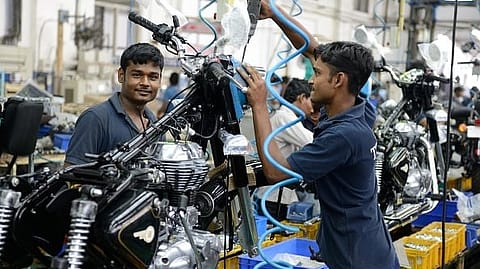
Export orders, meanwhile, continued to rise, supported by demand from key markets including Australia, Germany, mainland China, Spain, Thailand, and the US. | Credits: Getty Images
India’s manufacturing activity weakened to a five-year low in August, extending its decline for the third straight month, even as official data showed the sector remained resilient during the first quarter of FY27.
The seasonally adjusted HSBC India Manufacturing Purchasing Managers’ Index (PMI) fell to 52.8 in August from 53.5 in July, pointing to the weakest improvement in overall manufacturing conditions in five years.
A PMI reading above 50 indicates expansion while a reading below 50 signals contraction.
The HSBC India Manufacturing PMI, compiled by S&P Global, tracks overall manufacturing conditions based on indicators including new orders, output, employment, supplier delivery times and stocks of purchases.
The latest survey showed that firms faced softer demand, leading to slower growth in purchasing activity and inventories. Employment also declined marginally during the month.
“India’s final manufacturing PMI slipped to 52.8 in August, extending its decline for a third consecutive month. The output index fell to its lowest level since August 2021, signalling that production is still expanding but at a markedly slower pace,” said Pranjul Bhandari, Chief India Economist at HSBC.
New orders, exports lose momentum
New orders continued to increase in August, but at their slowest pace in five years. Survey respondents attributed the moderation to challenging market conditions and weaker demand for some products.
Export orders, meanwhile, continued to rise, supported by demand from key markets including Australia, Germany, mainland China, Spain, Thailand, and the US. However, the pace of growth in international orders eased from July. The slowdown in demand also weighed on manufacturers’ purchasing activity and stock levels.
Manufacturing jobs decline
Employment in the manufacturing sector fell for the first time in two-and-a-half years, although the decline was marginal. Companies that cut staffing levels largely cited lower business requirements.
“Employment edged into a mild contraction in August, the first decline after more than two years of job growth. Meanwhile, input cost pressures continued to ease, and manufacturers responded by raising selling prices more modestly,” Bhandari said.
Manufacturers continued to face higher costs for some inputs, including steel, as well as transportation expenses. However, the overall pace of input-cost inflation eased to its weakest level in six months.
{{#most-powerful-women-snapshot-individual.slug}} {{/most-powerful-women-snapshot-individual.slug}} {{^most-powerful-women-snapshot-individual.slug}} {{/most-powerful-women-snapshot-individual.slug}} {{#showRanking}} {{current-rank}} {{/showRanking}} {{#photo.0.url}}
{{name}}
Lower cost pressures allowed companies to moderate increases in selling prices. Output price inflation rose only marginally and fell to a 45-month low, remaining below its long-term average.
Business confidence improves
Despite the weaker performance in August, manufacturers became somewhat more optimistic about the year ahead. Business confidence rose to a three-month high. Around 16% of survey participants expect output to increase over the next 12 months while the remaining respondents anticipate little or no change in production. “Confidence rose to its highest mark since May, but remained subdued by historical standards,” the survey said.
The HSBC India Manufacturing PMI is compiled by S&P Global based on responses from purchasing managers at around 400 manufacturers. The panel is structured by detailed sector and company workforce size, with weights reflecting each sector’s contribution to GDP.
Follow Fortune India
NEXT STORY