No petrol, diesel price hike despite global oil prices spiking to $80
/ 4 min read
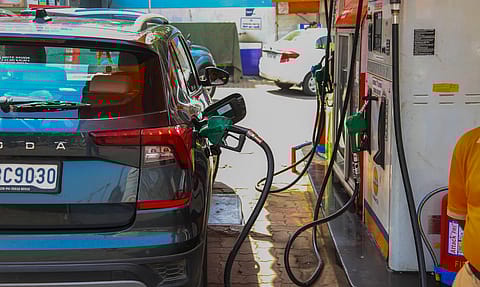
Brent crude, the global benchmark, climbed close to USD 80 per barrel, while US-traded crude rose 8.6 per cent to USD 72.79, up from around USD 67 on Friday. | Credits: Sanjay Rawat
No petrol, diesel price hike despite global oil prices spiking to $80
Despite a 9% surge in global oil prices due to US-Israeli conflicts with Iran, India is unlikely to raise petrol and diesel prices soon. The government aims to shield consumers by maintaining stable retail prices, even as crude oil costs rise, to avoid inflationary pressures and political backlash ahead of key state elections.
This summary is AI-generated, and Fortune India is not responsible for its content or any associated copyright issues.
For India, which imports 88 per cent of its requirement of crude oil, which is turned into fuels like petrol and diesel at refineries, higher global prices translate into a larger import bill and potential inflationary pressures.
THIS STORY FEATURES
Brent crude, the global benchmark, climbed close to USD 80 per barrel, while US-traded crude rose 8.6 per cent to USD 72.79, up from around USD 67 on Friday. | Credits: Sanjay Rawat
International oil prices rose about 9 per cent following US and Israeli attacks on Iran and retaliatory strikes by Tehran, but retail petrol and diesel prices in India are unlikely to be increased in the near term, sources said.
Brent crude, the global benchmark, climbed close to USD 80 per barrel, while US-traded crude rose 8.6 per cent to USD 72.79, up from around USD 67 on Friday.
For India, which imports 88 per cent of its requirement of crude oil, which is turned into fuels like petrol and diesel at refineries, higher global prices translate into a larger import bill and potential inflationary pressures.
However, retail fuel prices are not expected to be raised immediately, as the government continues to follow a calibrated policy of allowing companies to build margins when international prices are low and cushioning consumers when rates rise, sources said.
Retail petrol and diesel prices have been on a freeze since April 2022, with fuel retailers like Indian Oil Corporation (IOC), Bharat Petroleum Corporation Ltd (BPCL) and Hindustan Petroleum Corporation Ltd (HPCL) absorbing losses when crude prices are high and making profits when rates are low.
This meant that when globally fuel prices went up in response to elevated crude prices, prices were stable in India. And when softening of crude prices pushed down fuel rates globally, rates in India remained unchanged.
The government wants to continue to shield consumers and the same policy will continue unless there is a huge spike in crude prices, they said.
With assembly elections in critical states like West Bengal, Tamil Nadu, and Assam round the corner, it doesnt want anything that could give the opposition a handle.
As military conflict in the Middle East escalated, Oil Minister Hardeep Singh Puri on Monday reviewed the situation on crude oil, LPG and other petroleum products with senior officials from his ministry and public sector companies.
India imports 88 per cent of its crude oil needs and roughly half of its natural gas requirement. These mostly come via the Strait of Hormuz, which the Iranian authorities have threatened to shut down following attacks by the US and Israel.
"We are continuously monitoring the evolving situation and all steps will be taken in order to ensure availability and affordability of major petroleum products in the country," the ministry said in a post on X.
{{#most-powerful-women-snapshot-individual.slug}} {{/most-powerful-women-snapshot-individual.slug}} {{^most-powerful-women-snapshot-individual.slug}} {{/most-powerful-women-snapshot-individual.slug}} {{#showRanking}} {{current-rank}} {{/showRanking}} {{#photo.0.url}}
{{name}}
Following the US and Israeli attacks on Iranian government, military and nuclear facilities, Iran warned shipping away from the strait and insurers withdrew coverage, effectively halting tanker movements.
"They (oil companies) have enough cushion to sustain this kind of prices spike," a source with direct knowledge of the matter said. "We have seen prices rise to USD 119 per barrel in June 2022 in the aftermath of the Russia's invasion of Ukraine. That year they had nominal profits but in FY24 they posted record Rs 81,000 crore profit."
This year, the three companies have posted Rs 23,743 crore profit in the December quarter alone.
Crisil Intelligence Director Sehul Bhatt said developments in the Middle East could increase pricing and procurement risks for crude oil and liquefied natural gas (LNG), posing substantial challenges for India. India meets roughly half of its gas supply through imports.
"If geopolitical issues ease, we expect prices to average USD 65-70 in CY2026, but prolonged conflict could push prices even higher," Bhatt said. "While Iran supplies 4.5-5 per cent of global oil, the main concern is disruption at the Strait of Hormuz which is vital for almost half of India's imports of both these commodities, thus increasing vulnerability."
If disruptions persist, shipments may be rerouted via the Cape of Good Hope, lengthening transit times and increasing the cost along with rising freight and insurance premiums.
"Sustained disruptions would keep crude prices elevated and tighten LNG availability underscoring the need for strategic planning to protect India's energy security," Bhatt said.
The United States and Israel launched military strikes on targets in Iran over the weekend. Tehran retaliated with missiles and drones aimed at Israel and countries hosting US forces, including the United Arab Emirates, Qatar, Kuwait, Bahrain, Iraq, Jordan, and Saudi Arabia.
Media reports suggest the conflict has effectively closed the Strait of Hormuz, a key conduit for global energy flows. Roughly one-third of the world's seaborne crude oil exports and about 20 per cent of liquefied natural gas shipments transit the narrow waterway.
India -- the world's third-largest oil importer -- imports roughly half of its oil needs through the narrow Strait.
"This (closure of Strait of Hormuz) raises the risk of further disruptions in the Red Sea and across the wider Middle East," Moody's Analytics said.
"Airspace closures have compounded the strain, affecting passenger travel and cargo flows through one of the world's most important trade corridors."
Wood Mackenzie said oil prices could exceed USD 100 per barrel if tanker traffic through the Strait of Hormuz is not swiftly restored.
The disruption, it said, creates a dual supply shock. Current exports through the strait are suspended, while additional OPEC+ volumes and most of OPEC's spare capacity -- typically used to balance the global oil market -- are inaccessible as long as the waterway remains closed.

Follow Fortune India
NEXT STORY