The FAQs are AI-generated, and Fortune India is not responsible for its content or any associated copyright issues.
Tariff reliefs can disappear, India-US BTA should be about sustainable long term economic partnership
/ 3 min read
Compared to the enthusiastic responses from Gor and Goyal, the official statement issued by the Ministry of Commerce after the conclusion of the discussions was sober.
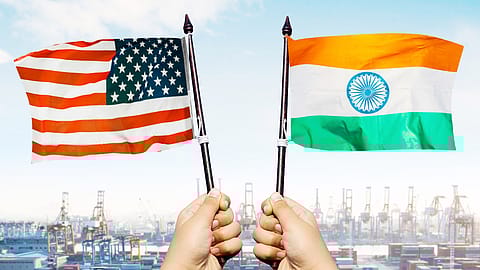
India-US BTA | Credits: Shutterstock
Even before the four day visit of a delegation from the Office of the United States Trade Representative (USTR) to Delhi for discussions on an interim India-US Bilateral Trade Agreement (BTA) ended on June 4, the US Ambassador to India Sergio Gor announced that the negotiations are almost over and the BTA is ‘99%’ there. Union Commerce Minister Piyush Goyal also expressed the same level of confidence when he said that the negotiations are now focussed on a few minor issues, some ‘commas and full stops’.
Compared to the enthusiastic responses from Gor and Goyal, the official statement issued by the Ministry of Commerce after the conclusion of the discussions was sober. It merely stated that the USTR delegation and their Indian counterparts held constructive and positive discussions across a wide range of issues covering trade in goods, non-tariff measures, customs and trade facilitation, economic security alignment and other areas of mutual interest. “The engagements were marked by a spirit of cooperation and pragmatism, with both sides reaffirming their commitment to concluding a mutually beneficial agreement that strengthens bilateral trade and economic ties,” the statement said.
While the positive announcements and the statements indicate that an interim BTA is imminent, the parallel moves of the USTR to club India with other trade partners of the US in all its actions—the latest one being the proposal to slap additional Section 301 tariffs of up to 12.5% on imports from 54 economies, including India, over forced labour-related concerns—are dampening this spirit. The Section 301 is a provision in the US trade law, the Trade Act of 1974, which gives the US government the authority to investigate and retaliate against unfair trade practices by other countries that are harming US interests. USTR, the body which is negotiating BTA with India is in charge of Section 301 investigations too.
What makes the current USTR action worrisome is that the 301 investigation is not based on allegations that Indian exports use forced labour, but on whether India restricts imports linked to forced labour in third countries. Indian trade experts cannot be blamed if they feel that by pushing India, along with others, irrespective of the BTA negotiations, India is being arm twisted to accepting a free trade deal that is disproportionately going to benefit the US.
“The proposed 12.5% tariffs is part of a broader effort by Washington to increase pressure on India through Section 301 investigations and tariffs. India should be prepared for additional Section 301 tariffs in areas such as excess capacity,” says Ajay Srivastava, founder of Delhi based think tank Global Trade Research Initiative.
If fact, to blow hot and cold has been the strategy of the US ever since US President Donald Trump decided to ‘Make America Great Again’ by extracting more favourable terms of engagement from the country’s trade partners. Bilateral deals and unilateral tariff announcements were happening side by side with most countries in tune with the Trump’s strategy. Seen from this context, there is nothing surprising about BTA negotiations with India going along with Section 301 investigations.
The US is one of India’s most important partners in trade and services, and the country needs to learn to live with the two faces of the US when it comes to such negotiations. The India-US relationship has to be long term and sustainable, and that should be the focus of BTA negotiations. Tariff reliefs can be short term as the US is continuously finding new ways to tax imports. “New Delhi should treat the Bilateral Trade Agreement (BTA) negotiations and the Section 301 investigations as separate matters. For doing this India must be prepared to fight and pay section 301 tariffs like other countries,” Srivastava says.
Frequently Asked Questions
NEXT STORY