Piyush Goyal eyes faster FDI approvals, easier KYC as India seeks to attract more foreign investment
/ 3 min read
India’s FDI rose 17% to $94.5 billion in FY26, as the government explores faster approvals, streamlined KYC norms and mutual recognition agreements to improve investor confidence and ease of doing business.
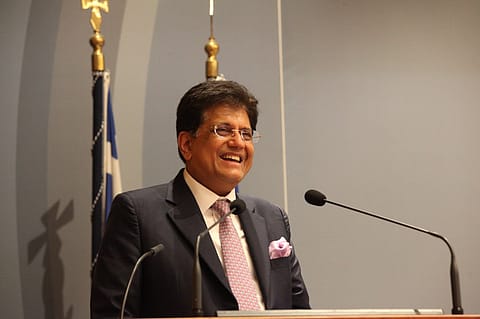
Union Commerce and Industry Minister Piyush Goyal | Credits: Piyush Goyal's X account
Improvements in processes and procedures, more efficient KYC norms, and streamlined approvals will facilitate a faster flow of foreign direct investment and provide greater comfort to investors, Commerce and Industry Minister Piyush Goyal said on Thursday.
There are very few sectors where foreign direct investment (FDI) is restricted, and the government is open to ideas from industry to further improve the investment regime, he said.
"Our focus is on process and procedures...There is a tremendous scope to improve processes and procedures, to help faster flow of FDI and to help give comfort to the investors," Goyal told PTI when asked if the government is considering a proposal to promote ease of doing business for foreign investors.
On how the government can streamline processes, he said wherever investments need DPIIT (Department for Promotion of Industry and Internal Trade) or government approvals, processes can be streamlined to make them faster.
"We can have faster and more efficient KYC (know your customer) norms; we can have MRAs (mutual recognition agreements) with regulators in other countries which respect each other's approvals," he added.
Several new ideas have emerged during engagements with industry and stakeholders in Japan, he noted.
"It will be a continuous process where we take ideas, do stakeholder engagements and continue to improve," Goyal said.
India allows 100 per cent FDI under the automatic route in most sectors, while certain sensitive sectors and activities have restrictions or require government approval.
The government is considering a proposal to raise the threshold for foreign direct investment proposals requiring approval from the Cabinet Committee on Economic Affairs to Rs 15,000 crore from Rs 5,000 crore at present to further improve the country's investment climate.
It is also mulling a proposal to ease FDI norms for downstream investments to boost overseas fund inflows.
FDI into India rose by 17 per cent to USD 94.5 billion in 2025-26.
{{#most-powerful-women-snapshot-individual.slug}} {{/most-powerful-women-snapshot-individual.slug}} {{^most-powerful-women-snapshot-individual.slug}} {{/most-powerful-women-snapshot-individual.slug}} {{#showRanking}} {{current-rank}} {{/showRanking}} {{#photo.0.url}}
{{name}}
When asked if Japan is suggesting India join the 12-member bloc Comprehensive and Progressive Agreement for Trans-Pacific Partnership (CPTPP), the minister said a lot of people are asking India to consider this suggestion.
"But we have not yet really applied our mind (to it)," he said.
He added that India's focus is on bilateral trade pacts.
India at present is negotiating trade pacts with countries and groups, including Israel, Chile, Peru, Canada, GCC (Gulf Cooperation Council), Russia-led EAEU, and SACU (South African Customs Union).
With Mexico, terms of reference are under finalisation to start talks for a trade agreement. India and Mercosur are also looking at expanding the existing preferential trade pact.
"And the demand goes on," he said.
While Commerce Secretary Rajesh Agrawal is in Chile to review the trade pact talks, not much progress is happening with Peru.
The CPTPP is a major free trade agreement between 12 countries spanning the Asia-Pacific region and Europe. The members include Japan, Australia, Canada, the UK and New Zealand. India is not a member of this grouping.
On promoting manufacturing in India, Goyal said the efforts are for end-to-end upstream and downstream indigenisation, along with businesses that are either running in India or coming to India.
Citing an example of the paint industry, he said that as India significantly imports titanium dioxide for the product, India is promoting its manufacturing.
Similarly, in semiconductors, the focus is not only on design and testing but also on bringing in the complete value chain.
"So, our effort is more and more going deep dive and self-reliant," he said.
Whether Japan has demanded the removal of import duty on certain semiconductor materials, he said there was only one product - a compound - which had an exemption under the trade pact with Japan.
"But certain unscrupulous elements had misused that exemption, due to which we had to suspend the benefits. And we are exploring how we can find a framework to safeguard against misuse, as well as honour the CEPA (comprehensive economic partnership agreement) commitments," he said.
WEST ASIA CRISIS AND INDIAN EXPORTS: ---------------------------------------------- Whether India is looking at alternate routes to ship goods to the region, he said the Gulf countries are now looking at their eastern shore and creating new routes from the eastern shore.
"So, new pipelines are coming up, new train lines are coming up. Some people are creating alternate routes. Other than that, of course, all our imports continue to come, or exports continue to go from other routes; otherwise, we wouldn't have had such a fabulous performance in the first four months," he said.
During April-July this fiscal, exports jumped 17.04 per cent to USD 173.78 billion, and imports climbed 19.27 per cent to USD 292.38 billion.
PLI SCHEMES FOR NEW SECTORS: ------------------------------------- The minister said it is an ongoing process and these things are at different stages of discussion.
"Wherever we are able to be convinced that there is a cost disadvantage in India compared to other locations, which we need to bridge in a fair manner, we will consider PLI in those sectors," he said
NEXT STORY