Govt extends 70% LPG allocation to key industries, shifts to sector-based supply framework
/ 2 min read
The latest clarification follows a series of directions issued on March 16, March 18 and March 27, when LPG supplies were rationalised due to disruptions linked to the West Asia conflict.
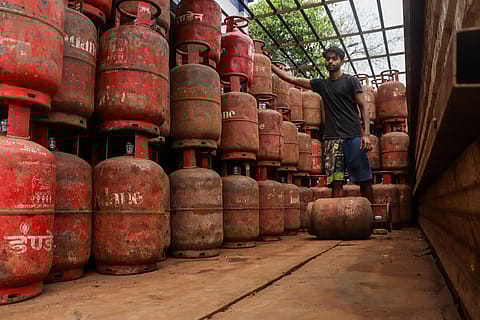
The latest directive has formally brought a wide range of industrial sectors under the allocation framework, effectively ensuring predictable supply for these segments. | Credits: Getty Images
The government has extended the 70% LPG allocation framework to a defined set of industrial sectors, including pharma, food, polymer and metals, shifting from earlier state-level supply measures to a more structured, sector-based approach.
In a communication dated April 8, Petroleum Secretary Dr Neeraj Mittal said industrial units across sectors such as pharma, food, polymer, agriculture, packaging, paint, steel, metal, ceramic, foundry and glass will receive 70% of their pre-March 2026 bulk non-domestic LPG consumption, subject to an overall sectoral ceiling.
Chandrajit Banerjee, director general, CII, said, "The government’s decision to extend LPG allocation to industry at 70% of the units’ pre-March 2026 consumption levels, along with the additional reform-linked LPG allocation, is a welcome step. This provides much-needed assurance to sectors such as pharmaceuticals, steel, food processing, agriculture, metals, polymers, ceramics and glass, where LPG remains a critical production input and viable substitutes are often limited."
"As geopolitical tensions in West Asia continue to persist and keep global energy markets volatile, the Government’s calibrated measures provide stability to domestic manufacturing and enables better production planning across industries. By encouraging greater adoption of PNG while safeguarding genuine industrial LPG requirements, the policy strikes a balanced approach that supports business continuity and strengthens the resilience of India’s manufacturing ecosystem", Banerjee added.
Builds on March directives amid supply disruption
The latest clarification follows a series of directions issued on March 16, March 18 and March 27, when LPG supplies were rationalised due to disruptions linked to the West Asia conflict.
Under those measures, states were allocated 70% LPG supply, with an additional allocation of up to 10% linked to reforms promoting piped natural gas (PNG). However, the framework at the time did not explicitly define sector-wise figures, with allocation largely administered at the state level.
From state-level to sector allocation
The latest directive has formally brought a wide range of industrial sectors under the allocation framework, effectively ensuring predictable supply for these segments.
The move comes amid the two-week conditional ceasefire announced by the United States of America and Iran where the criterion to reopening of the Strait of Hormuz brought an immediate relief to the global energy markets.
Despite the improvement in global conditions, the government has opted not to fully restore industrial LPG supplies to pre-crisis levels, indicating a cautious approach to demand management.
Conditions tied to usage and transition
The government has reiterated that LPG allocation will prioritise applications where the fuel cannot be easily substituted.
Industries are required to comply with conditions such as registration with oil marketing companies and, where applicable, transition to piped natural gas (PNG), although exemptions may be granted for critical uses.
{{#most-powerful-women-snapshot-individual.slug}} {{/most-powerful-women-snapshot-individual.slug}} {{^most-powerful-women-snapshot-individual.slug}} {{/most-powerful-women-snapshot-individual.slug}} {{#showRanking}} {{current-rank}} {{/showRanking}} {{#photo.0.url}}
{{name}}
States have also been encouraged to implement reforms promoting PNG and compressed biogas (CBG), which would make them eligible for additional LPG allocation.
The move is expected to provide clarity to industries following weeks of supply uncertainty, as the government transitions from crisis-driven allocation to a more defined distribution framework.
Follow Fortune India
NEXT STORY