The FAQs are AI-generated, and Fortune India is not responsible for its content or any associated copyright issues.
India must not rent the infrastructure of its intelligence future: Gautam Adani
/ 2 min read
Adani Group Chairman pitches sovereign AI, energy security and domestic compute infrastructure as India’s next strategic growth pillars; announces fresh $100-billion data centre commitment
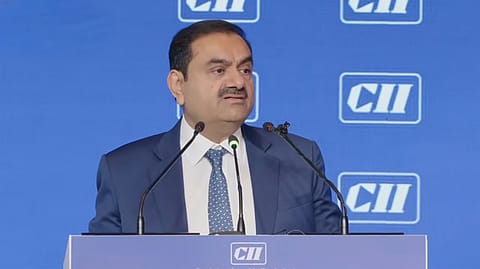
Adani Group Chairman Gautam Adani | Credits: Screengrab from X
India must “own the infrastructure of its intelligence future” and build sovereign capabilities in both energy and artificial intelligence, Adani Group Chairman Gautam Adani said on Monday, while unveiling a fresh $100 billion commitment towards the conglomerate’s data centre business.
Speaking at the Confederation of Indian Industry (CII) Annual Business Summit 2026 in New Delhi, Adani said the global order was shifting from globalisation to strategic self-reliance, with energy security and digital infrastructure emerging as the “twin foundations of national power”.
“The country that controls its energy will power its industrial future. The country that controls its compute will power its intelligence future. And the country that controls both will shape the century ahead,” Adani said.
The billionaire industrialist positioned India’s next growth phase around what he described as the “AI stack” — power, compute and applications — arguing that artificial intelligence can no longer be viewed merely as software.
India’s power demand could quadruple by 2047
“AI is not just software. AI is infrastructure. AI is energy. AI is cooling. AI is chips. AI is networks. AI is data. AI is talent. AI is governance,” he said.
The comments come at a time when countries across the world are sharply increasing investments in domestic AI infrastructure, semiconductors, clean energy and data sovereignty amid intensifying geopolitical tensions.
Adani stated that India’s rising energy and digital demand presents a once-in-a-generation opportunity. India crossed 500 GW of installed power capacity in March 2026, with 53% of the capacity added in the past decade. He added that the country could scale capacity fourfold to 2,000 GW by 2047.
At the same time, India’s data centre capacity — estimated at 5 GW by 2030 — could surge to nearly 75 GW by 2047 as AI adoption accelerates across sectors, he said.
Data centre capacity may jump 15-fold amid AI boom
Against this backdrop, Adani outlined the group’s aggressive infrastructure expansion plans. The conglomerate has already commissioned 35% of its 30-GW renewable energy project at Khavda in Gujarat, which Adani described as the world’s largest single-site renewable energy park.
“Our total commitment towards the energy transition stands at 100 billion dollars, making us one of the largest clean-energy investors anywhere in the world,” he said.
On the digital side, the Adani Group is building large-scale data centre campuses across India, including a gigawatt-scale facility in Visakhapatnam in partnership with Google Cloud.
{{#most-powerful-women-snapshot-individual.slug}} {{/most-powerful-women-snapshot-individual.slug}} {{^most-powerful-women-snapshot-individual.slug}} {{/most-powerful-women-snapshot-individual.slug}} {{#showRanking}} {{current-rank}} {{/showRanking}} {{#photo.0.url}}
{{name}}
“We, in partnership with Google, are building in Visakhapatnam the country’s largest Gigawatt scale campus,” Adani said, calling it a “multi-billion-dollar commitment to sovereign compute on Indian soil”.
He added that Microsoft, Flipkart and Uber were also partnering with the group for data infrastructure requirements.
Old IT model’ may not be enough in AI era: Adani
In a sharp commentary on India’s technology ecosystem, Adani said the country’s IT services success model — built around servicing global platforms — may not be sufficient in the AI era.
“The old IT model wrote code for the world. The new model must build intelligence and can afford to be largely sovereign,” he said.
Adani also pushed back against fears of AI-led job losses, arguing that India should use artificial intelligence to expand productivity and entrepreneurship rather than shrink employment.
“The real measure of AI will not be how many jobs it replaces. The real measure will be how many Indians it empowers,” he said.
Follow Fortune India
Frequently Asked Questions
NEXT STORY