India-US trade talks to resume April 20; tariff changes prompt rethink of proposed pact
/ 3 min read
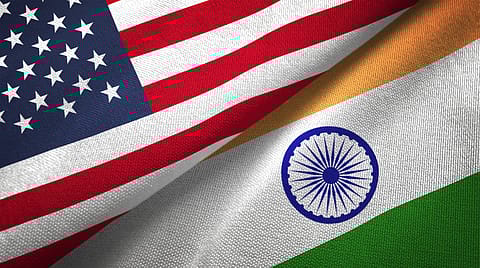
US- India flag | Credits: Getty Images
India-US trade talks to resume April 20; tariff changes prompt rethink of proposed pact
India and the US will hold three-day talks in Washington from April 20 to recalibrate their proposed trade pact after major shifts in the US tariff regime. With Trump-era reciprocal tariffs struck down and a new 10% blanket duty in place, negotiators will redraft the February framework, seek fresh comparative advantages, and address two ongoing Section 301 investigations.
This summary is AI-generated, and Fortune India is not responsible for its content or any associated copyright issues.
India and the US, in February, announced finalisation of a framework for the first phase of the bilateral trade agreement. According to that framework, the US had agreed to reduce tariffs on India to 18%.
US- India flag | Credits: Getty Images
Chief negotiators of India and the US will begin three-day talks in Washington from April 20 on the proposed trade pact, as the agreement finalised in February requires recalibration in view of changes in the US tariff landscape, a senior government official said on Wednesday.
Commerce Secretary Rajesh Agrawal said there is a need for further discussions and follow-up engagements on the pact.
"Indian team led by chief negotiator Darpan Jain will be visiting the US from 20th of this month. The negotiating teams will be meeting in person after a gap of about 3–4 months. We are looking at finalising the legal agreement, which is a logical follow-up of the joint statement released on February 7," he told reporters here.
He further said that the two Section 301 investigations launched by the US last month against a host of countries, including India, will also be discussed during the meeting.
"Both sides will sit together and discuss how these issues need to be structured and addressed. India and the US will work together to finalise timelines and next steps as part of the ongoing engagement," he added.
India and the US, in February, announced finalisation of a framework for the first phase of the bilateral trade agreement. According to that framework, the US had agreed to reduce tariffs on India to 18%.
However, the tariff architecture in the US has changed following its Supreme Court ruling against President Donald Trump's sweeping reciprocal tariffs. After that, the US President imposed 10% tariffs on all countries for 150 days from February 24.
In light of these changes, the meeting between the chief negotiators of India and the US scheduled in February was postponed.
Further, when India finalised the deal, it was at a comparative advantage compared to its competitor countries. Now all the US trading partners are facing the same 10% tariffs. The interim pact now requires recalibration.
The February agreement was negotiated as Indian goods were facing 25% reciprocal tariffs under the International Emergency Economic Powers Act (IEEPA) of the US. Now the American Supreme Court has struck down those levies.
"So the agreement will have to be recalibrated, redrafted," a government source said, adding, "that amount of change will take place from their side".
{{#most-powerful-women-snapshot-individual.slug}} {{/most-powerful-women-snapshot-individual.slug}} {{^most-powerful-women-snapshot-individual.slug}} {{/most-powerful-women-snapshot-individual.slug}} {{#showRanking}} {{current-rank}} {{/showRanking}} {{#photo.0.url}}
{{name}}
"In our case, since the agreement has not been signed, we have got the option where we can right now change whatever needs to be changed," the source said, adding that as the circumstances have changed, every country is engaging with the US to see "what is going to be the nature of their agreements".
On March 12, the United States Trade Representative (USTR) launched a Section 301 probe, covering 60 economies, including India and China.
The investigation will determine whether acts, policies, and practices of each of these economies related to the failure to impose and effectively enforce a ban on the importation of goods produced with forced labour are unreasonable or discriminatory, and burden or restrict US commerce.
On March 11, the USTR launched a separate Section 301 trade investigation, targeting policies and industrial practices of 16 economies, including India and China.
Today was the last date for filing the response on these probes, and India has filed it with the US Trade Representative.
Further, the source added that India will be looking forward to the comparative advantage which it will get in the pact under the new changed circumstances.
"What kind of commitments that we will get, which will give us a comparative advantage in the US market, is something that we are looking at," the source said, adding, "Every other country is now recalibrating its earlier agreement; we are also moving in that direction. We will have to have the trade-offs. So the trade-off from the other side is something that we like to hear from them".
(Except for the headline, Fortune India has not edited the content of this PTI report.)
Follow Fortune India
NEXT STORY