India’s bilateral trade worth $117 billion at risk as Middle East flares up with US attacks on Iran
/ 4 min read
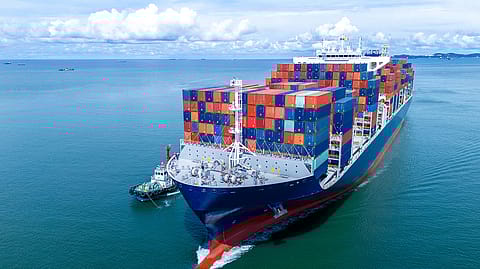
Export, Import, trade, Supply chain, shipment | Credits: Shutterstock
India’s bilateral trade worth $117 billion at risk as Middle East flares up with US attacks on Iran
The US and Israel's attack on Iran has sparked tensions in the Middle East, threatening India's $117 billion bilateral trade with the region. The conflict could lead to oil price surges and trade disruptions, impacting India's economy. The situation is further complicated by Iran's potential support from Russia, China, and Turkey, which could prolong the crisis and affect global economic stability.
This summary is AI-generated, and Fortune India is not responsible for its content or any associated copyright issues.
If the purported regime change—a justification behind the US-Israel strike—takes a long time on the lines of the Russia–Ukraine war, and Iran receiving tacit support from players like Russia, China and Turkey, it will wreak havoc on the global economy.
Export, Import, trade, Supply chain, shipment | Credits: Shutterstock
The inevitable has happened. The US and Israel have jointly attacked Iran. Iran has vowed to avenge the attacks and its strong retaliations on the US bases across the Arab states, including Bahrain, Kuwait, Qatar and United Arab Emirates, may lead to a massive flare up in the Middle East, if the situation escalates. The conflagration has the potential to deeply impact the global economy with crude oil price spiral and trade disruptions.
If the purported regime change–a justification behind the US-Israel strike--takes a long time on the lines of the Russia–Ukraine war, and Iran receives tacit support from players like Russia, China and Turkey, it will wreak havoc on the global economy. That said, the immediate impact too will be massive.
For India, the ramifications are large. The Middle East disruption comes at a time when India’s economic growth is galloping ahead, inflation is benign and interest rates are moderate. From bilateral trade and exports to oil shocks, a number of aspects will have to be watched out for on the Indian macroeconomic front if Middle East flares up.
Trade talks and exports
India has been pursuing bilateral trade agreements with multiple trading partners, having already secured deals with the UK and EU. It has also signed a preliminary understanding with the US and both the sides were supposed to finalise a deal in early March, though a Supreme Court ruling invalidating the Trump tariffs has caused some uncertainty. However, it is a given that with the current disruption, global economic growth and trade growth will be severely impacted.
As it is, the nations involved in the crisis in the Middle East (Iran, Bahrain, Kuwait, Qatar and United Arab Emirates) account for bilateral trade worth about $117.32 billion, with the UAE accounting for a major share of $100 billion.
The government had recently highlighted the India–UAE trade pact signed in 2022 as one of the success stories as it achieved the trade target ahead of plan.
“The India-UAE Comprehensive Economic Partnership Agreement (CEPA) marked India’s first such accord in the Middle East and North Africa (MENA) region, ushering in a new era of strategic economic cooperation between the two countries. The agreement was concluded with the potential to raise bilateral trade to $100 billion over five years while creating substantial employment and business opportunities in both economies,” the government said in release earlier this week.
“The impact of the agreement is already visible in trade outcomes, with bilateral trade surpassing $100 billion in FY 2024-25, registering strong growth and reaffirming the UAE’s position among India’s key trading partners, the government release added.
One of the major trading partners getting entangled in the crossfire between the US and Iran is for sure matter of concern.
Oil prices spiral
To add to it, an oil price shock is yet another threat to the Indian economy, especially at a time when inflation is extremely benign. In fact, in June last year, when the US attacked the nuclear establishments of Iran, Brent crude prices surged by over 12% to nearly $78 per barrel. JPMorgan projected that Brent crude could reach $120 per barrel in a worst-case scenario.
It is worth noting that a $10-per-barrel increase in crude oil prices could raise India’s oil import bill by $12–13 billion annually and widen the current account deficit (CAD) by approximately 0.3% of GDP, leading to depreciation of the rupee, which has already fallen to 86 per US dollar.
{{#most-powerful-women-snapshot-individual.slug}} {{/most-powerful-women-snapshot-individual.slug}} {{^most-powerful-women-snapshot-individual.slug}} {{/most-powerful-women-snapshot-individual.slug}} {{#showRanking}} {{current-rank}} {{/showRanking}} {{#photo.0.url}}
{{name}}
Higher oil prices will stoke inflation, and sectors that use crude oil as a key input—such as paints, tyres, cement, and chemicals—will face pressure on margins and profitability. Amid the conditional trade talks with the US, Russian oil may not be a fall back option for India.
The Strait of Hormuz
Another major concern is Iran potentially blocking the Strait of Hormuz—a critical chokepoint through which the majority of India’s crude oil imports pass. The strait emerged as a flashpoint last year as well. Strait of Hormuz accounts for about 20% (20 million barrels per day) of the global oil supplies,
Iran has previously blocked the Strait during times of tension. Last year too, Iran’s Parliament had ratified the proposal to shut the Strait of Hormuz unanimously, in retaliation for the US’s airstrikes on its nuclear facilities at Fordow, Natanz, and Isfahan.
Explaining the strategic significance of the Strait, the US Energy Information Administration analysis dated June 16 last year said, “Flows through the Strait of Hormuz in 2024 and the first quarter of 2025 made up more than one-quarter of total global seaborne oil trade and about one-fifth of global oil and petroleum product consumption. In addition, around one-fifth of global liquefied natural gas trade also transited the Strait of Hormuz in 2024, primarily from Qatar.” The strait is about 70 km wide.
Any disruption could severely curtail oil supplies, driving up global crude prices.
Follow Fortune India
NEXT STORY