Tourism can add $3 trillion to India’s economy, but infrastructure, hotel supply remain hurdles: IHCL’s Puneet Chhatwal
/ 2 min read
He also pointed to the sector’s multiplier effect. Every rupee invested in tourism creates an estimated ₹3.25 to ₹3.50 in incremental economic value, while ₹1 crore of investment in the sector can create around 80 jobs.
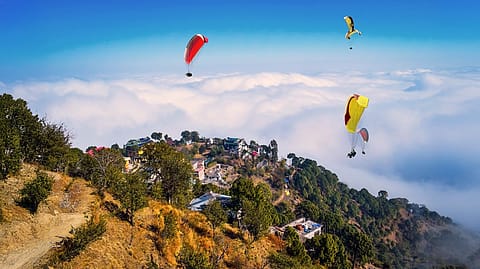
Himachal Pradesh, tourism, travel, Bir | Credits: Getty Images
India may have the destinations, heritage and diversity to become a global tourism powerhouse, but a shortage of infrastructure, hotel rooms and coordinated policy is keeping much of that opportunity untapped, Indian Hotels Company Ltd (IHCL) managing director and CEO Puneet Chhatwal said at the 7th HAI Hoteliers’ Conclave 2026.
“India does not have a tourism deficit. Tourism has an opportunity deficit,” Chhatwal emphasised, arguing that the country needs to connect its existing assets with better infrastructure, connectivity and policy execution.
The scale of the opportunity, he said, is significant. India currently has around $250 billion of economic value coming from tourism, which could rise to nearly $3 trillion as the country moves towards its Viksit Bharat 2047 ambition. Chhatwal said tourism could account for 10% of a potential $30 trillion Indian economy by 2047.
He also pointed to the sector’s multiplier effect. Every rupee invested in tourism creates an estimated ₹3.25 to ₹3.50 in incremental economic value, while ₹1 crore of investment in the sector can create around 80 jobs.
What are the obstacles?
Yet, Chhatwal said India continues to leave substantial tourism spending on the table because of inadequate capacity and connectivity. Branded hotel supply currently stands at just around 0.1 beds per 1,000 people, while he estimates that India needs to increase its branded hotel room inventory from about 200,000 to 2 million additional rooms. This would require around ₹1 lakh crore of capital.
“The cost of capital is immense in India to build hotels,” he said, adding that infrastructure status could lower borrowing costs and encourage more investment into the sector.
Infrastructure beyond hotels is another constraint. India’s tourism infrastructure ranks 54th globally, according to Chhatwal, while last-mile connectivity remains a problem. He cited the connectivity between Hampi airport and Hampi as an example of the gaps that need to be addressed.
Policy fragmentation is another challenge. Tourism does not fit neatly into the Centre, state or concurrent lists, which, according to Chhatwal, complicates efforts to secure infrastructure and industry status and to create a consistent policy framework.
The country also needs to diversify beyond a handful of established destinations. Chhatwal said 75% of leisure traffic is concentrated in just 15 to 20 destinations, increasing pressure on these locations and contributing to issues such as landslides and inadequate destination management.
Foreign tourist arrivals remain another area of opportunity. While Paris attracts around 25 million foreign tourists, India receives fewer than 10 million, Chhatwal said. Similarly, Peru’s Sun Temple attracts around 1.5 million visitors, compared with fewer than 10,000 at Konark’s Sun Temple.
He also called for renewed global promotion of India, saying that since the original Incredible India campaign, the country needs a fresh international tourism push.
{{#most-powerful-women-snapshot-individual.slug}} {{/most-powerful-women-snapshot-individual.slug}} {{^most-powerful-women-snapshot-individual.slug}} {{/most-powerful-women-snapshot-individual.slug}} {{#showRanking}} {{current-rank}} {{/showRanking}} {{#photo.0.url}}
{{name}}
“Every additional $1 million invested in tourism marketing budget can result in 10,000 incremental foreign tourist arrivals,” Chhatwal said, adding that this could generate more than $35 million in gross economic value.
The MD said the sector currently supports around 45 million jobs and could reach 60 million by 2030 and 100 million by 2047, provided the necessary investment, infrastructure and policy changes are made.
For him, the opportunity is clear. “The assets are here, the diversity is here, the culture is here,” he said emphatically . “It is our collective responsibility to connect all the dots and make it happen.”
Follow Fortune India
NEXT STORY