UPI MDR row reaches Supreme Court as PIL challenges 0.4% charge above ₹2,000
/ 2 min read
It also points to what it describes as a financial “cliff”: a ₹2,000 transaction attracts no MDR while a ₹2,001 payment becomes chargeable. The petitioner argues that such distinctions could influence merchant behaviour, including transaction splitting.
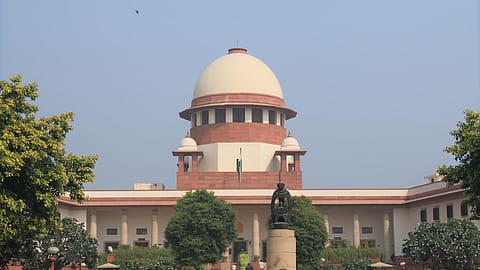
Supreme Court of India | Credits: Fortune India
The Centre’s decision to introduce Merchant Discount Rate (MDR) on select Unified Payments Interface (UPI) merchant transactions above ₹2,000 has reached the Supreme Court, with a public interest litigation challenging the legal basis and structure of the new payment framework.
The PIL, filed by advocate Anjan Datta through advocate Ashutosh Dubey, challenges the September 14 Gazette notification issued under Section 10A of the Payment and Settlement Systems Act, 2007, as well as the MDR framework announced by the UPI & Services Steering Committee on September 15. The new framework is scheduled to take effect from October 15, 2026.
According to LiveLaw, the plea has been filed against the Union government, the Reserve Bank of India (RBI), the National Payments Corporation of India (NPCI) and the UPI & Services Steering Committee. The petitioner has sought quashing of the framework or, alternatively, a fresh consultation based on disclosed evidence and an independent review.
What the PIL challenges
Under the new framework, specified person-to-merchant (P2M) UPI transactions above ₹2,000 will attract an MDR of 0.4%, capped at ₹300 for transactions of ₹75,000 and above. Payments up to ₹2,000 and person-to-person transfers remain free. Certain essential and thin-margin sectors will attract a flat ₹5 charge, while capital-market transactions will carry an MDR of 0.02%, capped at ₹300. Merchants classified under the P2PM category and receiving up to ₹1 lakh a month through UPI will continue to enjoy zero MDR.
The petition questions the empirical basis for several of these thresholds, including the ₹2,000 transaction limit, ₹1 lakh monthly-receipt ceiling and ₹75,000 cap.
“The Rs. 2,000 transaction threshold, the Rs. 1 lakh monthly-receipt classification, the differential sector rates, and the Rs. 75,000 cap are unsupported in the public domain by disclosed data or determining principles,” the plea said.
It also points to what it describes as a financial “cliff”: a ₹2,000 transaction attracts no MDR while a ₹2,001 payment becomes chargeable. The petitioner argues that such distinctions could influence merchant behaviour, including transaction splitting.
RuPay comparison, statutory challenge
A central issue raised by the PIL is the September 14 notification itself. The notification protects RuPay debit-card transactions without a monetary ceiling, while extending the same statutory no-charge protection to UPI only up to ₹2,000.
The plea reportedly argues this differential treatment is arbitrary and violates Articles 14 and 19(1)(g) of the Constitution.
The petitioner also challenges the delegation of rate-setting powers to the UPI & Services Steering Committee, arguing that essential rate-making and classification decisions require clear legislative standards and regulatory oversight.
“The challenge is not to the legitimate objective of maintaining secure and resilient payment infrastructure. It is to the manner in which a nationwide compulsory payment burden has been created, classified and distributed,” the plea stated.
{{#most-powerful-women-snapshot-individual.slug}} {{/most-powerful-women-snapshot-individual.slug}} {{^most-powerful-women-snapshot-individual.slug}} {{/most-powerful-women-snapshot-individual.slug}} {{#showRanking}} {{current-rank}} {{/showRanking}} {{#photo.0.url}}
{{name}}
The government, meanwhile, has maintained that the MDR is intended to support the sustainability, infrastructure and cybersecurity of the UPI ecosystem and that consumers will continue to make UPI payments free of charge.
Follow Fortune India
NEXT STORY