“Influencer marketing and new media will be the real growth engines,” says DCAA CEO Uday Singh Gauri on Dharma’s talent reset
/ 4 min read
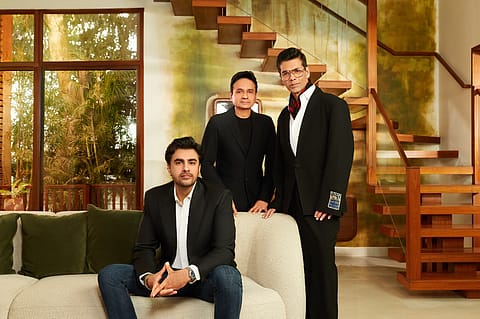
The move marks a strategic reset for the company’s talent vertical, positioning it as Dharma’s exclusive platform for artist representation across multiple cultural industries. (L-R) Uday Singh Gauri, CEO, DCAA, Apoorva Mehta, CEO, Dharma Productions and Karan Johar, Filmmaker.
“Influencer marketing and new media will be the real growth engines,” says DCAA CEO Uday Singh Gauri on Dharma’s talent reset
Dharma Productions has fully acquired its talent management joint venture, relaunching it as Dharma Collab Artists Agency (DCAA). This move enhances strategic control and positions DCAA as a key player in India's evolving creator economy. CEO Uday Singh Gauri emphasizes the agency's commitment to a talent-first approach while exploring new revenue streams like influencer marketing and live events.
This summary is AI-generated, and Fortune India is not responsible for its content or any associated copyright issues.
After Dharma takes full ownership of its talent arm, Gauri outlines how DCAA plans to scale beyond commissions into IP creation, brand-led content and live experiences—while staying talent-first in a crowded agency landscape
The move marks a strategic reset for the company’s talent vertical, positioning it as Dharma’s exclusive platform for artist representation across multiple cultural industries. (L-R) Uday Singh Gauri, CEO, DCAA, Apoorva Mehta, CEO, Dharma Productions and Karan Johar, Filmmaker.
As India’s entertainment and creator economy professionalises, studios are increasingly rethinking how they control, nurture and monetise creative capital. Dharma Productions has taken a decisive step in that direction by acquiring Cornerstone’s stake in its talent management joint venture, consolidating full ownership and relaunching the business as Dharma Collab Artists Agency (DCAA).
The move gives Dharma tighter strategic control over its talent vertical, deeper integration across businesses such as Dharmatic Entertainment, and a clearer pathway toward building a unified “Dharma 2.0” cultural ecosystem. It also positions DCAA as a supply-chain partner for producers across the industry, even as it reiterates its commitment to being an agnostic, talent-first agency.
In an exclusive conversation with Fortune India, DCAA CEO Uday Singh Gauri outlines what the ownership change means, where future growth will come from, and how the agency plans to scale in an increasingly crowded market.
With Dharma acquiring full ownership and relaunching DCAA, what does this change in terms of strategic control, decision-making, and long-term capital commitment compared to the earlier joint venture structure?
Full ownership brings clarity and alignment. Talent management is a long-term business—you’re building careers over years, sometimes decades—and that requires patient capital and consistent strategic thinking. With Dharma now fully owning DCAA, decision-making becomes more streamlined and cohesive, without the need to balance multiple shareholder perspectives.
It also signals a deeper, long-term commitment to the talent vertical. This allows us to invest in people, systems and newer business lines with a longer horizon. Leadership continuity ensures that while the structure has evolved, the philosophy of the agency remains intact.
Talent agencies are increasingly expanding beyond commission-based representation into IP creation, brand partnerships, and platform-led content. How does DCAA plan to diversify its revenue streams, and which segments do you see driving growth over the next few years?
We are in a strong position because we already see ourselves as a platform. Today, talent wants more than representation—they want opportunities to start their own businesses, co-create brands, invest in startups and participate in ownership.
There’s also growing momentum around tactical brand marketing. You don’t always need a full-scale, multi-year association with a brand to create value. Shorter, high-impact collaborations can still generate meaningful revenue.
Another important shift is the concert and live events economy. Event-led businesses are far more organised and structured than before, opening up sustained opportunities across music, culture and experiences.
From a growth perspective, creative and new media offer the greatest scalability. Influencer-led marketing has been recognised globally as the next big growth engine, with leading companies allocating significant capital to this space. That potential is only beginning to be unlocked in India.
{{#most-powerful-women-snapshot-individual.slug}} {{/most-powerful-women-snapshot-individual.slug}} {{^most-powerful-women-snapshot-individual.slug}} {{/most-powerful-women-snapshot-individual.slug}} {{#showRanking}} {{current-rank}} {{/showRanking}} {{#photo.0.url}}
{{name}}
As the Indian talent management ecosystem becomes more crowded and professionalised, how do you plan to scale DCAA while maintaining strategic focus and differentiation from both boutique agencies and large global networks?
This is a deeply personal business. At its foundation are relationships and trust. You’re dealing with human beings and shaping their professional journeys, and that responsibility is something we take very seriously.
Internally, we’ve built a structure where teams actively compete—pitching, negotiating and advocating for the best outcomes for each artist. Every talent has a dedicated, customised management setup rather than a standardised approach.
Experience also plays a role. I’ve spent 16–17 years in this business, and talent management in India itself is still relatively young. As the ecosystem matures, the emphasis will increasingly return to responsible monetisation—ensuring we grow commercially while protecting long-term career value. Our focus is on consolidating departments and sectors within the agency so that these fundamentals remain front and centre.
Dharma has articulated an ambition to build a full-stack cultural enterprise beyond film production. How does DCAA fit into that larger vision, and how do you balance being part of a studio ecosystem while remaining talent-first in your approach?
Dharma is arguably one of the most influential entertainment brands in the country and has played a key role in shaping popular culture. Today, it operates across multiple verticals—from film production to streaming through Dharmatic, brand-led content and now a consolidated talent platform through DCAA.
Our role within this ecosystem is very clear. We are not a captive supply chain for Dharma. We are an agnostic, talent-first agency. That principle is non-negotiable. While it’s valuable to have a strong ecosystem behind you, the nature of a talent agency’s business is to represent artists across producers, platforms and brands.
That agnosticism builds trust with talent and with the wider industry. We will always remain committed to being talent-first, even as we benefit from being part of a larger cultural enterprise.
As India’s creator economy matures, the boundaries between cinema, music, digital influence, live entertainment and brand commerce are rapidly converging. Dharma Collab Artists Agency, which represents talent across film, music, sports, digital media and live culture—including Janhvi Kapoor, Ananya Panday, Sara Ali Khan, Disha Patani, Aditya Roy Kapur, Neeti Mohan, Jonita Gandhi and Sumukhi Suresh—aims to operate at the centre of this shift. Backed by Dharma Productions, co-owned by filmmaker Karan Johar and entrepreneur Adar Poonawalla, yet committed to an agnostic, talent-first model, DCAA reflects a broader recalibration in how creative capital is structured and monetised. As influence increasingly translates into IP ownership and long-term enterprise value, the next phase of growth will favour platforms that can balance scale with stewardship—a position DCAA is now building toward.
Follow Fortune India
NEXT STORY