Ralph Lauren bandhani wrap skirt controversy: Attribution vs assumption
/ 3 min read
A closer look at the recent Ralph Lauren bandhani skirt controversy suggests that what appears as appropriation may sometimes be a failure of attention, not intent.
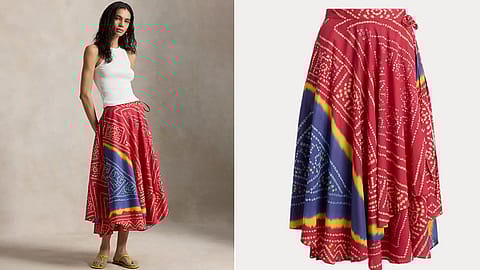
Ralph Lauren cotton skirt inspired by traditional bandhani tie-dye techniques | Credits: Ralph Lauren
In today’s hyper-reactive digital landscape, fashion controversies often erupt as quickly as they fade, with social media acting as both judge and amplifier. While global brands continue to draw from diverse cultural traditions, not every instance of inspiration is examined with equal nuance. In many cases, outrage precedes verification, and details that might offer clarity are overlooked in the rush to respond. As conversations around cultural appropriation grow louder, so too does the need to question whether the backlash is always justified—or if, at times, the narrative is shaped more by assumption than fact.
Barely a few months after American fashion designer Ralph Lauren showcased dangling earrings that closely resembled Indian jhumkas on the runway—drawing sharp backlash on social media—the brand is once again in the spotlight. This time, it is for images of its wrap skirts that appear to feature Indian tie-and-dye and bandhani patterns. Social media, once again, has been quick to react, with users questioning why such a prominent brand would overlook giving due credit.
Even though, at first glance, the product page on the Ralph Lauren global website describes the piece simply as a “Print Cotton Wrap Skirt,” a closer look reveals a more detailed description: “This beautifully draped cotton skirt is printed with a vibrant design inspired by traditional Bandhini tie-dye techniques and motifs.”
So, what is this controversy really about?
Some posts argue that the issue lies in the pricing—why a skirt costs ₹44,800 when similar designs are available for a fraction of the price. But by that logic, one could question why a Birkin bag commands such a premium when a similar leather bag costs far less, or why a Rolex is priced exponentially higher than a standard wristwatch. Luxury products are priced not just for utility, but for craftsmanship, design, exclusivity, and brand value.
Even as it is often argued that global brands freely draw inspiration from Indian crafts—such as Prada with Kolhapuri chappals or Dior with mukaish embroidery, and even Ralph Lauren’s earlier jhumka-inspired pieces—in this instance, the outrage appears to have outpaced the facts. The attribution, while not prominently placed, is clearly mentioned on the product page.
As for previous controversies, experts point out that there is little legal recourse available. According to IP lawyer Safir Anand, partner at Anand & Anand, “Traditional cultural expressions like jhumkas, bandhani, chikankari, or kolhapuris often fall into a grey area in intellectual property law. Copyright protects original works, not centuries-old designs. Design law protects new designs, not traditional ones. Trademarks protect brands, not cultural motifs. So heritage sits in a legal vacuum. Culture is valuable, but legally under-protected.”
He adds, “Unlike art or academia, fashion has no strong tradition of citation. A runway show may refer to ‘vintage-inspired’ or ‘heritage aesthetic,’ but it will rarely explicitly say, ‘Inspired by traditional Indian jhumka jewellery.’ That absence of attribution fuels debates around cultural appropriation.”
This raises a broader question: should such matters be addressed through legal frameworks, or left to the ethical judgment of brands? In the case of the Prada–Kolhapuri controversy, the brand eventually acknowledged its oversight and partnered with artisans in Kolhapur to produce “Made in India” footwear. That could serve as a constructive way forward—even when inspiration is unintentional or attribution is initially absent.
Ultimately, the debate goes beyond any single collection. While it highlights a systemic gap in how global fashion engages with living traditions, it also raises questions about the speed and nature of public reactions. Those quick to call out such issues may need to examine the details more carefully before amplifying outrage.
Perhaps, had the brand placed the attribution more prominently in the main description, the controversy might not have arisen at all. This leaves an open question: is the responsibility solely on the brand for not highlighting the inspiration clearly enough, or also on audiences who react without fully examining the context?
In the end, the episode underscores a more nuanced reality than the outrage cycle often allows. While global fashion must move towards clearer and more visible acknowledgment of cultural influences, there is an equally pressing need for more informed and measured responses from audiences.
{{#most-powerful-women-snapshot-individual.slug}} {{/most-powerful-women-snapshot-individual.slug}} {{^most-powerful-women-snapshot-individual.slug}} {{/most-powerful-women-snapshot-individual.slug}} {{#showRanking}} {{current-rank}} {{/showRanking}} {{#photo.0.url}}
{{name}}
Not every resemblance amounts to erasure, and not every oversight is deliberate appropriation. As the dialogue between heritage and high fashion evolves, the way forward may lie in balance—where brands communicate with greater transparency and consistency, and audiences engage with greater diligence before passing judgment. Only then can the conversation shift from reaction to responsibility, and from assumption to understanding.
Follow Fortune India
NEXT STORY