Akasa Air's ascent to conquer duopoly
/ 11 min read
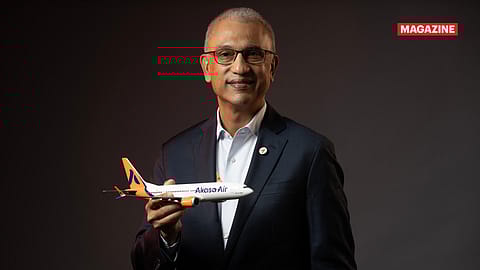
Vinay Dube, founder & CEO, Akasa Air | Credits: Nishikant Gamre
Akasa Air's ascent to conquer duopoly
Amid the pandemic's challenges, Vinay Dube launched Akasa Air, capitalizing on the opportunity to build an airline from the ground up. With a fleet of 34 aircraft and a 5.1% market share, Akasa has become India's third-largest airline, challenging the duopoly of IndiGo and Air India by focusing on cost efficiency and dependability.
This summary is AI-generated, and Fortune India is not responsible for its content or any associated copyright issues.
More than three and a half years since its first flight, Akasa is taking slow but steady strides to become the third force to reckon with in a market dominated by IndiGo and Air India.
Vinay Dube, founder & CEO, Akasa Air | Credits: Nishikant Gamre
This story belongs to the Fortune India Magazine march-2026-indias-biggest-unicorns issue.
IT CAME TO VINAY DUBE during the unlikeliest of times.
The time and age were such that most airline owners were staring into the abyss as the world came to a complete standstill. The Covid-19 pandemic had wreaked worldwide havoc, and airlines were grounded as passenger travel came to a halt.
But for Dube, it was a moment of reckoning. The airline veteran knew in his gut that the time felt right to start his own airline. After all, he had been the CEO of two airlines — Jet Airways and GoAir — before and was well-versed in Indian aviation. India’s skies may have a bloodied history, with airlines folding up quite often, but Dube wasn’t worried about that pattern.
Instead, another pattern and number caught the maths major’s eye. “My thinking was that there has to be a very high correlation between the only airline that was successful and the only one started by an aviation professional,” Dube says, in reference to IndiGo, which was started by Rakesh Gangwal, an airline professional, and Rahul Bhatia. Other airlines in India, such as Jet Airways, Sahara, Air India, Air Deccan, Kingfisher Airlines, GoAir, and SpiceJet, were all founded by businessmen.
“It doesn’t take high-level math or AI to tell you there’s a pattern here,” Dube says. “There was an opportunity to build an airline from the ground up as an aviation professional and foreseeing what might come 5 or 10 years from now, engineering that from day one was a great opportunity.”
And thus, on August 15, 2020, as India celebrated its 74th Independence Day and barely five months into a nationwide lockdown to combat Covid-19, Dube set out to start an airline. More than five years later, that airline has quietly grown on the fringes, taking on the mighty IndiGo and Air India in India’s duopolistic skies, by carrying over 19 million passengers.
The pandemic-induced slowdown, perhaps, proved to be a blessing in disguise for Dube. “There was no better time to start,” explains the co-founder and CEO of Mumbai-based Akasa Air. There had never been a better time to purchase aircraft because nobody was ordering them. “You could get pilots, engineers, and senior leaders, because many of them were unfortunately laid off during Covid-19. So, the opportunity was never better than at that moment. That’s why there was no need to think too much about it.”
More Stories from this Issue
With a fleet of 34 aircraft and flights to over 30 destinations, including six international ones, Akasa Air is now India’s third-largest airline. In 2025, the airline had a 5.1% market share and the highest passenger load factor — a measure of the total seats filled by passengers. The airline operates entirely on a fleet of once-grounded Boeing 737 Max aircraft, with an order book of 192.
“There’s no other airline in the 125-year history of global aviation that has gone from zero to 34 aircraft in such a short time,” Dube says. “We have not only done that, but we’ve also done that with a very high degree of dependability. Akasa’s on-time performance over three and a half years (since its first flight in August 2022) has been right up there at the top of the Indian industry. So, to have growth with this kind of dependability, I think, is exceptional.”
“Akasa has done the hard part, which is the survive and launch phase along with relevance,” says Alok Anand, the chairman of Acumen Aviation, an aircraft asset management and leasing company, as he highlights the parameters listed above. “They crossed 100,000+ departures [by their three-year mark]. For a new airline in a duopoly market, that’s broadly on [or slightly ahead of] expected lines, but the next phase is much harder. That’s consistency and profitability through cycles.”
Credits: Getty Images
Akasa Takes Wings
{{#most-powerful-women-snapshot-individual.slug}} {{/most-powerful-women-snapshot-individual.slug}} {{^most-powerful-women-snapshot-individual.slug}} {{/most-powerful-women-snapshot-individual.slug}} {{#showRanking}} {{current-rank}} {{/showRanking}} {{#photo.0.url}}
{{name}}
Dube’s tryst with aviation began almost straight out of college.
Armed with a degree in mathematics and economics from Knox College and a master’s in operations research from the University of North Carolina, Dube has been a lifer in the aviation world. He started with American Airlines as an operations research analyst before rising to senior vice president at the U.S.-headquartered Delta Airlines.
At Delta, Dube found acclaim for establishing a $10-billion joint venture with Air France, KLM, and Alitalia. He also had a critical role in Delta’s acquisition of Northwest Airlines in 2008. All that meant, when Jet Airways — once India’s largest airline — was looking for a CEO amid turbulence in 2017, Dube was brought in. Unfortunately for Dube, though, that journey ended in less than two years when Jet Airways folded amid ballooning debt. He was soon hired by Nusli Wadia-owned GoAir in February 2020, but left within six months.
The pandemic struck during his GoAir stint and the aviation sector took an immediate hit. That’s when the IndiGo model caught Dube’s interest. “It was quite easy for me to see what they (IndiGo) did right from day one. And it centred around getting a good aircraft deal that will give you a highly competitive cost structure to capitalise well, because you never know what twists and turns are coming…[and] surrounding yourself with a set of smart professionals and creating a professional environment that allows professionals to do what they have been trained for.”
By November 2021, Dube, along with his brothers Sanjay and Niraj, founded SNV Aviation Ltd. Over the next few months, the company began looking for investors. Then came serendipity in the form of ace investor Rakesh Jhunjhunwala. The ‘Warren Buffett of India’, with a net worth of a little over $4 billion, was waiting for an opportunity to enter the airline sector. Dube had first met Jhunjhunwala briefly in 2018, but his “proper” meeting took place in May 2021, almost 10 months after he decided to start his own airline.
Jhunjhunwala pumped in around $40 million into SNV, and with that, Dube and Akasa were ready to fire. By July 2021, Aditya Ghosh, the former IndiGo president credited with putting the airline on an unprecedented growth trajectory, also came aboard as a co-founder. Akasa Air received the air operator’s licence by July 2022. It was ready for the take-off.
Meanwhile, in November 2021, even as the pandemic’s aftershocks continued to be felt worldwide, Akasa announced a firm order for 72 fuel-efficient Boeing 737 MAX airplanes, valued at nearly $9 billion at list prices. The move raised eyebrows, not for the staggering amount, but largely because it had only been a few months since a global ban on the Boeing 737 Max had been lifted. But the decision was also largely based on the belief that the aircraft, which was grounded worldwide after two crashes, had seen enough scrutiny and audit, thereby ensuring safety.
Despite the American aircraft maker’s 109-year-old legacy spanning the likes of the Boeing 747 and the Boeing 777, it was no cakewalk to get investors, Dube admits. “It’s difficult to convince people to invest in a startup airline in the middle of Covid-19. Convincing them on a Boeing fleet or another fleet is a pittance compared to the order of magnitude of just telling people this is the best time ever to start an airline,” he recalls.
But that’s where Jhunjhunwala came as a saviour of sorts. “RJ’s vision and intuition were so amazing. For someone who has not spent their whole life in aviation to see that the time was right with the right partner and the right aircraft type, and that India’s future depended on it, was just amazing,” the Akasa founder says. “Obviously, he did not put undue pressure. At the end of the day, he wants to run a smart company. It took him like a week [to come on board].”
The airline finally took to the skies in August 2022. As Covid-19 restrictions started to ease, the first Akasa Air flight took off from Mumbai to Ahmedabad. “Akasa has found a place in the right market and arguably at the right time,” says Satyendra Pandey, the managing partner of aviation finance firm AT-TV. “With Air India and IndiGo both targeting a more complex strategy that includes premium long-haul operations, the pure low-cost-carrier space is up for grabs, and Akasa has that field to itself.”
A Sky-high Opportunity
That said, the airline’s more than three-year-old journey has not been without turbulence. Despite maintaining a steady 5% market share, Akasa has also been hit hard by delays in aircraft supply. Initially, the airline planned to have 70 aircraft within four years of operations. But at 34, only half have been delivered so far. “Their growth has been slow and steady,” says Pandey. “Especially given the challenges concerning the aircraft supply chain and aircraft production.”
Consultancy firm McKinsey reckons that only about 7,000 aircraft were delivered globally in the six years between 2019 and 2024 — far below the pre-pandemic trajectory, which, had it continued, would have resulted in about 12,000 aircraft over the same time frame. Having a fleet of 70 aircraft in a short span, especially in India’s fast-evolving skies, would have undoubtedly played to Akasa’s favour.
Currently, there are only three operators, including Akasa, for Indian passengers, and on several routes, there is only one. “Indian skies need additional competition,” says Pandey. The domestic market is a clear duopoly with both Air India and IndiGo facing their own challenges.
The year 2025, when IndiGo and Air India — with a combined domestic market of 91% — had a rough ride, is a case in point. IndiGo, which controls around 63% of the domestic market, plunged into crisis when it was forced to cancel thousands of flights due to inadequate regulatory preparedness, stranding thousands of passengers at airports. The woes of India’s largest passenger airline began in November, when it started cancelling flights. It soon unfolded into a nationwide catastrophe, with as many as 1,600 of its 2,200 daily flights having to be halted as IndiGo grappled with a new rest-norm implementation imposed by the Centre for flying crew. The turmoil forced the government to step in and cut IndiGo’s schedule by 10%.
Meanwhile, Air India, criticised for its slow turnaround after its 2021 acquisition by the Tata group, has been fighting a perception crisis following the crash of a Boeing 787 Dreamliner that proved fatal to as many as 260 people.
“International is a different ballgame where the competition is even more intense. Airlines must compete on product, price, and people, and India’s airlines are facing an uphill challenge on all three fronts,” adds Pandey.
Dube, though, believes that the way out for an airline like Akasa is to effectively manage its costs by preventing them from spiralling into a tailspin. It would also help to be well-capitalised. Last year, the airline raised as much as $125 million from a clutch of investors, including Premji Invest, leading asset management firm 360 ONE Asset, and Ranjan Pai-backed Claypond Capital, alongside an additional capital infusion from the Jhunjhunwala family, the existing investors in Akasa Air.
According to data from Tofler, the standalone net loss of Akasa Air in FY25 rose 18.7% year-on-year to about ₹1,983 crore, largely due to higher costs in areas such as employee wages, maintenance, airport charges, and forex fluctuations. In FY24, the net loss had more than doubled to ₹1,670 crore, up from ₹745 crore in the previous fiscal. Revenues stood at ₹4,636 crore in FY25, compared to ₹3,069.6 crore the year before.
“In terms of fundamentals, the question is who has the best opportunity to create India’s leading cost structure, and who has the best opportunity to serve customers with the kind of dependability on one side, and with the kind of empathy and kindness with which we are doing it?” Dube says. “If we stay focussed on our mission and our strategy, then India is a large enough market to support multiple airlines,” he adds.
That means, even while chasing cost structures, the company has been paying close attention to what Dube calls empathy in Indian aviation, which goes beyond customer experience into the environment and even how its crew functions. Akasa’s crew uniform is made from recycled polyester. The cabin crew are expected to show up at work in gender-neutral uniforms and comfortable sneakers. The airline also refuses water gun salutes at airports.
“Because the market is enormous, small improvements compound quickly,” says Acumen’s Anand. “In India, empathy must show up as predictability and recovery. Customers forgive a delay; they don’t forgive confusion. That means, fast, transparent disruption handling, and ruthless reliability on basics such as on time performance, baggage, and call centre response.”
But even as Dube wishes for an airline that remains different from its competitors, it’s easier said than done in a market like India, which remains price-conscious, where air fares are still lower than in many parts of the world. “Culture can be a key differentiator but is one of the hardest things to create,” says Pandey. “Also, it must be distinct to a point where the passenger is paying for the difference. That has not happened yet.”
There is also the recent departure of two co-founders, Praveen Iyer and Neelu Khatri, who have left to pursue their personal interests.
On Cruise Mode
Yet that hasn’t stopped the airline from setting some ambitious targets for the near term. The airline is now targeting a 60:40 split in operations with 60% from domestic and 40% from international operations. “It is not going to bother me if it stays at 75:25 or 70:30,” Dube adds. With IndiGo now shedding its low-cost tag and adopting a hybrid model that includes long-haul flights, its version of business-class seats, and frequent-flyer programmes, it is difficult not to fall into the trap of following the market leader.
“When you go fishing, you don’t need to catch every fish in the pond,” Dube explains his strategy. “Somebody else can catch another type of fish. If the pond has enough fish for you to be happy, that’s good enough.”
In December 2024, the airline stitched up a codeshare agreement with Etihad, the flag carrier of the U.A.E. It is gearing up for more such agreements. A codeshare agreement is an agreement to issue and accept tickets for flights operated by a partner airline.
Akasa is also preparing for an IPO in the next two to five years, making it the third airline after IndiGo and SpiceJet to do so. “But that’s not something that’s cast in stone,” Dube reiterates.
For now, though, Akasa’s focus remains steadfast on building the best structure and a path to profitability, although there are no fixed timelines for that. “When you can create the most efficient cost structure, then it doesn’t matter who is leading a price war or who’s setting fares,” Dube says. Quite often, Indian airlines find themselves in a price war when one offers discounted tickets, prompting others to follow suit.
But can Akasa successfully break the domestic duopoly? Akasa doesn’t need to ‘beat’ IndiGo, it only needs to become the default second choice on enough routes to be impactful, says Anand. “Incumbents have scale economics, distribution muscle, and airport advantages,” he explains. “Getting to a steady 5% share already proves they can take bites. The real impact comes if they can push towards high single digits while improving reliability and narrowing losses, because then they change pricing behaviour and capacity discipline in the whole market.”
So, is there a sense of satisfaction in Akasa’s three and a half years? “My mindset has been typical of an executive of a company, which is let’s not think from one month to the next,” Dube says. “Any time you have long-term thinking, growth is not sufficient for long-term success. You must have the quality that comes with growth. Growth on its own will get you one year, five years, or 10 years. But eventually, if you don’t give consumers what they want beyond just growth, you won’t have long-term success. So, the dependability and the quality of growth for me should be the foundation of any journey of any young business.”
After a smooth take-off, Akasa seems to be cruising well. Now, it’s all about avoiding turbulence.
Follow Fortune India
Sign in to read full story
To access our exclusive magazine content, sign in to your Fortune India account.
Sign In NowNEXT STORY