Balaji Wafers: Made in Rajkot, scaling across Bharat
/ 9 min read
A volume-led growth strategy, high-quality, pocket-friendly snacks for the masses, and a cautious expansion plan aided by technology make the ₹7,500-crore Balaji Wafers India’s fastest-growing snacks manufacturer.
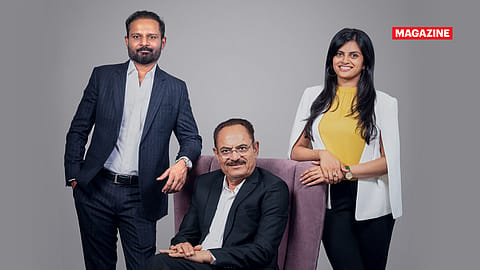
Chandubhai Virani (centre), founder & MD, Balaji Wafers; with Mihir Virani (left), director, Balaji Wafers; and Manasi Virani, director, Balaji Wafers. | Credits: Sanjay Rawat
This story belongs to the Fortune India Magazine May 2026 issue.
IT IS LUNCHTIME at the Balaji Wafers headquarters in Rajkot and two generations of the Virani family (owners of the snacks company that posted revenues of ₹7,500 crore in FY26) are headed to their private dining hall on the third floor of the sprawling campus. However busy the day may be, the family lunch every afternoon is sacrosanct. As they enter the dining hall, a sumptuous home-cooked Gujarati meal awaits them. While patriarch Chandubhai Virani cuts mangoes for everyone, younger brother Kanubhai serves laddoos that he has made himself. Over the next one hour the family talks shop, gossips, and engages in banter.
“A family that eats together, stays together,” Chandubhai says in Hindi with a Gujarati accent, as he serves us freshly set curd made from Gir cow milk, sourced from his 200-cow-strong gaushala. The 70-year-old claims that his family values reflect in his products. “Hum per day 3 crore packet nastha banate hai aur har packet mein ghar jaise swad hota hai (We produce 30 million packets of snacks daily, and each packet tastes like home),” says the MD of Balaji Wafers.
Understanding consumer needs and offering high-quality products at an affordable price has always been his forte. At a time when industry peers are relying on premiumisation for growth, deep trade discounts and heavy marketing spends are the norm, Chandubhai’s mantra is simple: “If I give good quality products to my consumers at an affordable price point, they will be loyal to me. When I started in the 1980s, the trade refused to sell my potato chips. I won them over by ensuring that my product was so good that the consumer asked for it.”
From a three-product (potato chips, moong dal, and chana dal) company, Balaji Wafers today boasts of 63 products, which includes western snacks, confectionery, and instant noodles, Gippi. Over 70% of the company’s revenue comes from ₹5 and ₹10 packs, while peers are piggybacking on revenue from larger pack sizes (priced at ₹20). The larger the pack size, the higher the margin, but the Rajkot-based snacks manufacturer has proved to the industry that a volume-based strategy not only works, but is extremely profitable, too. In FY25, the company clocked revenues of ₹6,548 crore and net profit of ₹291 crore. When the bulk of the industry has had to stay content with a modest 5-10% growth, Balaji Wafers has been consistently growing at 20% for the past five years. What is even more interesting is that unlike its peers (the likes of PepsiCo and ITC), Balaji Wafers is available only in the western and northern parts of the country.
Just as one assumes that Balaji Wafers is a traditional, family-run business, comes the big surprise: from sorting the potatoes, to peeling, chopping to frying and packaging — the entire process of namkeen (salted snacks) manufacturing is automated. The icing on the cake is the team of robots at the packaging segment of the factory, which effortlessly packs hundreds of packets of Balaji products into cardboard boxes. “Most of our products are sold in smaller packs and these robots have been specially designed to pack ladis or smaller packs more efficiently,” says Mihir Virani, director, Balaji Wafers, and the second son of Chandubhai’s elder brother Bhikhubhai. While the older generation built the business and set up factories in Rajkot, Valsad, and Indore, Mihir says the next-gen has brought in high-end automation.
Balaji’s first fully automatic plant came up way back in 1995, when automation was a far cry for most snacks manufacturers. “We rented machines from a local manufacturer who [had] shut shop and we got into trouble, but we eventually managed to buy the plant,” recalls Chandubhai.
The balaji playbook
More Stories from this Issue
When Chandubhai and his brothers launched Balaji Wafers in the 1980s, the strategy was to first make their products available in Rajkot and its adjoining areas and then penetrate into the whole of Gujarat. For a long time, they were a one-state brand. They eventually entered Maharashtra in the early 2000s, after which they went to Rajasthan and Madhya Pradesh. They are also available in certain regions of Uttar Pradesh and Karnataka. Spreading themselves thin has never been their strategy. Balaji doesn’t have a national presence (it is present in 15 states), and is in no hurry to expand, says the MD.
Focussing on a limited geography has enabled the company to service the trade and consumers better. They have managed their logistics costs and made sure that their availability on shop shelves is high. They service the stores at least thrice a week so that products are constantly available. Their manufacturing is closer to the markets too. Their 50-acre plant in Rajkot and Valsad caters to Gujarat, Maharashtra, and Rajasthan. They also have a manufacturing facility in Indore and one in the Hardoi district of Uttar Pradesh. As they penetrate down South, they are also coming up with a huge facility in Tumkur near Bengaluru. Balaji’s third plant in Gujarat is coming up in Himmat Nagar.
According to an industry source, the company has created a supply chain through an outsourced CFA (carrying and forwarding agent) who owns their distribution vehicles. “They have a technology-led order management system that makes them extremely cost-efficient,” the source says.
Technology has been at the forefront of its operations. Be it logistics, manufacturing or storage, everything is tech-enabled. “Their agile operations customised to service the outlet frequently, along with active adoption of technology across the value chain results in higher availability, higher share in outlet and lower cost of operations,” explains Rishav Jain, MD and co-leader of consumer, consumer tech and retail practice, Alvarez & Marsal. This is supplemented with higher grammage and high-quality products, he adds. In fact, the snacks company offers twice the grammage of what its peers offer across all its SKUs — a strategy that has helped it build consumer stickiness.
{{#most-powerful-women-snapshot-individual.slug}} {{/most-powerful-women-snapshot-individual.slug}} {{^most-powerful-women-snapshot-individual.slug}} {{/most-powerful-women-snapshot-individual.slug}} {{#showRanking}} {{current-rank}} {{/showRanking}} {{#photo.0.url}}
{{name}}
The snacks major continues to be a huge believer in traditional distributors at a time when the industry at large is relying heavily on e-commerce and quick commerce. Over 85% of Balaji Wafers’ sales is direct-to-distributor, and it has a dominant share in most markets. Chandubhai says e-commerce contributes around 5% to sales. It’s a platform he isn’t averse to, but he is clear he will not do anything that will lead to growth at the expense of the traditional trade.
The Virani family isn’t a huge fan of premiumisation. Neither do they believe in offering huge discounts. “Discounting may not be essential if the pricing is right,” says Kannan Sitaram, co-founder & partner, Fireside Ventures. “The largest part of the market is in smaller packs. Since they are interested in scale, they are right not to go in for a premiumisation strategy.”
However, since the company is gradually spreading its wings to newer geographies such as the southern and eastern parts of the country, Sitaram believes that catering to local tastes and preferences would be important. “They will need to see to what extent they localise flavours, which can be quite complex for their operations. They should also keep in mind that there are preference drivers apart from taste that consumers may be looking for. In South India, for instance, consumers are actively looking for brands that are not made with palm oil, have no preservatives.”
According to Chandubhai, whichever market he enters, he talks directly with consumers and innovates for them. Hiring a research agency is not part of his playbook. “When we entered Maharashtra, the consumers wanted chivda and peanut bhujiya; we gave it to them.”
He doesn’t see an opportunity in health-based snacks either. “We are a snacking company, and our goal is to delight consumers by offering great taste for which we need to use oil. We do have products such as moong dal in our portfolio that consume less oil,” he says. According to him, his consumers, mostly from the lower-income strata, buy a ₹5 snack packet to kill hunger. “They are people who can’t afford restaurants, so oil actually gives them energy. Moreover, snacking has to be done under moderation. Too much of anything, including drinking too much of milk, could be unhealthy,” he argues.
Balaji’s next-gen
Just as the family lunch is mandatory for every member of the Virani family involved in the business, Chandubhai makes sure he doesn’t miss his afternoon siesta either. Is that an indication of the older generation passing the baton to the next-gen? “The next generation of Balaji Wafers is extremely active.” “What Chandubhai is to the older generation, Keyurbhai is for our generation,” says Manasi Virani, director, Balaji Wafers, referring to the elder son of the Bhikhubhai. Manasi, Kanubhai’s daughter, is the newest entrant into the business. Keyur and his brother Mihir are currently at the forefront. Chandubhai’s son Pranay and Kanubhai’s son Shyam are also in the business. The next-gen Viranis involved in the family business are directors at Balaji Wafers.
So how different are the next-gen Viranis? “Zameen-aasman ka fark hai (They’re as different as chalk and cheese),” says Chandubhai. “I would have never bought robots, nor would I have got into western snacks... But it is the younger generation that will take the business ahead. [So] we have to empower them, not clip their wings.”
Mihir says the older generation initially wasn’t in favour of getting a private equity partner on board. General Atlantic recently picked up a 7% stake in the company. While the deal size wasn’t disclosed, industry estimates put it in the range of ₹2,000-3,500 crore, valuing Balaji Wafers at ₹35,000-40,000 crore. Chandubhai admits that he was never in favour of a stake sale. “I still am not in favour. I agreed to sell a minimum stake only when the second generation proved it to me that family-run businesses without professional intervention eventually shut down.”
Mihir says the business needed a devil’s advocate and that was possible only if an external partner came on board. “We have always been working our way, without knowing whether we are right or wrong. An external partner like General Atlantic can tell us where we are going wrong, since they are associated with several companies.
The younger Viranis are far more aggressive than the older generation, says a marketing consultant who works closely with Keyur, but declined to be named. “They are more experimental. Their SKUs have doubled in the past three years. They want to enter newer states more often. They are a hungrier version of Chandubhai. However, their ethos and vision for the organisation are similar.”
Professionalising Balaji
Ask any member of the Virani family the reason for selling stake to General Atlantic, and the spontaneous answer would be to bring in professional best practices into the business. Having said that, the family has an altogether different definition of professionalisation, especially when it comes to managing its over 5,000-strong workforce.
Chandubhai doesn’t believe in setting sales targets for his employees. “I give them a free hand just as I give to my family,” he says. Setting targets, he says, would limit the employees from achieving what they want for the business. “It has worked.”
“Anyone who doesn’t do his/her work is unprofessional and vice-versa. Getting a private equity partner doesn’t mean we will get expensive, white-collared talent,” adds Mihir.
Professional best practices, according to Manasi, would mean using technologies such as AI in a far more sustained manner. “Chandubhai prefers reaching out to consumers directly, but as we expand our product range as well as enter newer geographies, we will need to do marketing so that people are aware of our products. Our strategy has to be different.”
Jain of Alvarez doesn’t expect a drastic change in the way the company does business. “A PE partner enhances the ability to attract senior talent. You can structure better value outcomes for that individual — particularly at senior levels.”
Chandubhai is confident that the partnership will take the business to newer levels. “Mai aapko humari dosti dikhake rahunga (I am confident that our partnership will bear fruit),” he says. There were over 40 suitors for this business and General Atlantic was the only investor who understood them. He says that an IPO could be on the cards in the next two years. “We as family members will continue to think from our heart. Professionals think from their mind. I think both are important for the longevity of a business.” Will Balaji Wafers be able to adhere to its rather simplistic way of doing business in the long run? The journey ahead is worth a watch.
Follow Fortune India
Sign in to read full story
To access our exclusive magazine content, sign in to your Fortune India account.
Sign In NowNEXT STORY