Fortune India Exclusive: Berkshire’s lesser-known India portfolio
/ 11 min read
As Greg Abel takes charge of the Berkshire Hathaway empire, he also inherits a quietly formidable India operating portfolio.
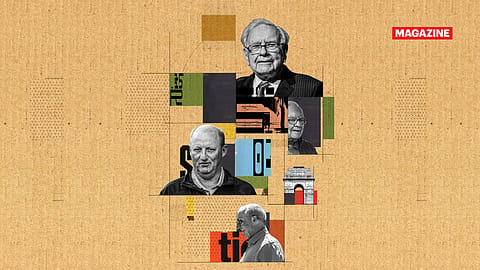
Warren Buffett (top) and
Greg Abel | Credits: Anirban Ghosh
This story belongs to the Fortune India Magazine may-2026-biocon-next issue.
MAY 2 marked a decisive change in the history of Berkshire Hathaway, with Greg Abel chairing the 2026 annual shareholder meeting following the legendary Warren Buffett having stepped down as the CEO of the conglomerate in 2025.
What’s unique about the $1-trillion empire is that, besides the insurance business, it has a notable collection of 58 unlisted operating companies: from energy to rail freight, lubricants to metals tooling, batteries to real estate, jewellery to sneakers, engineering to rodent control and lots in between. Interestingly, a prominent set of these companies also have an India presence; in fact, some have been here for multi-decades (See: The Omaha Connection).
Unlike One97 Communications a.k.a Patym, the only public investment that cost Berkshire 40% of its principal investment of $260 million, the operating portfolio of Berkshire in India is far more robust.
Lubrizol, the big India bet
The numbers alone tell a significant part of the story.
Lubrizol India and Lubrizol Advanced Materials India have a combined top line of over ₹3,200 crore, making it Berkshire’s biggest bet on Indian soil via Lubrizol Inc., which hit $6 billion in revenues last year.
Not surprising that Rebecca Liebert, president and CEO, The Lubrizol Corp., sees a great opportunity in India in the industries it serves. “When we allocate capital, we consider market demand, the ability to localise supply and the talent needed for success. India checks those boxes across our portfolio. Investment here is a meaningful part of our growth strategy,” Liebert tells Fortune India.
More Stories from this Issue
But the more interesting story is not the numbers. It’s the Berkshire philosophy behind it and the man driving it.
The crown jewel is being led by Abhishek Shrivastava, MD, India, Middle East, and Africa. A chemical engineer from IIT Kharagpur, with a PhD from the University of Minnesota, Shrivastava spent 11 years at Dow Chemical, before one conversation changed his trajectory.
Lubrizol was looking for someone who could hold two things simultaneously: deep fluency in Lubrizol’s global strategic context and the ability to execute in India within Berkshire’s operating framework. “The conversation [with the board] was less about specific financial targets and more about philosophy: what’s your strategy, what will be your guardrails as you grow, how will you think about values and risk management as you scale quickly in a complex market,” Shrivastava tells Fortune India.
He traces much of his understanding to a fireside chat between Abel and Liebert in early 2023, around the time he served as vice president, innovation and decision science at Lubrizol. “Greg said something that stuck with me immediately: it’s not growth at all costs for Berkshire. Risk management, reputation, and compliance come first. That’s the philosophy in a sentence.”
{{#most-powerful-women-snapshot-individual.slug}} {{/most-powerful-women-snapshot-individual.slug}} {{^most-powerful-women-snapshot-individual.slug}} {{/most-powerful-women-snapshot-individual.slug}} {{#showRanking}} {{current-rank}} {{/showRanking}} {{#photo.0.url}}
{{name}}
But the one notable difference that Shrivastava found from his past experiences at Dow and DuPont is the absence of activist investor pressure. “No one is pushing you to cut down on R&D, sell a business unit, or optimise for short-term earnings multiple at the expense of long-term positioning. That clarity is valuable when you’re trying to build something real,” he elaborates.
Liebert, who took over as the president and CEO in 2022, mentions that Berkshire relies on its businesses and their leaders to make strategic decisions for their organisations. “That has been the Lubrizol experience since Berkshire’s acquisition of Lubrizol [in 2011] and continues today.”
While having read The Intelligent Investor and being aware of the Buffett-Munger philosophy is one thing, living it as an operating principle has been a revelation for Shrivastava. “For a chemical engineer who wants to focus on innovation, being owned by Berkshire and not the stock market is genuinely a good thing… We can play the long game,” says Shrivastava.
Building the India moat
Lubrizol’s India story is not new. It began six decades ago as a 60:40 JV with Indian Oil Corp. (IOCL) to serve the lubricant additives market. Lubrizol brought the technology, IOCL the supply chain. Today, Lubrizol has taken the lead with IOCL holding 26%.
The foundational business for Lubrizol in India is mobility additives, the chemistry that goes into engine oils for everything, from cars and trucks to the 125cc motorcycles that rural families treat as a prized possession. The multinational, however, has been layering businesses on top of it for the past two decades, and the pace has accelerated significantly in recent years. Lubrizol Advanced Materials was set up in 1991.
The company’s second major bet is chlorinated PVC (CPVC), the plastic used in high-performance plumbing pipes that replaces metal and outperforms standard PVC. “In a market with increased urbanisation and rising living standards, CPVC enables a fundamental need: clean, safe drinking water and reliable infrastructure,” says Liebert. “We introduced that category in India,” adds Shrivastava. The business model involves selling both the resin and the compound to pipe manufacturers such as Ashirvad Pipes and Finolex, who then extrude it.
The success attracted competition from Astral Poly Technik with its backward integration into compounding and piping. “Healthy competition makes you sharper. But markets evolve; what looks like head-on competition today looks very different when margins compress and the strategic calculus changes,” says Shrivastava.
The CPVC manufacturing outlay is a significant one at over $130 million. Lubrizol partnered with Grasim Industries, which had an integrated chemical plant needing an outlet for chlorine — a key raw material for CPVC chlorination — in a partnership to produce 100,000 metric tonnes of CPVC resin, to meet the high demand for plumbing pipes. This special type of polymer material, widely used in hot and cold-water pipes, is manufactured at the chlor-alkali unit of Grasim to take advantage of the captive chlorine integration. “The total cumulative investment in India across entities over the past three years runs north of $200-250 million, and if you count running capital for existing plants and the ongoing capex, it’s well into hundreds of millions,” reveals Shrivastava.
Beyond CPVC and additives, Lubrizol operates in paints and coatings: supplying hyper-dispersants and resins to Asian Paints, Berger Paints, and Birla Opus. It supplies thermoplastic polyurethanes for medical devices via a JV with Polyhose in Chennai.
“A lot of customers still prefer Germany or Europe for medical devices, but we’re working to build the narrative that India is ready for high-quality manufacturing... there’s no reason to source them from outside when you can make them here,” justifies Shrivastava. The company also supplies polymers that go into shampoos, soap bars, as well as pharmaceutical formulations to companies, including Unilever.
A ₹30-crore technology centre is under construction with a dedicated R&D facility staffed by Indian engineers working specifically on Indian problems. “You cannot localise without real science,” insists Shrivastava. He offers the soap bar as an example. India consumes soap bars, a mass-market staple with enormous rural penetration, in a way almost no other country does. The innovation problem is making that bar last longer, but costing less for the manufacturer. “To solve a 10-rupee problem, you need serious, expensive chemistry and very smart people. To solve the rural farmer’s soap bar problem, you need IIT and UDCT engineers who understand how soap works at the molecular level,” explains Shrivastava.
A five-year strategic plan carries a commitment to grow at more than 1.5 times India’s nominal GDP. In high-growth segments such as medical devices and beauty, the target is five to six times the GDP growth, though off a smaller base. “The IOCL entity is a majority stake JV; the rest are tie-ups. That split reflects the different technology and competitive dynamics in each market,” Shrivastava adds.
The portfolio beyond Lubrizol
While Lubrizol is Berkshire’s flagship in India, it is far from the whole story.
International Metalworking Companies has three entities in India: TaeguTec India (₹468 crore revenue, ₹83 crore PAT), Tungaloy India (₹354 crore revenue, ₹21 crore PAT), and Iscar India (₹264 crore revenue, ₹15 crore PAT). These are precision metal cutting and tooling businesses used in manufacturing supply chains, and for supplying carbide inserts and tooling systems to machine shops, automotive manufacturers, and engineering firms. Incidentally, during his only visit to India in 2011, Buffett had visited TaeguTec India’s factory in Bengaluru.
Berkadia Services India, a JV between Berkshire Hathaway and Jefferies Financial Group, operates in real estate services. It is one of the largest commercial mortgage banking and real estate advisory firms in the U.S., and its Indian entity services the institutional real estate ecosystem.
Meanwhile, Samuel Aaron Trading (India), with ₹323 crore in revenue, sits under the Richline Group, Berkshire’s jewellery manufacturing and retailing arm. Marmon Technologies India (₹86 crore) operates under Marmon Holdings, the diversified industrial conglomerate. Shaw Floors India (₹66 crore) represents the Shaw Industries’ flooring business. Duracell India Operations (₹283 crore) needs little introduction as the battery brand is one of the rare consumer-facing Berkshire names in India. Integrated Project Services International (₹5.6 crore, currently loss-making) offers technical consulting. TTI Electronics Asia India (₹4 crore) handles electronic components distribution.
Then there are entities that either have exclusive licensee arrangements or a sourcing connection with India — Forest River (camp trailers), Benjamin Moore (paints), Brooks (sneakers), Berkshire Hathaway HomeServices Orenda (real estate services), Business Wire India (press release agency), Detlev Louis (biking accessories), Fruit of The Loom (innerwear), and Dairy Queen (ice cream QSR).
And then there is NetJets, the world’s largest private jet operator. In fact, last December, CEO Adam Johnson was given an additional charge as president of Berkshire’s portfolio of 32 companies across consumer products, service, and retailing businesses.
Interestingly, last September, NetJets got registered as an independent entity in India, a milestone for a company that also offers fractional jet ownership. It first entered in 2008 through a tie-up with Shreyans Group to provide private jet services for international long-haul travel. The solo entry signals a bet the company is making on the high-net-worth wealth effect at play in India.
The sheen is showing
Every annual meeting, Berkshire shareholders get a chance to shop at the Borsheims counter at the CHI Health Center, the venue of the meeting. The jewellery store was acquired in 1989 by Berkshire. While there are no plans to venture into the country, there is an Indian connection for Borsheims.
Karen Goracke, CEO of Borsheims, is unambiguous on the retail question. “We do not have plans to enter India with a retail store,” she tells Fortune India, acknowledging that Borsheims has customers worldwide, and some components in its jewellery may be made in India. “Some of our loose diamonds, as well as the diamonds in our preset jewellery, are polished in India. Lab-grown diamonds are an area of growth for our business, and one of our leading brands offers diamonds that are both grown and polished in India.”
The comment is a quiet reminder of how deeply India’s gem and jewellery ecosystem, centred on Surat’s polishing industry, Mumbai’s diamond trading houses, and the country’s growing lab-grown diamond manufacturing capacity, is woven into the global fine jewellery supply chain, including Berkshire’s own.
Ditto with Berkshire-owned Richline Group, which had, in 2017 acquired the New York-based Aaron Group, a fashion diamond and gemstone fine jewellery manufacturer. The deal included its operations in India as well. While Richline India today serves as the diamond-sourcing division, since 2022 it has entered the ear-piercing distribution market in the country through its Inverness Division, a segment that has seen significant growth.
The second act
Gaurav Marya has spent two decades navigating global brands’ India ambitions and the ground reality. As chairman of Franchise India and founder of Bradford License India, the Indian arm of New Jersey-based Bradford Licensing LLC, he has been in boardrooms for more brand-entry discussions than he can easily count.
Two Berkshire brands, he says, are now closer to getting it right.
Fruit of the Loom, one of the world’s largest innerwear brands, has been in India before through a partnership with Rupa. Rupa Group’s subsidiary Oban Fashions signed a 10-year licensing deal with Fruit of the Loom in 2017 to manufacture and sell the brand across 30,000 Indian outlets, paying a 5% royalty on revenues. But in 2024, the Berkshire brand tapped Bradford as its exclusive licensing agency in India, tasked with finding and securing new partners across casualwear, sleepwear, innerwear, and accessories. “It’s just a larger strategy. The brand wants to go omnichannel, while Rupa was limited to a certain channel where the strength is general distribution. They want to really look at the larger piece of the overall innerwear market in India,” Marya tells Fortune India.
The direction is clear. Fruit of the Loom wants a playbook different than the one it explored with Rupa. “They are weeks away from announcing the larger rollout plan for India, especially exploring newer channels such as e-commerce and quick commerce.”
The positioning will be premium-adjacent rather than mass-market. Women’s innerwear will be a significant focus, an area where, Marya notes, the brand’s strength in India has historically been underestimated. “People know it more from men’s innerwear. But women is a very significant line, and a lot of extension into leisure and loungewear, which is their core strength, [is on the cards].”
Whether the brand will position itself above or below the current benchmark Jockey, is the one Marya answers carefully: “It’s going to be premium. When I say premium, it’s still value.”
Dairy Queen, the ice cream and QSR chain that Berkshire bought in 1998, now with over 7,000 locations worldwide, is a longer-running India story. Marya has been involved in some of those discussions for the past 10 years.
This time it’s different. The company has tied up with Devyani International to dig deeper into India’s burgeoning QSR market. The focus, as with Fruit of the Loom, has shifted to channels — specifically the new distribution architecture that e-commerce and quick commerce have created. “Classic formats are always challenging because of the cost of operations. So, when companies want to really evaluate India — the classic sometimes becomes very complex, especially in the value space,” explains Marya. Dairy Queen, he suggests, is not playing the value game. “They are aspirational value, not too premium, but still aspirational.”
The broader realisation, built over years of brokering global brand entries into India, is that partner selection is everything. “I’ve realised that very few handpicked companies in India have the capability for global partnerships, because they don’t understand brand expectations,” he says. And the timeline cannot be compressed. “You have to look at a 20-year horizon, just as Domino’s did. Jubilant is a good example.”
The lesson applies to Berkshire as much as to anyone. Brands that have struggled in India often suffer from partner mismatch, short-termism, or the underestimation of India’s complexity. “Unless you have local partners, the cost of overlooking direct operation in India is very high,” says Marya.
The India growth story
Berkshire’s India operating portfolio is skewed towards Lubrizol, followed by the IMC Group companies, Berkadia Service, Richline, and Duracell.
Universal Corp. is the sole national distribution partner for Duracell batteries in India. Recently, Satya Intl secured a licensing agreement with Duracell to produce and distribute automotive batteries and accessories across Asian and African countries.
What the India portfolio reveals is what Berkshire values: durable competitive positions that compound quietly. Liebert mentions: “We allocate capital with discipline across regions based on where we can create value and realise growth. We don’t look at India and China as an either‑or choice. China remains a critical market for innovation and manufacturing. India also has that opportunity with strong technical talent, expanding domestic demand, and a growing role in specialty chemicals.”
Shrivastava captures it best when he describes the company’s relationship with Skipper Pipes, whose brand ambassador is M.S. Dhoni. “My father-in-law watched the video and said he saw M.S. Dhoni, he saw Skipper Pipes, but he didn’t see Lubrizol anywhere. And I said: ‘Exactly. That is what I need. My job is done’.”
That invisible chemistry is what Berkshire has found in India.
The Sage of Omaha spent decades building his fortune by buying businesses that others overlooked. Along the way, he inherited an India portfolio by chance. “When I come back [to India], I will be 100 in 2030,” Buffett had joked back in 2011. While there are no signs of him coming back, Berkshire’s unintended India portfolio will remain, perhaps, the most Buffett-like investment of all.
Follow Fortune India
Sign in to read full story
To access our exclusive magazine content, sign in to your Fortune India account.
Sign In NowNEXT STORY