Beyond blue: How the nextgen is shaping Arvind
/ 12 min read
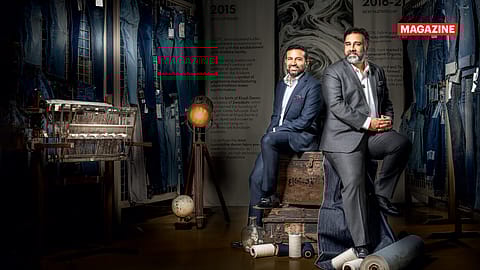
Punit S. Lalbhai (right), chairman, Anup Engineering; vice chairman, Arvind Ltd, and Kulin S. Lalbhai, chairman, Arvind SmartSpaces; vice chairman, Arvind Fashions; vice chairman, Arvind Ltd | Credits: Narendra Bisht
Beyond blue: How the nextgen is shaping Arvind
Arvind Ltd is undergoing a significant transformation, focusing on sustainability, innovation, and strategic brand management. With a sprawling facility in Ahmedabad, the company is enhancing its recycling capabilities and expanding its technical textiles division. The Lalbhai brothers are steering the nearly century-old textile giant towards a future of casual fashion, digital integration, and global market expansion.
This summary is AI-generated, and Fortune India is not responsible for its content or any associated copyright issues.
Arvind’s new generation, brothers Punit and Kulin Lalbhai, is taking charge — fuelling innovation, scaling fast, and powering growth.
Punit S. Lalbhai (right), chairman, Anup Engineering; vice chairman, Arvind Ltd, and Kulin S. Lalbhai, chairman, Arvind SmartSpaces; vice chairman, Arvind Fashions; vice chairman, Arvind Ltd | Credits: Narendra Bisht
This story belongs to the Fortune India Magazine march-2026-indias-biggest-unicorns issue.
ON THE OUTSKIRTS of Ahmedabad, the hustle and bustle of businesses meet the quiet resolve of transformation. About 15 km from the heart of the city stands a symbol of the next chapter in India’s manufacturing story: Arvind Ltd’s sprawling facility at Santej.
Spread across 450 acres, the campus symbolises both scale and ambition. Churning out approximately 5,67,000 metres of fabric per day, it also houses one of Arvind’s largest recycling plants — a nerve centre of innovation, where the three Fs converge: fabric, fervour, and foresight.
“This is one of our biggest plants,” says Punit Lalbhai, surveying the vast expanse with quiet pride. His younger brother Kulin chips in, “One among many.” The exchange captures the spirit of the Lalbhais who have always thought big. Arvind has 13 factories (for fabrics and garments) across India — six in Karnataka, six in Gujarat, and one in Ranchi.
The siblings are carrying forward the legacy of their father Sanjay S. Lalbhai (also, chairman of Arvind Ltd) and those from the Lalbhai family before him, who helped build flagship Arvind Ltd into a textile powerhouse. While Punit manages Arvind Ltd and Anup Engineering, Kulin is in charge of Arvind Fashions and Arvind SmartSpaces.
But what the duo is engaged in is not about scale alone; it’s about finding context for a nearly 100-year-old textile giant in a landscape where change is the only constant.
IN 1931, brothers Kasturbhai, Narottambhai, and Chimanbhai set up Arvind Mills Ltd in Ahmedabad to produce high-quality, superfine fabrics, in response to Mahatma Gandhi’s call for Swadeshi products. And from its first licensed brand in 1993, Arvind focussed on denim between 1997 and 2002, eventually becoming the world’s largest producer of the fabric. Currently, its portfolio includes the rights to manufacture and sell in India global brands such as U.S. Polo Assn., Calvin Klein, Tommy Hilfiger, and Arrow.
The pandemic years were challenging for Arvind, which had a much broader portfolio pre-Covid. During Covid, the group realised that in this business, true value comes from creating scale within brands, says Kulin. “So, we said, ‘let’s concentrate our energies on franchises, which we believe will become very, very large’. We structured saying these five brands are strategic because of several reasons... there’s Tommy Hilfiger and Calvin Klein at the top; Polo and Arrow in the middle, and Flying Machine on the youth side.”
More Stories from this Issue
The decision to double down on core brands laid the foundation for Arvind’s transformation after Covid. “There were a few things we were very clear about. One, improving efficiencies across the group. Since pre-Covid, group PAT has almost doubled. We are now at a RoCE of 20%-plus,” says Kulin. It also worked on deleveraging across the group — a debt-Ebitda ratio of 3x pre-Covid has come down to 0.7 in 2025.
At the group level, Arvind has set a capex target of ₹1,700 crore for FY27, with textiles at ₹500 crore, real estate at ₹1,000 crore, and Arvind Fashions and Anup Engineering at ₹100 crore each. According to Capitaline, the cumulative total income and revenue from operations of the four listed companies witnessed a CAGR of 4.5% each in the past five years.
Credits: Sanjay Rawat
Kulin believes “the future [of fashion] is casual”, and has set clear goals: each brand should scale ₹1,000 crore, with a 20% RoCE, within three to four years. Anything that did not fit that matrix was exited, a move that “dramatically changed the face of the company”.
“Today, one brand — U.S. Polo — has crossed ₹2,000 crore, two (Tommy Hilfiger and Calvin Klein) are around ₹1,000 crore, and two (Arrow and Flying Machine) are above ₹500 crore,” says Kulin. With 22% RoCE and robust cash flows, Arvind Fashions has positioned itself well for an omnichannel future.
{{#most-powerful-women-snapshot-individual.slug}} {{/most-powerful-women-snapshot-individual.slug}} {{^most-powerful-women-snapshot-individual.slug}} {{/most-powerful-women-snapshot-individual.slug}} {{#showRanking}} {{current-rank}} {{/showRanking}} {{#photo.0.url}}
{{name}}
The company also underwent a strategic shift for growth. From a wholesale-heavy model (where either franchises or distributors would sell the products), it pivoted to direct selling. “In this business, whatever inventory gets left behind, that is where all the leakage is,” explains Kulin. “We took charge of the inventory… Stores are 50% of our business; online is 25%. So, 75% of our business is where we now control the entire lifecycle of the inventory, see the consumer we are selling to, and collect the cash flow from sales directly.”
Technical textiles is another focus area. Arvind Advanced Materials Ltd (AAML), a wholly-owned subsidiary of Arvind Ltd, has built a ₹2,000-crore business, based on three major areas — human protection (technical garments used in hazardous conditions — a ₹1,000-crore business); industrial cluster focussed mainly on filtration (₹500 crore); and the industrial composites business, which are glass- and carbon-based fabrics (₹500 crore).
“The domestic consumption of these products is going to grow by leaps and bounds. We are at very, very early stages of consuming them in India. [Currently], it’s an export-dominated business... We have tie-ups with global technology providers for fibre, as well as with molecule suppliers and mass transportation experts,” says Punit.
In a recent report, brokerage firm Elara Capital says long-term business prospects remain intact for Arvind Ltd. “Investment in AAML and garments businesses should generate 20%-plus growth from FY26 due to healthy demand in exports market. We expect an Ebitda CAGR of 16.3% and a PAT CAGR of 25.9% in FY24-27E. Arvind Ltd is also set to generate cumulative free cashflow of ₹1,310 crore in FY24-27E.”
Arvind has also built a ₹1,000-crore B2C fabrics and ready-made business, where 30-40% of the revenues come from the rural markets. Its legacy blouse material product, dating back to 1931, remains the market leader. Tailoring is another major growth driver — The Arvind Store is now the third-largest tailoring brand in India, scaling rapidly beyond metros into smaller towns. The company is opening standalone stores offering premium tailoring alongside fabrics and ready-to-wear. Under Arvind Ltd, it operates 180 standalone stores, around 15,000 shop-in-shops for menswear, and nearly 25,000 retail points for its women’s blouse business across the country.
ANUP ENGINEERING, the group’s smallest vertical, is built on a 1990s acquisition of a capital goods maker. The business has a legacy of supplying to the space sector. Its core strength lies in heat exchangers, along with pressure vessels, columns, and centrifuges — heavy process equipment used across energy, hydrogen, fertilisers, pharma, and fine chemicals.
Earlier concentrated in oil and gas, it has now diversified, exporting to over 50 countries. Backed by 70–80% repeat orders, sales have grown above 20% annually for the past three fiscals. And with global supply chains de-risking China, Punit feels the business is well positioned to gain further market share.
According to ICICI Direct, exports and macro tailwinds provide upside levers for the company. “With ~53% revenue from exports, Anup remains well positioned to benefit from improving global capex cycles and normalisation in India-U.S. trade relations. Management commentary suggests U.S.-linked inquiries could revive meaningfully, creating incremental pipeline opportunities,” the brokerage says in a recent note.
In real estate, Arvind is banking on the group’s legacy and the implementation of RERA, as well as the financialisation of the sector (owning homes through EMIs). Arvind SmartSpaces has projects in Ahmedabad and Bengaluru and is looking to launch three-four projects in Mumbai within a year. “In 10 years with very little capital (the promoters would have put in a few hundred crores), we have come to a scale where we are close to ₹2,000 crore. We are sitting on over ₹10,000 crore worth of inventory. We will be investing ₹1,000 crore in the business. If one adds up the math, it will be one of the biggest businesses in the next five years,” says Kulin. “We are focussed on the sub-₹5 crore ticket size. We operate an asset-light model, with no debt on the books; 60% of our business is through JDAs (joint development agreements).”
ON THE operational front, Arvind is pushing the boundaries of just-in-time manufacturing. “Today, it relies on platforming and specialised factories optimised for small-scale production. Tomorrow, innovation will drive almost instantaneous manufacturing, a next-generation system being personally spearheaded by the chairman,” says Punit. For the industry, this is the Holy Grail — eliminating excess inventory or missed sales opportunities and radically reducing costs.
Then there’s another model Arvind has been developing since Covid: the future-forward factory. “India’s biggest challenge — part of the reason why we have such a small percentage of vertical integration — is managing garment operations. It is very challenging because of the labour landscape: where we have labour availability, there is no industrial culture; where there is an established industrial culture, we have an atmosphere of attrition,” explains Punit.
The future-forward factory deploys only one-third of the manpower of a conventional factory, allowing the company to play at extremely competitive price points. “We (Arvind Ltd) used to be an export-oriented garment [company] because the decentralised sector would out-compete us in the domestic market. But with this level of automation and productivity, we are able to compete even in the domestic market. Today, both exports and the domestic market are equally important, creating a huge opportunity,” says Punit.
He cites the manufacture of a typical T-shirt that would take around six minutes in a conventional set-up; automation cuts the time by half. “There are two, three levers. One is robotics, which does all the automatic placement of pockets, etc. Then, we put sensors on the machine. Generally, the sewing is dependent on human skill. Now, the human is only required to put the fabric at needle point. The sensor does the rest. We also do parallel operations. We automate material movement so that there are no human beings required for moving things around in the factory,” says Punit.
He feels the Arvind of the future will be able to give a solution from three, four countries “in a very, very balanced way, with best-in-class efficiencies guided by automation, and the new-age way of doing garments”.
Arvind Fashions, meanwhile, has been integrating AI and machine learning to optimise inventory, design, forecasting, allocation, and pricing. “How do I decide which design to send to which store? Today, it’s done by a human being with Excel and some basic software. Tomorrow, an AI algorithm will be able to decide it,” says Kulin.
He explains that the heart of the business is now digital, stressing that while 70% of the business happens offline, 70% storytelling happens on the smartphone.” This requires a new approach: working with micro-influencers, creating 5-10 pieces of content weekly — half of them AI-generated — and running highly personalised campaigns to stay “sexy and cool” and relevant to the new consumer.
The online push has aided reach. “Online is growing at 20%-plus on a very large base. We are the largest partners to the biggest marketplaces... because we are in casuals, and casuals work better online. More than 60% of our revenue comes from outside the top [towns]... I am only present in 280 cities of India, which will go up to 500 in the next 5-7 years. But with online, every pin code is open.” The last four years have been about strengthening the platform, while the next four will be about transformational growth, “where the business model will also evolve,” Kulin observes.
ARVIND OPERATES a near-zero freshwater textile model. “Humans drink around 5 litres per day. Now, Ahmedabad has 7 million people. That works out to be 35,000 cubic metres per day. We use more water than that to produce textiles. But not one drop of it is fresh. It’s all recycled,” says Punit. There’s no water that leaves the system, only evaporation losses occur, about 10–12%, which are replenished using treated city sewage. It also means that “a pair of jeans is made with even less than a glass of fresh water,” he quips.
The GWICA (Global Water Innovation Centre for Action) at Santej, created by Gap Inc. and Arvind, pilots future water technologies with innovators, runs studies in a state-of-the-art lab, designs treatment systems, and conducts industry training. The centre works across rural landscapes by building check dams, supporting 1,00,000 farmers with micro-irrigation, and offering bridge financing — a sort of a revolving credit system, where the farmer is financed upfront, and then help is given to recover the subsidy. Once the subsidy is recovered and the farmer repays the financing, it is used for the next farmer. The centre also promotes contouring and designs longer-lasting textiles that “consume less water” and “need to be washed less” — making sustainability “a competitive advantage.”
In 2022, Arvind partnered with U.S.-based PurFi Global LLC. “The quality of fibre deteriorates when you recycle,” says Punit. “PurFi is a technology that allows the quality of the fibre to be kept intact, and hence, when we use that fibre, it has a much higher percentage of recycled content in the final garment.”
Besides fibre-recycling technologies, Arvind sees energy transition as the next key pillar of its sustainability strategy. The company expects more than 80% of its power to come from renewable sources by end-2026, through different power purchase agreements and special purpose vehicles.
Textile production, which depends heavily on steam, was once fully fossil-fuel based, says Punit. Now “almost 50% is renewable.” The goal is to be fossil fuel free by 2028.
Raw materials form the third pillar. The company works with 1,00,000 farmers on sustainable cotton and has tied up with Reliance Industries Ltd, the Aditya Birla Group, and Austria-based Lenzing AG for responsibly sourced cellulosic fibres and recycled polyester. It also uses nylon made from discarded fishing nets. The fourth pillar, says Punit, are people. Stronger health and safety measures, progressive labour models, education initiatives, and increasing women’s participation in the workforce are key, he says.
ARVIND IS upbeat on the India story, especially in the wake of the rising number of free-trade agreements (FTAs). “The advantage India has that Bangladesh and Vietnam will never match is scale,” says Punit. Customers are cautious about expanding wallet share in Bangladesh and Vietnam, since they are already too much dependent on these markets.
India, by contrast, is just beginning its journey. “We have an unlimited runway,” says Punit, “and a massive domestic market, something these countries don’t”.
Exports are also looking up. “Due to the high saturation in Bangladesh and Vietnam, everybody is looking at India with a very positive outlook,” adds Punit. Arvind Ltd and Anup Engineering each have a 50% exposure to exports; Arvind Fashions and Arvind SmartSpaces are completely domestic.
That said, the company is taking a balanced and steady approach. “We’re dialling up domestically. We are [also] holding the U.S. steady while increasing our presence in all other markets,” explains Kulin.
Going forward, will denim remain the mainstay of the group? “There was a time when denim used to be 95% of this company. That was in the ’90s. But my father was clear that the group has to go beyond a single business. For 30 years, the group has invested in diversifying, taking cash flows from its original denim business, putting it in other parts of textiles, fashions, real estate, and Anup Engineering. Today, we are a diversified conglomerate with four completely separate listed companies, each with its own set of shareholders,” says Punit.
Kulin points to the statistics. Currently, denim is only 10% of the group’s total turnover of ₹20,000 crore. The technical textiles business is ₹2,000 crore, while Arvind Fashions is close to ₹5,500 crore, and real estate is close to ₹1,000 crore. Anup Engineering is inching towards ₹1,000 crore. “Even within textiles, our woven [fabric] business is now larger than denim, around ₹3,000 crore... In the next 20 years, we will be doubling down on many of these businesses of the future, both at the domestic and the global level,” adds Punit.
ASK THE brothers about “succession” and pat comes the reply: “We live under the same roof and are literally in it together.”
Kulin explains that succession is always a process. “We are still in that process where he (their father) is very much there, guiding us in all core capital allocation decisions of the group. All three of us have to agree, that’s the way we work. Punit and I sit on each other’s boards. So, we are, in that sense, partners in whatever we do. He plays some roles across the group. I play some. And the chairman is of course chairing the two companies (Arvind Ltd and Arvind Fashions). But in all big decisions, we are together.”
Agrees Punit. “Our father is still around and active, and we have the ability to tap into his wisdom and capability, when we need it. The way it is, we are running the four platforms, and he’s still working to build on the future, on the innovation path.”
So, what does the future hold for Arvind?
In 2014, after returning from Harvard Business School, Kulin joined Arvind Fashions at a time when Myntra and Flipkart were just emerging as digital channels. With the company initially reluctant to embrace online retail, he created a separate entity, hiring 120 professionals to build a strong digital backbone from scratch. Over the next decade, it transformed the business, with digital now contributing 30% of revenues.
“Sometimes, companies have to disrupt themselves,” says Kulin. “Since the last 20 years, we have been a part of the journey [of Arvind]. We have grown up thinking what the next 10 years need to look like. If you want a business to survive 100 years, you have to have one foot firmly planted in the present, because the present funds the future. The North Star is always the return on capital. But as entrepreneurs, you have to think that 10 years out, what is the business of tomorrow?”
Kulin also points out that the future is not just future businesses. “It’s also how you are future-proofing the business. You have to always be nimble enough to say that no matter how successful you are in what you do, you cannot take that for granted, because what it will take to win in the future is different,” he says, adding that many a time, one needs to unlearn what they’ve learnt.
“We have a great launchpad with these four lines of businesses. Our focus will be to strengthen them right now, rather than invent a fifth, sixth or a seventh line. It will happen organically,” Punit sums up, as Arvind plans for the next 100 years.
Follow Fortune India
Sign in to read full story
To access our exclusive magazine content, sign in to your Fortune India account.
Sign In NowNEXT STORY