Beyond ink: The world's most opulent pens
A billion-dollar deal? A landmark trade treaty? In moments that demand gravitas, a pen can be more than a writing instrument; it can be a statement. Here’s a look at some of the most expensive writing instruments ever crafted.
This story belongs to the Fortune India Magazine may-2026-biocon-next issue.
A tribute to timepieces
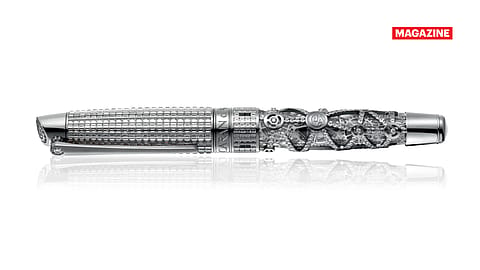
A HOMAGE to fine Swiss watchmaking, the writing instrument is named after the 10:10 watch hand position. The pen boasts an 18-carat solid white gold body encrusted with more than 850 diamonds in brilliant, emerald, and baguette cuts. The body comprises two cages. The bridges of the exterior cage are inspired by the gear train of a watch and are set with 150 emerald-cut diamonds. The interior cage, entirely in white gold, evokes the wheels of time. The cap, inspired by the teeth of a watch gear, is crowned with the Caran d’Ache monogram with 26 lines of baguette-cut diamonds; the clip is in the form of a watch’s hand. The exquisite fountain pen, worth $1 million, writes with an 18-carat gold nib.
Fulgor Nocturnus by Tibaldi: Of divine proportions and unmatched rarity
THE MOST expensive writing instrument, however, is the handcrafted fountain pen by the Italian brand Tibaldi. A one-of-a-kind, it is adorned with 945 black diamonds, 123 rubies, and an 18-carat gold nib. The pen lives up to its Latin name, which translates to “dazzling brilliance occurring at night”. But why the divine comparison? It’s one of those rare pens whose design has achieved the divine mathematical Phi ratio, or "the golden ratio of beauty". The cap and barrel, when closed, are equal to the Phi ratio of 1.618. Commissioned in 2020, it was sold for $8 million at a charity auction in Shanghai in 2020. The pen is as elusive as its divinity.
A celestial marvel
A CULMINATION of history, science, and impeccable craftsmanship distilled into a $1.5 million writing instrument. A tribute to Johannes Kepler, 5,294 sapphires and 570 diamonds form the night sky on the writing instrument. The cap’s sapphires emulate the Milky Way, while three white-gold rings representing Kepler’s three laws of planetary motion surround a 6.2-carat D-flawless diamond crown. The Ophiuchus constellation from Kepler's book De Stella Nova engraves the nib, and the orbit of Mars from Astronomia Nova features on the bottom of the cone. The deep blue sapphires coat the length of the pen with white gold fittings. A single diamond is set on both the precious AU750 nib and the compass.
Pinnacle of fine writing
A SOLID platinum barrel with a two-tone rhodium treatment and a gold nib finished with iridium — this masterpiece echoes the sophistication and modernity of Turin, the place it was crafted in. The writing instrument is adorned with 1,919 De Beers cabochon diamonds, weighing over 30 carats, an allusion to Aurora’s founding year, 1919. Each Diamante, with a hidden ink reservoir, takes up to two years to create. The cap is also platinum with a two-tone rhodium treatment. Online portal pens.com claims one can personalise the pen with a portrait, signature, or business logo. Typically, one pen is made per year at $1.47 million.
Opulence in your pocket
AN 18-CARAT white gold body encrusted with over 1,430 diamonds in flowing, wave-like patterns make this writing instrument a veritable Bohemian Rhapsody. Available in two styles — white diamonds or white diamonds alternating with black ones — it comes with a cartridge refill system and a retractable nib. Three white gold rings and 19 diamonds form the Montblanc logo, while the clip is set with a paramount-cut diamond (also available in black). The symbol of opulence is priced at an estimated $1.5 million.
The royalty among pens
AN EXUBERANT example of Montblanc's 'high artistry'. Priced over $2 million apiece, the collection emulates the grandeur of the Taj Mahal — the epitome of Mughal architecture. The 'Black Myth' draws inspiration from the legend that Shah Jahan planned to build himself a mirror image of the Taj Mahal, but in black, on the opposite bank of Yamuna from his wife's resting place. White gold, encrusted with black sapphires and brilliant-cut diamonds, adorns the body of the black and white writing instrument with a 24-karat, FL round brilliant cut diamond as the centre stone. The body, resembling a peacock feather, has a round opal cabochon at its centre that can be detached to reveal a lotus flower in mother-of-pearl marquetry beneath. The writing instrument also shares an uncanny resemblance to a dagger.