BMW is catching up with Mercedes-Benz in the race for the top spot in the luxury space
/ 10 min read
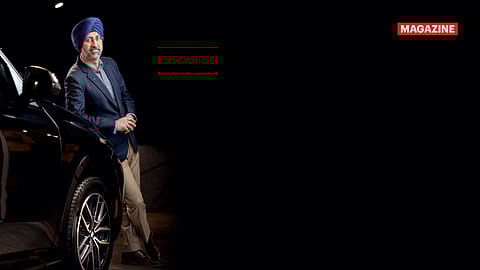
Hardeep Singh Brar, CEO & president, BMW Group India | Credits: Narendra Bisht
BMW is catching up with Mercedes-Benz in the race for the top spot in the luxury space
BMW is rapidly closing the gap with long-time leader Mercedes-Benz in India’s luxury car market, driven by aggressive electrification, a strong push into entry-level luxury, and long-wheelbase SUVs like the iX1. While Mercedes focuses on high-margin core and top-end models, BMW is building a younger customer base and expanding fast through dealers, new launches, and competitive EV pricing.
This summary is AI-generated, and Fortune India is not responsible for its content or any associated copyright issues.
BMW India is taking the fight to leader Mercedes-Benz in the luxury segment in India. How will the battle play out between the two German auto majors?
Hardeep Singh Brar, CEO & president, BMW Group India | Credits: Narendra Bisht
This story belongs to the Fortune India Magazine april-2026-the-emerging-100 issue.
THE DIFFERENCE is stark — truly chalk and cheese.
On the one hand, there is the undisputed market leader, pushing forward with a strategy to distance itself from entry-level luxury and instead turn all its attention to the core and super premium luxury car buyer. Mercedes-Benz, which has long reigned as India’s largest luxury carmaker, has made it abundantly clear that it’s not ready to battle out a price war underway in India’s entry-level luxury car segment and wants to sell more cars in its core segment.
Then, along comes a resurgent challenger, an opponent who had for a few years faded into the distance, to take a renewed shot at the top spot, with a strategy that in some ways has caught the market leader by surprise. BMW, Mercedes-Benz’s German rival in the country’s luxury car segment, closed last year just 1,000 vehicles adrift — its closest numbers in a decade — on the back of a new strategy. This year could redefine the pecking order if everything goes well for BMW.
“Last year was phenomenally good for us,” Hardeep Singh Brar, CEO and president of BMW Group India, tells Fortune India. “We did about 18,000 units, up from 15,000-plus units in 2024, a growth of close to 15%.” In sharp contrast, Mercedes posted negative growth last year, even though it retains the top spot in India’s luxury car market. In 2025, Mercedes sold 19,007 vehicles, a nearly 3% decline in its sales even as it achieved its highest-ever revenue.
“Of course, there are multiple factors,” Brar explains. “We launched multiple products last year. One of the biggest ones was the electric version of X1, the iX1, which has really helped us attract a lot of consumers from the near premium into the luxury space. It also helped us in growing the segment. We also made changes and brought in the X3, X5, and X7 as well.”
But it is certainly BMW’s decision to go on the offensive with electrification that has turned the tide for the automaker. In early 2025, BMW launched a long-wheelbase version of the iX1. The electric equivalent of the company’s popular SUV was launched at around ₹50 lakh. Now, this vehicle contributes over 85% of BMW’s electric vehicle sales in the country. BMW is India’s largest luxury EV maker, with sales of nearly 3,800 units a year. BMW Group India comprises BMW (including Motorrad, the German automaker’s motorcycles division), and British automobile brand Mini.
“With BMW, the demographics are clearly playing to their advantage,” says Puneet Gupta, director at automotive intelligence firm S&P Global Mobility. Between Mercedes and BMW, the latter has been associated with younger, aspirational customers. That is also shown in the success of the electric vehicles, with those willing to experiment and adopt technology, turning to BMW. “BMW has also become aggressive in its strategy, and that’s reflected in the segments that it is targeting.”
More Stories from this Issue
“The iX1 has been an important catalyst. It brought EVs into a more accessible luxury price band and helped BMW tap into a new customer cohort,” says Harshvardhan Sharma, group head, automotive tech & innovation group at financial services group Nomura. “But the comeback is more structural. BMW has aligned well with key demand trends in India: SUVs, long-wheelbase formats, younger buyers, and early EV adoption. At the same time, Mercedes has also been evolving its portfolio, especially at the top end and in EVs. So, it’s not a case of one gaining at the expense of the other, but rather both sharpening their respective strengths.”
Growth, fall, and rise
BMW arrived in India in 2007, more than a decade after Mercedes. The Munich-headquartered automaker set up a manufacturing plant in Chennai to make the 3 and 5 Series sedans, to begin with. Growth was swift — within two years, BMW passed Mercedes as India’s top luxury carmaker, selling just over 3,600 cars in 2009 and capturing 40% market share. The 5 Series led sales, with over 1,500 units.
For the next three years, BMW consolidated its position, remaining India’s largest luxury carmaker, until it was dethroned by Audi, the German luxury carmaker owned by the Volkswagen Group. In 2013, Audi sold over 10,000 vehicles, making it the largest luxury carmaker on the back of new launches, facelifts, and an aggressive pricing strategy. By 2016, the tables had turned, with Mercedes once again emerging as a clear winner in the country’s luxury segment, a position it hasn’t lost in a decade since.
That’s why BMW’s new-found aggression and a distinct focus on entry-level luxury seem to have taken the market and even its leader by surprise. In the luxury market, the entry segment accounts for around 30%, while the core category accounts for 50%. The top end is around 20%. For Mercedes, that mix is quite different: 25% of its sales in 2025 came from the top end, while the core luxury segment accounted for more than 60%. At the entry level, Mercedes sells only about 13%. In contrast, for BMW, the top end in 2025 was about 15%, while the entry segment accounted for between 25% and 30%.
{{#most-powerful-women-snapshot-individual.slug}} {{/most-powerful-women-snapshot-individual.slug}} {{^most-powerful-women-snapshot-individual.slug}} {{/most-powerful-women-snapshot-individual.slug}} {{#showRanking}} {{current-rank}} {{/showRanking}} {{#photo.0.url}}
{{name}}
Currently pegged at $1.5 billion, India’s luxury car market is expected to grow to $1.92 billion by 2031, notes market research firm Mordor Intelligence. Rising household wealth is a key factor driving demand for luxury goods. As of 2025, India had nearly 870,000 millionaire households (with a net worth of around ₹8.7 crore), according to the Mercedes-Benz Hurun India Wealth Report 2025 — almost double the number in 2021.
However, only about 50,000 luxury vehicles are sold in the country, of the total 4.5 million cars sold annually. “You can’t have people at the top growing,” Brar reckons. “Once they (the buyers) enter, they slowly and gradually upgrade to the bigger cars. And for that, you need your entry-level to be very strong, so people know what luxury is about. The expansion will always happen at the bottom.”
According to Vinay Piparsania, founder & principal, MillenStrat Advisory & Research, and former executive director at Ford India, brand relevance is critical in the luxury segment. “Mercedes’s strategy of maximising value per car is working well from a profitability standpoint. But BMW, by targeting younger, first-time luxury buyers, is effectively building a pipeline for future upgrades within the brand — even if it starts at the entry level. In that sense, Mercedes risks ceding the next generation of customers.”
In the process, BMW has also emerged as the largest luxury electric carmaker in the country. The EV penetration to total sales stood at 21%, up from 8% last year, with the iX1 as the highest-selling EV in the premium EV segment in India. While the iX1 retails at around ₹50 lakh, the cheapest electric car from Mercedes retails at ₹72 lakh.
“I think electrification is a big story for us,” Brar explains. “In the i7 (the electric variant of the 7 series) and iX1, the penetration of electric vehicles was 50% each. While we don’t have electric in other models, which is why the overall is 20%, wherever we are present, the penetration is 50%, which is unheard of for any other brand with an equivalent ICE (internal combustion engines) and electric.”
Electric vs ICE
Brar says that one reason for the high penetration of BMW’s electric variants is the fact that the company’s pricing for the electric variants and the ICE-based model is almost the same. “So, you don’t have to say that I’m paying 15% or 20% delta, and that has really worked for us,” says Brar.
Automakers in India have often struggled to achieve parity between the electric and ICE variants of their models. For instance, at the lower end of the market, the petrol variant of the Tata Punch retails from ₹5.6 lakh (ex-showroom), while the electric variant retails from ₹9.69 lakh. That’s almost double the price. Similarly, the electric variant of the popular SUV, Hyundai Creta, starts at ₹18.02 lakh, while the petrol variant retails from ₹13.88 lakh, a difference of almost ₹5 lakh.
It’s into this mix that the iX1 retails at the same price as the X1. “We are getting the car from China, and we are assembling it here,” Brar says. “So, the Chinese economy of scale is really, really helping us to get the price points that we want.”
It also helped that BMW began focussing on long-wheelbase models, emulating Mercedes. Nearly 10 years ago, Mercedes’s long-wheelbase E-Class transformed its India trajectory, appealing to those who want to be chauffeured on weekdays and drive over weekends. Launched in 2017 after 48 months of development, India was the first market for Mercedes’s long wheelbase E-Class.
“A few years back, we shifted to a long wheelbase strategy,” Brar adds. “So, the iX1 is a long wheelbase, whereas the X1 is still a short wheelbase. We have the 3 Series, the 5 Series, the 7 Series, and all these products are long wheelbase. I think that is another unique thing to BMW that you will not get in many other brands, which is really working for us.”
Today, a significant set of its buyers are environmentally conscious corporate employees, with women customers accounting for about 12-13%. “50% of these buyers are actually first-time buyers into the luxury or premium category,” Brar adds.
That means, with its ₹50 lakh entry-level proposition, BMW has also been convincing customers willing to spend around ₹30 lakh to consider an upgrade. To do that, the company is also banking on its financial services products, which would ensure residual value at the end of the term, effectively allowing the customer to pay only the EMI for a smaller sum. “So, the combination of unique products and financial services is helping us get a lot more consumers,” Brar explains.
Playing differently
Today, unlike its chief competitor Mercedes, BMW does not follow a direct-to-consumer model; instead, it relies on the dealership model for sales and service.
For nearly five years now, Mercedes has pursued a direct-to-consumer sales model, allowing customers to buy its luxury vehicles directly from the brand rather than through a dealer partner. Mercedes believes that the model removes deep discounting and gives control over residual value. This is in stark contrast to the existing system, where car manufacturers first sell their products to the dealers, which in turn retail the cars to the end consumers.
“Our philosophy is that your go-to-market is much quicker when your dealer has all the resources with them,” Brar says. “In a direct-to-customer model, you must make everything centrally available. When the control is with the dealers, they know what exactly is happening on a daily basis, and they can tweak what is required in the local market, which I think is a much quicker go-to-market.”
Brar also reckons that BMW’s ability to enter the market faster, using the dealership model, has been critical in closing the gap with Mercedes from about 5,000 a few years ago to 1,000 now. “They also didn’t have the products in the past,” Piparsania adds. “Today, they have their feet on the ground and have emerged as a fast mover.”
“BMW’s approach should support faster customer acquisition and volume growth, particularly as India’s luxury market broadens below the ₹1-crore mark,” adds Sharma of Nomura. “Mercedes’s strategy is clearly focussed on preserving brand exclusivity, pricing power, and profitability, which is equally critical in a luxury context. Over time, the outcome will depend on how the Indian luxury market evolves. If it widens significantly, BMW’s approach will scale well; if it premiumises faster, Mercedes will continue to lead on value.”
That also means BMW will continue its product offensive, with six new models launched this year alongside changes to four models. “The product offensive that we started last year will move into 2026 as well,” adds Brar. In addition, about 17 tweaks will be made to the models. Alongside, BMW is also busy expanding its network and is expected to add another 10 cities soon. The company is now present in 40 cities, with more than 55 sales showrooms.
To lead the offensive, BMW will also rely heavily on Brar, an automotive veteran, who had until last year served as the senior vice president of sales and marketing at Kia India. Brar started his career at Maruti Suzuki before working with a host of carmakers, including Volkswagen, General Motors, Nissan Motor, and Great Wall Motor Co.
What lies ahead
Today, with BMW closing the gap to Mercedes by about 1,000 units, Mercedes is likely to feel the pressure, even though the company may be chasing different targets. “I think nobody minds being at the top of the table, but we are not blindly following the numbers,” Brar says. “We want the growth to be profitable. The customer experience, and the brand value are very, very important.”
The company has been working closely with BMW’s financial services arm — which accounts for 25% of sales — to ensure that the vehicles retain their residual value, making them attractive to luxury buyers.
India’s luxury car market continues to show strong underlying demand, but it is still structurally underpenetrated at around 1% of total PV sales. With a strong shift towards SUVs and luxury EVs, and an increasing demand for technology and personalisation, luxury automakers also have a significant opportunity in the country. The constraints, however, remain high import duties, pricing barriers, infrastructure gaps for EVs, and a relatively narrow customer base beyond metros.
“BMW has done a strong job in expanding the addressable luxury market, especially through a wider portfolio and sharper play in entry luxury and EVs,” says Sharma of Nomura. “Mercedes, on the other hand, continues to define the benchmark in luxury, brand salience, and revenue quality.”
Now, amid a war in the Middle East and a global economic downturn, the luxury segment will likely take a heavy beating. But Brar and BMW remain cautiously optimistic. “We were honestly very bullish, but given the overall situation of geopolitics and macroeconomics, we are now being cautiously optimistic,” Brar says. “We must see how the next couple of months go. I hope the global situation improves because it plays on consumer sentiments.”
And does competition worry him? “Whatever challenges are there, for example, the macroeconomic challenges, the geopolitical challenges, it is the same for all of us in the luxury segment. So those challenges will be common. I think the difference will come from our strategies, the number of new launches, and the network expansion.” Brar says. “I think this is where the final magic lies.”
Brar clearly has his eyes set on the top spot in India’s luxury car segment. The race between Mercedes-Benz and BMW is truly on.
Follow Fortune India
Sign in to read full story
To access our exclusive magazine content, sign in to your Fortune India account.
Sign In NowNEXT STORY