How Andhra Pradesh plans to make the quantum leap
/ 2 min read
With Amaravati Quantum Valley, Andhra Pradesh eyes becoming a global hub for quantum computing, research, and manufacturing.
This story belongs to the Fortune India Magazine may-2026-biocon-next issue.
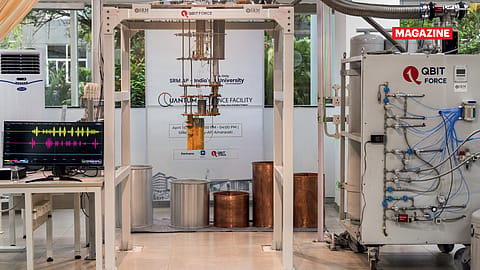
EVEN BEFORE Amaravati rises into being, it has showcased a feat worthy of the sobriquet ‘India’s quantum capital’. On April 14, Andhra Pradesh chief minister N. Chandrababu Naidu launched the Amaravati Quantum Reference Facility in the under-construction capital. He unveiled Amaravati 1S and Amaravati 1Q, India’s first indigenously built, open-access quantum computing test beds at SRM University, Amaravati, and Medha Towers in Gannavaram, respectively, both part of the Amaravati Quantum Valley initiative.
“Amaravati 1S and 1Q are not merely computers. They are fully instrumental quantum hardware test beds. They will enable validation, benchmarking, and certification under real operating conditions. They give India a platform not only to study quantum technology but to build it, test it, and trust it,” Naidu said.
With this, India makes three breakthroughs. First, the dedicated quantum test and certification ecosystem proves to be a shot in the arm for India’s deeptech startups. The facility will be useful for testing quantum hardware (cables, amplifiers, controllers, etc.) under real-world cryogenic conditions (-273°C). The open-access facilities will benefit researchers, students, startups, and companies alike. The mini quantum systems are designed to rigorously test quantum devices.
L. Venkata Subramaniam, CEO, QBIT Force, the company that set up the quantum system, tells Fortune India that until now Indian firms had to wait for two-three months as they had to do the testing abroad. The new facility reduces this to mere seconds. “This accelerates the development process,” he says, adding, it equips India to become a hardware nation. “The test bed is the first requirement. That process is now complete.”
The second breakthrough is the use of indigenous technology. Both facilities have been built entirely using locally developed components, reinforcing India’s push towards self-reliance. While the Tata Institute of Fundamental Research provided a processor and amplifiers, the next generation of wiring came from IIT Bombay, says Subramaniam. “IISc Bengaluru provided us with another processor. Sidwal (an Amber Group subsidiary) helped us make the dilution refrigerator. We always imported these things [until now]. Electronics from a university accelerator, precision power supplies, precision voltage, and current sources were done domestically.” The Defence Research and Development Organisation also extended its technical support.
The third breakthrough came in Andhra Pradesh’s intent to set up a quantum ecosystem in collaboration with the National Quantum Mission, under which a 50-acre quantum valley is coming up at Amaravati. Sridhar C.V., mission director, AP State Quantum Mission, Amaravati Quantum Valley, says the mission is to create a complete ecosystem for testing quantum and superconducting technologies.
Subramaniam says it was Naidu who urged the industry to make India’s own quantum computers. “An open call was given to the developers to come to Amaravati and make it happen. This was just six months ago. We took this call seriously,” he says.
More Stories from this Issue
With test beds in place and a focus on developing advanced quantum algorithms, hardware (including diamond-based systems), and AI integration, the state is poised for a quantum leap.
Follow Fortune India
Sign in to read full story
To access our exclusive magazine content, sign in to your Fortune India account.
Sign In NowNEXT STORY