How Cisco has geared up its businesses for the AI boom
/ 4 min read
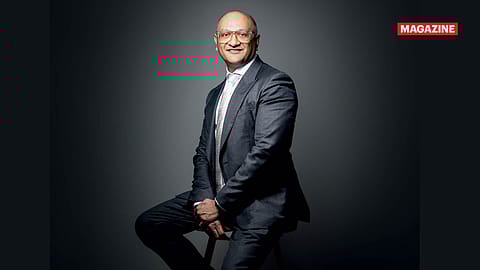
Jeetu Patel, president and chief product officer, Cisco | Credits: Narendra Bisht
How Cisco has geared up its businesses for the AI boom
Cisco has transformed from a router-centric firm into a software and AI infrastructure powerhouse, hitting 56% recurring revenue by FY25 and targeting multiple products fully coded by AI by 2026. Led by Jeetu Patel, it is building tightly integrated networking, silicon, security and observability, positioning itself as the critical infrastructure provider for the global AI era.
This summary is AI-generated, and Fortune India is not responsible for its content or any associated copyright issues.
As president and Chief Product Officer, Jeetu Patel leads multibillion-dollar categories, including networking, computing, security, and Splunk. he is now navigating the unknowns and preparing enterprises for the agentic era.
Jeetu Patel, president and chief product officer, Cisco | Credits: Narendra Bisht
This story belongs to the Fortune India Magazine april-2026-the-emerging-100 issue.
WHEN THE WORLD began to recover from the 2007-09 subprime lending crisis, John Chambers, then the chairman and CEO of Cisco, laid out his One Cisco strategy to shareholders in their 2010 annual report: balancing investment in the flagship business of routers that ruled the Internet with the seeding and investment requirements of next-generation growth opportunities.
Since 2015, when Chuck Robbins took over from Chambers and steered Cisco to dominate the software world as well, there have been leadership changes, business unit rejigs, and a string of acquisitions, including its largest ever, the $28-billion Splunk buyout.
In 2016, Cisco set a target to get over half of its revenue from software and services. It did not have a date in mind, but hit the target in 2024. For FY25, this recurring revenue stream accounted for 56% of its overall revenue.
Leading the charge in artificial intelligence is Jeetu Patel, president and chief product officer, who joined Cisco in 2020 to head its newly formed security and applications business group. He is steering several categories such as networking, computing, security, and Splunk.
Earlier this year, Cisco said it had built its first product entirely coded by AI. “I think our guess is that, by the end of 2026, we would like to have about half a dozen products within the Cisco portfolio that are 100% written with AI. And by the end of next year, I’m hoping, I don’t know… 50%, 60% or 70% of our products should be written with AI,” Patel tells Fortune India.
Explaining the breakthrough, Patel says in 2025, companies were in an extreme mode of experimentation with AI agents, but enterprise adoption and application lagged. However, in 2026, AI made meaningful advances, especially in coding, clearing a significant bottleneck.
“It doesn’t mean that engineers lose their jobs. We are going to need smart engineers who understand how technology works all day long because we’ve got way more ideas than we have resources to prosecute them,” Patel says.
More Stories from this Issue
Some of those ideas change the process of code writing, “We might actually find some unlocks that we have never even dreamed possible”.
As AI infrastructure build-out gains steam globally, with data centre and related investments expected to reach $1.7 trillion in 2026, Cisco is betting big on this segment. In 2024, the company’s venture arm announced a $1-billion AI investment fund, including strategic investments in Cohere, Mistral AI, and Scale AI.
For this year (FY26), the company expects AI orders exceeding $5 billion, over $3 billion in AI infrastructure revenue from hyperscalers alone, and a pipeline of more than $2.5 billion across neocloud, sovereign, and enterprise customers.
This bullishness follows several partnerships Cisco recently struck. It has partnered with chipmakers such as NVIDIA and with the BlackRock-led AI Infrastructure Partnership (AIP), a group that has Global Infrastructure Partners, MGX, Microsoft, NVIDIA, and xAI. Cisco also signed a memorandum of understanding (MoU) with G42, the U.A.E.-based global technology group, to collaborate on AI innovation and infrastructure development across the public and private sectors in the country.
{{#most-powerful-women-snapshot-individual.slug}} {{/most-powerful-women-snapshot-individual.slug}} {{^most-powerful-women-snapshot-individual.slug}} {{/most-powerful-women-snapshot-individual.slug}} {{#showRanking}} {{current-rank}} {{/showRanking}} {{#photo.0.url}}
{{name}}
In partnerships with global players where overlaps are inevitable, Patel says, companies have to learn to collaborate. “We are now in an era where you are going to have interoperable ecosystems. I don’t think any company is going to be smart enough to go out and build everything that the world needs.”
AI is no longer a zero-sum game, Patel says. “I think you have to make sure that you make it additive. And I feel that’s a very exciting time to be in because, for me to win, someone doesn’t have to lose. We actually can go at it together, and both of us can succeed,” he says.
At a time when major constraints to unlocking AI at scale include not just a trust deficit and a context gap, but also the infrastructure needed to achieve smarter agents and better AI, Cisco sees itself as a company solving these constraints.
“We want to be the critical infrastructure company for the AI era. Provide the underlying plumbing needed to solve with AI — every application, every problem (solving) is not constrained by the [AI] infrastructure to solve it, and is not constrained by the trust that’s needed, and is not constrained by the context that needs to be given to the agents,” Patel says.
How has Cisco positioned its portfolio to leverage AI? It sees a full-stack opportunity ranging from providing high-performance, low-latency, power-efficient networking both within the data centre, connecting GPUs, to silicon buildout, network ASICs (application-specific integrated circuits), the systems, hardware, and operating systems.
“That entire stack is something that we build, and we build it to integrate it really tightly. You will always see better, faster, cheaper, more efficient, energy-efficient capabilities that are coming out from us,” Patel says.
For Cisco, as one of the top networking companies, another opportunity lies in security, where its offerings aim to secure AI and use AI as a mechanism for providing machine-scale defence.
“If you think about Splunk, which was a very strategic acquisition we did, 55% of the data that’s growing in the world right now is machine data, and that’s only going to get higher as more agents come online,” he says.
As for the electricity demand coming from AI data centres, Patel says the figures are underestimates.
“If at all, we are underestimating the amount of capacity that AI is going to need, not overestimating it over the long term,” Patel says. While the short term may see some spikes, demand would outstrip supply in the long term.
As the monetisation from all the AI build out trickles down to enterprises paying for it, and where metrics such as GPU performance, application and AI agent performance (tokens per dollar per watt), become important, says Patel, “We will provide that full visibility to an organisation. So, if we can do that, there’s a tremendous amount of upside in building out what we call this critical infrastructure for AI.”
Follow Fortune India
NEXT STORY