If India wants to genuinely be China plus one, it has to demonstrate end-to-end cost advantage: Flex CEO Revathi Advaithi
/ 10 min read
Electronics manufacturing services is now more of an integrated product play. The mantra is to differentiate, innovate, and intersect where customer interests lie, says the Flex CEO.
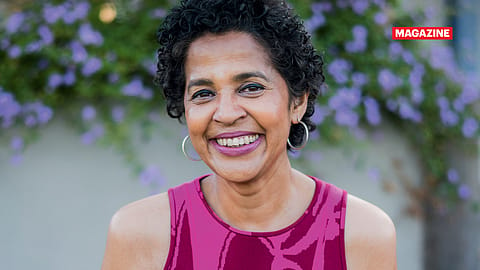
Revathi Advaithi, CEO of Flex:
“The assessment is the same in every sector… it always starts with the same question: does your portfolio have value? And the only way it has value is if customers think it does.”
This story belongs to the Fortune India Magazine may-2026-biocon-next issue.
YOU ARE among the very few women in the manufacturing sector, which brings down overall representation to very low single digits. Could you walk us through how your journey began?
I was born in Gujarat. My dad worked for Indian Oil Corp., which involved moving around and building oil refineries. I spent my early years in Bihar and in Assam, and then, like most Tamilians, we ended up in Chennai after my dad passed away. I did my 10th, 11th, and 12th in Chennai, and then came the crucial choices. In my family, no one followed the engineer-or-doctor narrative. My sisters were into anthropology and political science. I finally decided somebody needed a real job to pay the bills, so I went to [BITS] Pilani and did mechanical engineering, for no reason other than I thought it would be hands-on and fun. There was no internet in those days to think through these options carefully.
After that, I worked for a couple of years in Chennai, then went to the U.S. in the early 1990s... My sister was in Oklahoma, and so were some of my friends, so I pursued my master’s but soon enough realised that it wasn’t of much value and decided to find a job. I was surprised when I landed one at an industrial company in Shawnee, Oklahoma. You go to the U.S. expecting Manhattan and when you end up in small-town America, the learning is very different. All my moves across India helped with that, because India is also a dichotomy: every state is a different world. Learning [about] the U.S. through small-town America, figuring out how to get accepted, understanding the norms was a great experience. My first job was as a shop floor supervisor, managing about 50 men running heavy machinery. I had to earn their respect to accept me as their boss.
How long did it take to break the ice on the shop floor?
I was in the job for only a couple of years, so it happened relatively quickly. I’m a huge believer in genuinely enjoying people, understanding the psychology of what makes them who they are. If I get to know you, your family, your kids, what you’re interested in, we develop a real relationship. Then they accept you. They invite you home to the barbecue. You become [a] part of their world.
I didn’t do it to fit in. I did it because I enjoyed it. It was my way of understanding who these people were and what shaped their lives. Their kids’ sports teams were the most important thing in the world, which was completely new to me. Everything around hunting, fishing, Saturday and Sunday routines. It was all new. I enjoyed listening and learning, and as they got to know me, they accepted me. You have to rinse and repeat with every new city and every new culture you enter. I’m a little thick-skinned, so the differences didn’t get into my head. You’re also just too busy getting through to the next day to pay much attention to them.
How did the transition from shop floor to executive role happen?
More Stories from this Issue
Though I started out as a shop floor supervisor, I realised that decisions were being made by product managers. So, I convinced people to promote me into a product manager role. That was the stepping stone to becoming a general manager and owning a P&L. I didn’t know anything about P&L or balance sheet. I had to read up books and learn. But it was a great experience in understanding what it means to run your own business: what’s cost, what’s price, what’s innovation, what’s revenue and growth. That led to more general management positions.
My first stint at Eaton was in the hydraulics business, that made equipment for heavy machinery names such as Caterpillar. From there I moved to Honeywell and into aerospace, which was a completely different ball game. I had to learn about certifications, qualifications, and what innovation looks like in that industry. I did operations and P&L roles there. Then within Honeywell I moved into oil and gas. Every move put me in a new end market, a new business, starting from scratch. That helped me become versatile and able to learn fast.
I then moved back to Eaton, to their electrical business, which I knew nothing about. I did that for the longest time, took on many different roles and, eventually, ended up running their electrical business globally. It was one of the most exciting and demanding jobs I’ve had. I started running Asia Pacific, then North America, then eventually ran it globally.(1)
And then the CEO opportunities began coming your way?
{{#most-powerful-women-snapshot-individual.slug}} {{/most-powerful-women-snapshot-individual.slug}} {{^most-powerful-women-snapshot-individual.slug}} {{/most-powerful-women-snapshot-individual.slug}} {{#showRanking}} {{current-rank}} {{/showRanking}} {{#photo.0.url}}
{{name}}
Yes. At the end of that run I started thinking, what next? I was already No. 2, and CEO opportunities were coming, all from industrial companies given my background. But I was a little bored. Technology innovation cycles in industrial companies are slow: it can take five to 10 years for a meaningful cycle to play out. That’s when the Flextronics opportunity came along. I hadn’t worked in contract manufacturing; I’d only dealt with them as a supplier. I had to study the space quickly and decide whether it made sense.
When you took charge at Flex, the stock was trading at $7...
Yes. And I thought it shouldn’t be hard to double the stock price! I asked my husband, ‘Should I be joining an industrial company, or this, which is another end market I know nothing about?’ He replied, ‘Go do it. If it doesn’t work out, leave and do something else.’ So, I came in with a clear thesis. I had studied the end-market and felt it was ripe for change. Between that and some fiscal discipline, doubling shareholder value seemed achievable. That was the simple logic. I also knew that the average tenure of a woman CEO in a public company was two and a half years. I didn’t want to bring that average down. So, the other goal was simply to make sure I got past two and a half years, so the average could move up. Those were the two things in my head when I joined seven years ago. Today, the stock is trading at $61.(2)
We moved out of a lot of end markets: mainly consumer-driven ones where there wasn’t real money to be made. That’s why, if you look at our revenue from 2019 to now, it’s flat on the surface, because we’ve taken out a lot of low-value businesses and added new ones. Those portfolio shifts also drove the margin from 3% to 6.5%.(3) So, mix shift is a huge part of the story. We also invested in data centres well before data centres became popular, which turned out to be the right call. Disciplined productivity was another big part of it, and the geopolitical tailwind around nearshoring helped the narrative.(4) Not to mention building the right culture and talent pool, and the results followed: over 600% in shareholder value creation, plus the Nextracker (now Nextpower) spin-out, which is now valued at $17.53 billion.
Your whole journey was with industrial firms. Then you moved into contract manufacturing. How did you identify what was low-value and what had margin potential?
The assessment is the same in every sector. Whether I am in aerospace, oil and gas, electrical, it always starts with the same question: does your portfolio have value? And the only way it has value is if customers think it does. Customers only think it has value if the technology is right and the price is right.
So, you look across the businesses and ask: why is the customer buying from you? Are you differentiated? Why are they paying you? That’s why we exited the consumer end markets as the value-add wasn’t there. They were paying us cost-plus. That doesn’t make sense. At Eaton’s electrical business, which was around $15 billion, I exited the lighting business. Great business at the time, but with LEDs, you could see commoditisation coming. Customers would stop valuing that portfolio. Same evaluation, same standard thinking: why is this good, what is the customer paying for, and how do I solve for technology or service?
One of the early moves at Flex was identifying our data centre integration business. We took servers, storage, and integrated them, and tucked inside that was a small business that actually designed the power that powered the chips. Coming from a power background, I was intrigued. It owned the IP; it owned the design. It was a small business, maybe $20 million, but you could see that compute was going to get power-hungry. If we were designing power, we’d better be very good at it because the demand was going to accelerate. So, we started investing heavily in the power business and working with all the chip manufacturers. We ended up building out a power portfolio by simply identifying that technology was going to scale and getting ahead of it.(5)
That’s an interesting parallel. In the AI gold rush, the ones making money are those selling shovels such as NVIDIA with GPUs. But the narrative and the multiples that NVIDIA got didn’t necessarily reflect down to someone such as Flex in the value chain?
I would disagree with that framing. Anyone participating in AI infrastructure, on the hardware side, has seen their multiples shift. NVIDIA has its premium, yes, but everyone across that value chain, including utilities, have seen their multiples move. The rising tide has lifted all boats. It’ll never be proportional: there’s always someone leading the pack. But to say the benefit hasn’t reached the rest of the chain isn’t accurate.
A good example is utilities. I spent much of my career in the energy business trying to convince utilities to upgrade their transmission lines. Nobody cared. Now enormous amounts of money are being spent, and utility stocks are moving. There will always be differentiation in how much value each player captures, but the larger shift from software multiples to hardware and AI infrastructure multiples has benefitted everyone involved.
EMS has always been about handling complexity at scale. Today, it’s about geopolitical risk on a scale. How do you see this redefining the business? And on the competitive side, how do you read Foxconn and the Chinese EMS players?
I don’t see Foxconn as a typical competitor for us. The dynamic between Asian and Western contract manufacturers has changed substantially. People are no longer choosing manufacturing partners purely on labour arbitrage. Resiliency has become more important than lowest cost. Even within our own business, the shift from Asia to North America has been significant during my tenure, driven by geopolitics and by our deliberate decision to support western manufacturing. Our PP&E (property, plant, and equipment) investment has shifted meaningfully towards Europe and North America.
As a CEO, we constantly look at the next five to seven years and ask: what is the world going to look like? There’s a desire to build manufacturing close to the consumer. But is it feasible? Do you have the right supply chain, the labour, the population density to support it? The decisions we make today play out two, three, four years from now. Some bets will be right, some won’t.
When consumer company CEOs call me and say they want to build in the U.S. or Mexico, I often ask: are you willing to pass the cost on to your customers? If you’re not willing to look at the full value chain and understand who ultimately pays the premium, then I can’t help you make that work. In healthcare, the calculus is very different. The risk of not building resilient supply chains is so significant that customers are willing to pay the premium.
How are you navigating the current business environment, where both structural and cyclical factors are at play?
When I look at the last 25 to 30 years, once you eliminate the noise, the fundamentals of how you run a company haven’t structurally changed. Twenty or 30 years ago, it was all about labour arbitrage. Today it’s about resiliency, tariffs, and geopolitics. But put all that noise aside and ask: what does the customer need from your organisation, and what are you delivering? That question has never changed.
I try hard not to get caught up in the noise. Every day brings something new: a war, a tariff moving by x%, a new administration. You can get consumed by it. You have to step back and have three-year plan conversations that look through all of that, and come up with a tangible path forward for the company.
At the same time, the need for curiosity and agility has never been greater. I have to deeply understand what’s happening with AI. Not just as a supplier of infrastructure, but how it changes the future of my factories and how I operate. That means talking to young people in Silicon Valley, understanding what’s genuinely different, bringing that back to my team, and challenging them. So, clarity of thought through the noise, curiosity kept alive, continuous learning, quick decisions, and then you rinse and repeat.
How much has Flex invested in India, and are you planning to grow the manufacturing footprint here?
We’ve been operating in India since 2001, and we have a mix of manufacturing as well as a global capability centre. Over the years we’ve exited a lot of consumer end markets in India and grown the non-consumer ones. Cisco is our largest client in India right now, and most of our current growth and capacity expansion is being driven by them as they shift their global footprint significantly. Beyond Cisco, it will be similar for other customers that are shifting their manufacturing footprint into India, with some domestic need but largely for export. Globally, Flex’s large customers are probably fewer than 80 in total, so in any country, a handful of customers drive most of the growth.
What gives India its edge as a manufacturing destination for Flex? Is it cost, labour, or something else?
If India wants to genuinely be China plus one, it has to demonstrate end-to-end cost advantage, not just what’s made here, but the entire supply chain. You can’t just be bringing components in and assembling them in India. What I’ve been personally pleased by is that wherever we’ve moved production into India, including highly complex products, the results have been good. Skills are there, both on the factory floor and in engineering capability. The work culture is strong as well.
My big push for India has been that the local supply chain needs to be built end-to-end: plastics, components, everything. When we move a customer in, we may start with final assembly, but we’ll progressively build out the full domestic supply chain. The products we’re building in our India facilities are highly tech-intensive — one mistake is a significant cost. We are now sending engineers from other global centres to train here, which is a reversal from 10 years ago when it was the other way around. That tells you something meaningful about how India’s capability has grown.
Follow Fortune India
Sign in to read full story
To access our exclusive magazine content, sign in to your Fortune India account.
Sign In NowNEXT STORY