India needs to plug the skilling gap and build institutions of excellence on its path to Viksit Bharat. Here’s why
/ 4 min read
The country needs to solve its skilling problem and focus on research if it wants to become a developed nation, say experts.
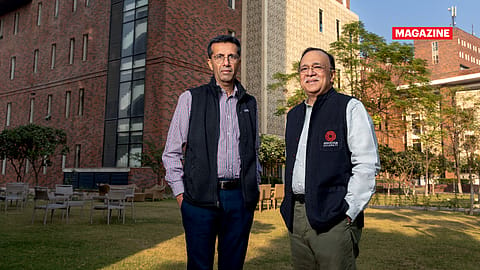
Ashish Dhawan (left), founding chairperson, board of trustees, Ashoka University, and Pramath Raj Sinha, chairperson, board of trustees, Ashoka University. | Credits: Sanjay Rawat
This story belongs to the Fortune India Magazine may-2026-biocon-next issue.
FOR A COUNTRY firmly on the path to Viksit Bharat by 2047, India has a skilling problem. According to the India Skills Report 2026, by talent assessment and remote proctoring company Wheebox, employability has steadily increased since 2021, from 45.9% to 56.35%. Yet, nearly 44% of the workforce remains unemployable. “Our institutions need to keep pace with how quickly the workplace is evolving, and with the pace of innovation itself,” Pramath Raj Sinha, chairperson, board of trustees, Ashoka University, tells Fortune India.
He’s not alone. Experts believe that institutions are unable to match industry demands. “Even when hiring is for other disciplines, the industry expects a certain level of AI proficiency. Therefore, the industry-academia skill supply-demand mismatch may be widening for hiring from academic institutions,” says Kamlesh Vyas, partner, Deloitte India.
While domain skills will always matter, Sinha says: “The workplace also rewards people who can think across complexity, communicate well, adapt, and keep learning.”
For Ashish Dhawan, founding chairperson, board of trustees, Ashoka University, the bottom half of higher education institutions needs to “get taken out through market forces and more and better institutions need to come up”. Students need to learn to think for themselves, he adds.
So, how will India solve its skilling problem? For a country of its size and diversity, says Sinha, the only way to reach people at scale is through a portfolio of approaches: strong residential institutions for those who can access them, well-designed online programmes, and hybrid models that bring the strengths of both. “The institutions that will matter most are those that figure out how to deliver this longitudinally, not just as a one-time course but as a sustained journey of learning and growth across a person’s career,” he says.
Research focus
Vyas says universities and industry need to do more in research and innovation. “This sometimes calls for a long-term strategy that includes global collaborations, industry-academia partnerships, broad-basing research at all levels, creating the right facilities, building a team of researchers, enhancing PhD programmes, encouraging multi-disciplinary and inter-disciplinary learning, and policies and strategies that support research.”
More Stories from this Issue
Sinha highlights that research is where India has the most ground to cover. The first issue, he explains, is people. “You cannot build a research culture without researchers. India has not yet been able to bring back enough of its best PhD students from the U.S. and the U.K. to anchor its institutions. China did this deliberately and at scale through programmes like the ‘Thousand Talents’ initiative... Given the current disruption in American higher education, there may not be a better moment to act.”
The second issue is within the institutions themselves. Sinha says research requires the right conditions: adequate funding, proper infrastructure, reasonable teaching loads, and the ability to pursue questions that may not yield results quickly. “Many of our faculty are stretched too thin to do work of long-term depth. Getting the balance between teaching and research right is a fundamental institutional decision that has to be made early and protected consistently,” says Sinha.
For private universities, research funding is a concern. Dhawan says if India wants to achieve its aim of having 20 universities among the Top 200 globally by 2047, funding has to be equally split between government and private institutes. While government institutions such as IITs, IISc, etc. are the obvious ones, the private ones will most likely be the ones that are better research-focussed. And it is necessary to “create the right level-playing field, so that research money goes equally [to government and private institutes].”
Third is culture. “Building research excellence requires institutes that set globally competitive standards. It requires collaboration across disciplines and with industry. It requires a long-term commitment that is not easily disrupted by short-term pressures or shifting priorities,” Sinha says.
{{#most-powerful-women-snapshot-individual.slug}} {{/most-powerful-women-snapshot-individual.slug}} {{^most-powerful-women-snapshot-individual.slug}} {{/most-powerful-women-snapshot-individual.slug}} {{#showRanking}} {{current-rank}} {{/showRanking}} {{#photo.0.url}}
{{name}}
But why isn’t industry and academia working together? “Industry does not always see universities as genuine contributors... And universities, for their part, have not always been structured or incentivised to pursue industry-relevant work,” he explains. This results in mutual scepticism. What is needed is demonstrated excellence, he says. “When you look at how AI innovation came out of American universities, or how Chinese universities contributed to lithium battery technology and EV development through partnerships with companies, the link was built on real intellectual contribution, and not just proximity.”
Agrees Vyas, putting the onus on institutes. “They must continually upgrade their curricula and enhance the experiential learning, practical experience, and application-based learning quotients,” he says.
These will help students graduate with a much clearer sense of what workplaces need from them, says Sinha. Sustained investment, autonomy, and long-term commitment are key.
Another important piece is accreditation. “When accreditation is tied to outcomes and funding, it creates a genuine incentive for institutions to keep raising their standards. That link is worth strengthening in India,” Sinha says.
Vyas proposes “a performance-based funding model” for government-funded institutes. “This could be taken up in a phased manner,” he says.
And that is what is required for India to achieve its goal of Viksit Bharat.
Follow Fortune India
Sign in to read full story
To access our exclusive magazine content, sign in to your Fortune India account.
Sign In NowNEXT STORY