India’s Biggest Unicorns: IPO-bound PhonePe is busy building a future-ready business. Here’s how
/ 6 min read
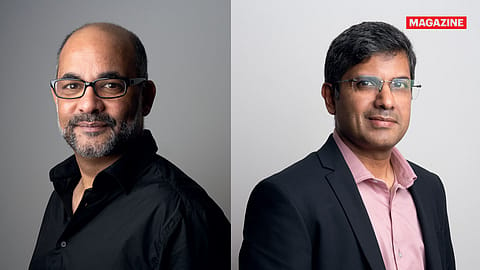
(From left) Sameer Nigam, founder & CEO, and Rahul Chari, founder & CTO, PhonePe
India’s Biggest Unicorns: IPO-bound PhonePe is busy building a future-ready business. Here’s how
PhonePe, a leading digital payments platform in India, is preparing for its IPO, marking a significant milestone in its journey. Founded in 2015, the company has grown to over 650 million users and holds a 50% market share in UPI payments. The IPO aims to solidify its position as a sustainable, multi-generational business, expanding into diverse financial services.
This summary is AI-generated, and Fortune India is not responsible for its content or any associated copyright issues.
PhonePe, ranked No. 2, was acquired by Flipkart in 2016 for around $20 million. Now, its IPO will see Walmart’s partial exit, but without ceding control.
(From left) Sameer Nigam, founder & CEO, and Rahul Chari, founder & CTO, PhonePe
This story belongs to the Fortune India Magazine march-2026-indias-biggest-unicorns issue.
IN 2020, during the Indian Premier League (IPL), PhonePe aired a campaign to highlight the role played by the company in enabling a digital economy. Weaved in the form of a storyline, the six brand adverts, titled, “Karte Ja. Badhte Ja”, showed a sceptical Aamir Khan gradually being convinced by Alia Bhatt on PhonePe’s ubiquity, summing up the company’s belief that progress isn’t pushed — it’s unlocked when simplicity meets trust.
“People don’t need to be sold to. They need to be shown how their lives can get simpler,” founder and CEO Sameer Nigam has been repeatedly quoted as saying.
Founded in December 2015 by former Flipsters (who work/worked at Flipkart) Sameer Nigam, Rahul Chari and Burzin Engineer, PhonePe started out with a mission to build India’s largest transaction platform. And now, 11 years later, with over 650 million registered users — nearly one in every two Indians uses PhonePe — and a 50% market share in UPI payments, the founders stand at the cusp of taking their company public.
For the serial entrepreneurs whose association started much before PhonePe when their first venture Mallers Inc. (Mime360), a digital media distribution platform, was acquired by Flipkart in 2011, the IPO moment is nothing less than a dream come true.
“It’s a significant step towards making PhonePe an even more durable, well-governed and multi-generational business. It validates our belief that free market competition, driven by product innovation, is what will ultimately drive the future,” Nigam tells Fortune India, while talking about the IPO. In December 2025, the platform processed over 9.7 billion transactions, valued at over ₹13.5 lakh crore, nearly half of the total value of UPI transactions in the country.
Originally incorporated in 2012 as FX Mart Pvt. Ltd, the company changed its name to PhonePe Pvt. Ltd in 2016 and launched the PhonePe app, based on the Unified Payments Interface (instant payment systems and protocol), the same year. By 2017, it had recorded nearly 10 million downloads!
The IPO is not just a destination, but a very important milestone in the journey towards building a company that would outlast them, says Rahul Chari, founder and CTO. “It is a marker of our maturation. We operate in a highly regulated space that touches people’s hard-earned money. We have always been compliant and well-governed, but becoming a publicly listed company places significant additional responsibility on our shoulders — a responsibility we believe is vital for a company of our scale.”
More Stories from this Issue
The business evolution
As the largest payments company in the consumer space, PhonePe has evolved over the years, starting with an app for managing end-to-end payment needs of merchants in 2018, to foraying into the sale of insurance products in 2020, to starting payment gateway services primarily aimed at MSMEs, and its stockbroking and merchant lending business in 2023.
More recently, in 2025, the company launched co-branded credit cards through tie-ups with HDFC Bank and SBI Cards.
The payments business — where it earns through transaction processing and convenience fees on mobile recharges, bill payments, digital gold and silver transactions, and travel and transit ticketing services—remains the primary source of income, accounting for over 50% of the company’s revenue stream. It is followed by merchant payments, with 28% revenue share. Here, the company charges transaction and subscription fees for setting up its payment devices, including speakers, on the merchant side. PhonePe also counts advertisement sales as a revenue stream.
{{#most-powerful-women-snapshot-individual.slug}} {{/most-powerful-women-snapshot-individual.slug}} {{^most-powerful-women-snapshot-individual.slug}} {{/most-powerful-women-snapshot-individual.slug}} {{#showRanking}} {{current-rank}} {{/showRanking}} {{#photo.0.url}}
{{name}}
The company sees customers’ financial journeys anchored around four distinct pillars — send, spend, manage, and grow. “The foundation of this vision was ‘send’ and ‘spend’ — covering person-to-person (P2P) transfers via UPI and merchant payments to help create a high-frequency habit. The ‘manage’ pillar focusses on reducing friction in everyday life by handling utility bills, loan repayments, and recharges through the app. The next phase, ‘grow’, is dedicated to helping Indians build their wealth and livelihood through products such as savings, investments, insurance and lending,” says Chari.
With payments now bringing in the user base, the company is eyeing an organic expansion and deeper penetration of the other financial offerings.
“We are seeing this play out in the numbers — our revenue from lending and insurance distribution actually grew 100% (YoY) in the first half of this fiscal (FY26). It is the right sequence for the population we serve; providing access to affordable insurance and formalised credit is how we truly unlock the flow of money and democratise progress,” Chari adds.
On the back of its diversification into other financial services businesses, PhonePe also launched Share.Market in 2023 for distribution of mutual funds and other wealth products. Share.Market also houses the company’s broking business.
Launched in 2024, the Indus Appstore (available on Android), meanwhile, provides consumers access to popular apps and games in 12 Indian languages, in addition to English. The company has partnered with leading original equipment manufacturers such as Xiaomi India, Motorola, Lava and Alcatel to embed Indus Appstore on all their smartphones sold in India.
According to Nigam, both offerings are a part of the company’s long-term bets — operating in massive markets, but with very different competitive dynamics compared to its core payments business. “Right now we are giving them adequate time to find the right product-market fit,” says Nigam.
Explaining the rationale, Chari says by providing a DIY (do-it-yourself) platform through Share.Market, PhonePe is targeting those looking to start their investment journeys, while the bet on the app store is aimed at increasing engagement with the non-English speaking population in Tier II cities and beyond.
“It’s not just about the most popular apps; it’s about discovering apps for upskilling, financial education, and learning. Our mission with Indus is to reimagine that discovery gateway for Bharat,” points out Chari.
The company also houses nearly 30 insurers on its platform, and offers both personal and merchant loans through lending partners such as Muthoot Fincorp, Aditya Birla Capital Finance, Piramal Finance, IDFC First Bank, and Shriram Finance.
In 2023, PhonePe launched its hyperlocal e-commerce app Pincode on the Open Network for Digital Commerce (ONDC) platform for shopping in food, grocery, electronics, pharmacy, fashion, and home decor segments. It was shut down last September due to lack of demand.
According to the updated DRHP (draft red herring prospectus), the company registered ₹7,115 crore in revenue from operations in FY25, while net losses narrowed to ₹1,727 crore, from ₹1,997 crore in FY24. Its adjusted Ebitda turned positive in FY25, with the company registering an (adjusted) margin of 20.76%, compared with 12.87% in FY24. It boasts of nearly 12,338 full-time employees.
Eye on the public market
The Indian public market is no stranger to UPI-based payments and financial companies. Paytm and MobiKwik received overwhelming subscriptions at the time of their listings in 2021 and 2024, respectively. With PhonePe now set to join the list, Chari says while new-age fintech companies have been instrumental in driving equity participation and financial inclusion, the era of burning investor money is now giving way to building sustainability and profitability.
“When you are dealing with people’s finances, you can’t be a company that isn’t sustainable itself. We need to build while keeping a multi-generational view. The ‘new breed’ of fintech companies are taking that view and accepting the responsibility, which is vital for how our sector is perceived in the public market.”
The upcoming IPO is entirely an offer for sale. Promoter Walmart (WM Digital Commerce Holdings Pte. Ltd), which holds 71.77 % on a fully-diluted basis, is looking to exit partially but retain control. Post IPO, it will be the single-largest shareholder in any fintech company in the Indian public market space. Two other investors — Tiger Global and Microsoft Global Finance Unlimited, who hold under 1% each — are looking at complete exits.
“One of the things we are most proud of is that we have had investors like Walmart and General Atlantic, and all our investors have backed us with patient capital, enabling us to take a long-term view, avoiding ‘local maxima’ and instead, building for sustainability,” says Chari. “We are proud of the fact that most of these investors will continue to stay invested and be part of our journey going forward.”
Earlier in February, a research report by Bernstein noted that the IPO-bound company remained significantly ahead of Paytm in terms of consumer scale, despite having relatively limited diversification into lending and other non-payment businesses. However, on the merchant side, Paytm has a slight edge.
More recently, global broking firm Macquarie had pointed out that PhonePe’s higher valuation of nearly $14.5 billion compared with Paytm could likely trigger a rerating of the latter. Also, the National Payments Corp. of India’s (NPCI) plans to cap the UPI market share at 30% by December 31, 2026, could be a potential headwind, given that PhonePe has a 50% share in the UPI space.
In the next leg of the company’s journey as a listed entity, the focus would be on two things, says Nigam. “One, we will need to invest time and effort in educating our new shareholders, especially individual retail shareholders, about the company’s business models. Two, we will need to focus on becoming an even more predictable business from the financial standpoint,” he adds.
With robust growth and market dominance, PhonePe’s IPO could redefine India’s digital payments landscape.
Follow Fortune India
Sign in to read full story
To access our exclusive magazine content, sign in to your Fortune India account.
Sign In NowNEXT STORY