India’s Biggest Unicorns: The digital doctors’ prescription for success at API Holdings
/ 7 min read
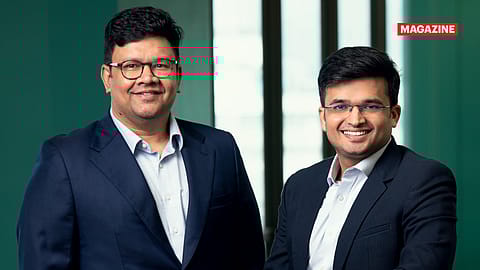
Siddharth Shah (right), co-founder & vice chairman, API Holdings, and Rahul Guha, MD & CEO, Thyrocare and API Holdings | Credits: Padmini B
India’s Biggest Unicorns: The digital doctors’ prescription for success at API Holdings
API Holdings, parent of PharmEasy, has transformed from a failed online pharmacy idea into India’s largest outpatient digital healthcare ecosystem through nearly 50 acquisitions, including Medlife and Thyrocare. Now in a consolidation phase, it is integrating diagnostics, e-pharmacy, B2B supply, and AI tools while cutting debt and targeting profitability by FY27 and revenue of ₹15,000 crore in five years.
This summary is AI-generated, and Fortune India is not responsible for its content or any associated copyright issues.
API Holdings, ranked 19, is redefining outpatient digital healthcare, and it has only just begun.
Siddharth Shah (right), co-founder & vice chairman, API Holdings, and Rahul Guha, MD & CEO, Thyrocare and API Holdings | Credits: Padmini B
This story belongs to the Fortune India Magazine march-2026-indias-biggest-unicorns issue.
SIDDHARTH SHAH learnt early that speed alone doesn’t win races — timing, strategy, and endurance matter just as much. A three-time national go-karting champion during his school days, Shah, 37, nurtures the dream of owning a Ferrari some day. Right now, he feeds his passion by travelling twice a year to the Yas Marina Circuit in Abu Dhabi, hiring Formula 3 cars to relive the adrenaline rush.
Kart racing or karting is a motorsport discipline that uses open, four-wheeled vehicles known as go-karts.
“It is an aspiration in your life as a school kid, and that dream keeps you going… soon I may own a Ferrari,” Shah says with a laugh.
That appetite for speed and ambition mirrors his business journey. As vice chairman of API Holdings — the parent company of India’s largest outpatient digital healthcare platform — Shah and his team engineered one of the most aggressive consolidation strategies in the country’s healthtech space. Over the past decade, API Holdings has completed nearly 50 acquisitions, at least 10 of them large and strategically significant, transforming a digital pharmacy startup into an integrated healthcare ecosystem.
The most visible pillar of that growth is PharmEasy, which rose to become India’s largest e-pharmacy platform. A defining moment came when it acquired rival Medlife, becoming the first Indian e-pharmacy startup to enter the unicorn club, and strengthening market leadership in an intensely competitive segment. The acquisition not only expanded scale, but also demonstrated API Holdings’ willingness to pursue consolidation as a growth lever.
An even bolder move followed in 2021, when API Holdings acquired pan-India diagnostics chain Thyrocare through its wholly owned subsidiary Docon Technologies for ₹4,895 crore. The deal marked the first acquisition of a listed company by an Indian unicorn, signalling a strategic pivot towards vertical integration. Rather than a consumer-facing digital pharmacy, API Holdings began positioning itself as a full-stack healthcare platform spanning diagnostics, procurement and clinical infrastructure, with a dedicated back-end supply chain.
Today, the company operates across both B2C and B2B healthcare segments. Alongside PharmEasy and Thyrocare, its portfolio includes Aknamed, a technology-enabled hospital supplies procurement platform; Docon, an electronic medical records and practice management solution for clinics and doctors; and Retailio, a pharmaceutical distribution network connecting pharmacies with wholesalers.
More Stories from this Issue
These businesses are supported by more than 50 warehouses and 39 laboratories across India, creating a logistics backbone, designed for scale, speed, and reach.
Needless to say, such expansion requires substantial capital. Over six primary funding rounds, API Holdings has raised roughly $1.18 billion (over ₹15,000 crore) in equity funding from close to 40,000 shareholders. The company’s growth coincided with a period of abundant venture capital for digital startups, though the management says the current phase is about consolidation rather than rapid expansion.
“Put together, we have invested over ₹8,000 crore in building the ecosystem, and our consolidated valuation now should be around ₹15,000 crore,” says Rahul Guha, MD and CEO, Thyrocare and API Holdings.
The financial performance reflects the shift in priorities. In FY25, API Holdings reported a total income of around ₹5,980 crore, alongside a net loss of ₹1,572 crore, according to Tracxn. Thyrocare posted consolidated revenues of ₹687 crore in FY25, a 20% growth year-on-year, and a net profit of ₹90 crore.
{{#most-powerful-women-snapshot-individual.slug}} {{/most-powerful-women-snapshot-individual.slug}} {{^most-powerful-women-snapshot-individual.slug}} {{/most-powerful-women-snapshot-individual.slug}} {{#showRanking}} {{current-rank}} {{/showRanking}} {{#photo.0.url}}
{{name}}
Revenue growth has moderated compared with earlier years as the company focussed on reducing debt accumulated during its acquisition drive and integrating multiple business units. “At the consolidated level, we will start to post profits by FY27,” says Guha, underscoring a pivot toward financial discipline, cost optimisation, operational efficiency, and synergy.
THE JOURNEY SO FAR
Shah says he never imagined himself as an employee. Even as a student, he was drawn to building something of his own. After studying computer engineering, he entered IIM Ahmedabad at 21 — an experience that would go a long way to shape his entrepreneurial journey later. It was at IIM-A that professor Anil Gupta encouraged him to go beyond classroom business plans and test a real-world startup idea. Shah registered DialHealth, envisioning what he believed could become India’s first online pharmacy platform, inspired by the success of JustDial.
Following a mandatory two-month internship at Goldman Sachs, Shah plunged full-time into the venture, along with friends Hardik Dedhia and Harsh Parekh, with an aim to simplify healthcare access — customers could visit dialhealth.com or call a central number to receive medical information, consult doctors, and connect with nearby pharmacies for medicines.
Reality, however, proved tougher than the trio anticipated. Patients preferred established doctors who had little time for online consultations or unfamiliar platforms. They often prescribed medicines stocked only in specific hospitals or neighbourhood pharmacies, while DialHealth’s network struggled to match the inventory. With over 200,000 brands in the market and most pharmacies carrying just a fraction of them, the founders realised that the success of any digital healthcare play depended heavily on backend supply-chain depth — something that demanded significant capital.
The company shut down within 18 months, but failure did not dampen the team’s appetite to experiment. In 2013, Shah and his co-founders launched Ascent Health and Wellness, pivoting to a B2B model focussed on rapid medicine delivery to retailers—often within four hours. The idea clicked, and Ascent expanded rapidly, building a network of thousands of retailers across Mumbai, Bengaluru, the National Capital Region (NCR), Chennai, and Ahmedabad.
Soon, two more friends — Dharmil Sheth and Dhaval Shah — joined forces. Their collaboration laid the foundation for what would later become PharmEasy, one of India’s most visible digital healthcare brands.
The early days were powered largely by family belief. Shah’s parents, doctors Bhaskar and Jasmine Shah, invested nearly their entire savings to back the venture. Dr Bhaskar Shah, who ran a small hospital in Ghatkopar before co-founding the Asian Heart Institute and later Jupiter Hospital, infused roughly ₹20 crore into the business, including a ₹10-crore loan facilitated through Nimesh Kampani of JM Finance. Besides, additional early investors included the Bagrodia and Morbia families, Bessemer Venture Partners, Orios Venture Partners, ATS Venture Partners, healthcare entrepreneur Ranjan Pai, and Everstone Capital. In 2018, PharmEasy and Ascent were consolidated, attracting institutional investors such as Temasek, CDPQ, LGT Lightrock, Eight Roads, and Think Investments.
Capital inflows accelerated thereafter. In 2021, Prosus Ventures and TPG Growth injected about $350 million, valuing PharmEasy at $1.5 billion. Major rounds included a $437 million Series E in 2021 and $216 million in April 2024 led by the Manipal Family Office, with participation from Prosus, Temasek, 360 One, and others. Today, the Manipal Family Office (through affiliates), 360 One, Prosus, Temasek, TPG, and CDPQ rank among the largest shareholders. Thyrocare founder Arokiaswamy Velumani has also reinvested roughly ₹1,500 crore into API Holdings.
As the organisation matured, the founding promoters stepped back from day-to-day executive roles, transitioning into strategic advisory and board positions. Professional management took charge, with Guha — formerly a leader in BCG’s healthcare practice who played a key advisory role in the Thyrocare acquisition—now heading both API Holdings and Thyrocare. In 2022, Guha was brought in to execute the Thyrocare integration and a year ago, was made MD and CEO for both API Holdings and Thyrocare.
THE CONSOLIDATION PHASE
After years of rapid expansion and experimentation, API Holdings is entering what its leadership calls a consolidation phase. Both Shah and Guha say the focus has shifted from adding new verticals or acquisitions to strengthening and integrating the ecosystem they have already built — spanning diagnostics, medicine delivery, and digital healthcare services.
“We’ve set up the building blocks from front end to back end and what’s required in outpatient healthcare delivery under the sun,” says Shah. “Now the priority is consolidation — leveraging the strengths of each business rather than extending further into unrelated areas.”
A key pillar of this strategy is customer integration. PharmEasy has been running a unified loyalty programme for over a year, allowing users to accumulate rewards whether they consult a doctor, book a diagnostic test, or purchase medicines. “It’s one integrated loyalty framework across services,” Guha explains. The programme has now been embedded into a digital wallet tailored for corporate clients, with about 50 companies already on board. Discussions are underway with insurance providers to extend the wallet to outpatient (OPD) coverage — a segment traditionally underserved in health insurance.
RIDING ON AI
Technology is another central lever. Guha says the company has invested heavily in AI and data analytics to create cross-platform efficiencies. One example is Swasth AI, a chatbot designed to interpret diagnostic reports and guide patients toward appropriate specialists. The system also nudges chronic-care patients when their regular medicines are due for refill. AI-driven call centre tools now handle roughly 40% of customer queries, while analytics supports backend planning, inventory management, and service optimisation.
These digital layers sit atop a sizeable physical infrastructure. API Holdings operates about 50 medicine warehouses handling above 1.1 million strips daily and 39 diagnostic laboratories that together process nearly 550,000 tests daily. The API Group has a 15,000-plus strong workforce; 11,000 of these are blue-collar workers, comprising 2,000-plus phlebotomists and last-mile executives, and another 2,000 as delivery partners, powering last-mile execution across the group.
Shah believes this combination positions the company strongly in outpatient healthcare, something he thinks will be far larger and more impactful than the inpatient segment going forward. “We’ve created the infrastructure. Digital capabilities layered on top allow us to scale access in a way that wasn’t possible earlier.”
The financial trajectory reflects that expansion. According to Shah, the business has grown roughly 60-fold over the past decade, from around ₹100 crore in revenue in 2015 to more than ₹6,000 crore today. The revenue mix has also evolved — nearly 90% now comes from customers and retail channels, compared with 75% earlier, when institutional sales had a larger share.
Balance-sheet discipline has also accompanied this shift. The company’s debt has reduced significantly, from ₹3,400 crore to around ₹1,200 crore. With consolidation underway, growth ambitions remain intact. “We aspire to at least double our revenue over the next five years,” says Guha. “That would take us towards the ₹15,000-crore mark, growing roughly at 15-20% annually.”
The company is betting on the tighter integration, AI-led efficiencies, and deeper engagement with outpatient healthcare to define its next phase of growth.
Shah, Guha, and the other promoters can now dream big — like Siddharth racing at Yas Marina. With digital healthcare still below 10% of India’s ₹2 lakh crore annual drug market, the runway is long; long enough for each of them to own a Ferrari!
Follow Fortune India
Sign in to read full story
To access our exclusive magazine content, sign in to your Fortune India account.
Sign In NowNEXT STORY