India’s Biggest Unicorns: The recipe for success at Rebel Foods
/ 6 min read
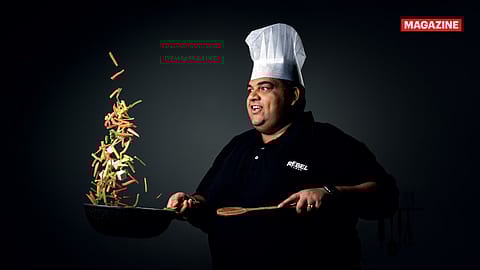
Ankush Grover, co-founder & global CEO, Rebel Foods | Credits: Narendra Bisht
India’s Biggest Unicorns: The recipe for success at Rebel Foods
Rebel Foods, born as Faasos in 2010, has transformed from a wrap-focused QSR into a multi-brand, cloud-kitchen powerhouse operating 450+ kitchens across 120 cities. Powered by its AI-driven Rebel OS, it manages 800 SKUs, rapidly launches new brands, partners with global players like Wendy’s, and is now steering towards a disciplined, profitability-focused IPO in 2026.
This summary is AI-generated, and Fortune India is not responsible for its content or any associated copyright issues.
From a humble wrap shop in Pune to a global multi-brand powerhouse, Rebel Foods, ranked 18, is rewriting the rules of the culinary world.
Ankush Grover, co-founder & global CEO, Rebel Foods | Credits: Narendra Bisht
This story belongs to the Fortune India Magazine march-2026-indias-biggest-unicorns issue.
THE VISION IS SIMPLE, and a melody to one’s taste buds: to build the world’s largest platform for launching, building, and scaling the most-loved food brands. The journey of a thousand miles begins with a single step. For Rebel Foods, that step was the launch of Faasos in 2010.
Founded as a quick-service restaurant (QSR) chain specialising in wraps by IIT alumni Jaydeep Barman and Kallol Banerjee, Faasos transitioned to a multi-brand, cloud kitchen-only model starting in 2015, after the founders realised that approximately 70% of customers had never actually visited their physical storefronts. Faasos’ official rebranding to Rebel Foods happened in 2018. From 2015 to 2018, the company launched at least five popular brands, including Behrouz Biryani, Oven Story, Mandarin Oak, Firangi Bake, and Sweet Truth.
Rebel Foods operates over 450 cloud kitchens across 120 Indian cities, and has a growing presence in the U.A.E. It also has an exclusive master franchise for Wendy’s in India, and the “Rebel Launcher” continues to scale external brands such as Naturals ice cream, Smoor, and Wow! Momo through its shared infrastructure.
To understand Rebel Foods in 2026, one has to peel the layers of its history, much like the paratha of a Faasos wrap. Co-founder Ankush Grover, who joined the company in 2012, and took over as global CEO in July 2025, reflects on the metamorphosis. The transition wasn’t just a business pivot; it was an engineering problem.
“If you look at the founder group, it’s all engineers and MBAs,” says Grover. “We knew how technology changed the world — what happened to shopping with the shift from Walmart to Amazon, or to movies with Netflix. That was the ambition: how can technology change how food operates?”
The “aha moment” in 2015 was less of a lightning strike and more of a data point. They were paying high rentals for high-street visibility, yet the vast majority of customers were only interested in the food appearing at their doorstep. The physical store was becoming the vestige of a bygone era.
“We realised people are only ordering delivery and not seeing our offline locations,” Grover recalls. “So we went cloud. And once we went cloud, we realised the power of that infrastructure. If we can make wraps in this kitchen, why can’t we make biryani, or pizza?”
More Stories from this Issue
This logic birthed what is now known as the Rebel Operating System (Rebel OS). It is the invisible backbone that allows a single 800-sq. ft kitchen to function as a Faasos, a Behrouz Biryani, an Oven Story, and a Wendy’s — simultaneously.
The symphony of SKUs
In a traditional restaurant, the menu is finite. A burger joint makes burgers. A biryani place makes biryani. The inventory is manageable, processes are more linear. But step into a Rebel kitchen, and you witness a complexity that would break a traditional restaurateur. “Any typical restaurant operates 70, maybe 80 SKUs (stock-keeping units),” Grover explains. “We operate 800 SKUs.”
Managing 800 distinct items — from the precise spice blend of a mutton biryani to the patty temperature of a Wendy’s burger — in a single kitchen requires more than just good chefs; it requires a digital conductor. This is where the Rebel OS shines. It isn’t just an app for the customer; it’s a rigorous, AI-driven backend that dictates every movement in the kitchen.
{{#most-powerful-women-snapshot-individual.slug}} {{/most-powerful-women-snapshot-individual.slug}} {{^most-powerful-women-snapshot-individual.slug}} {{/most-powerful-women-snapshot-individual.slug}} {{#showRanking}} {{current-rank}} {{/showRanking}} {{#photo.0.url}}
{{name}}
Grover describes a system that has moved beyond simple order management to predictive intelligence. “Our technology lets our people operate because they don’t have to sit and say, ‘Okay, 800 things I have to order, what do I do?’ The system takes care of it.”
This tech-first approach allows Rebel to slice and dice consumer demand in real-time. “We get so much customer data,” Grover says. “We see that North India complains the mutton is too spicy, but South India loves it. So, we tweak. We see people searching for Shawarma, so we launch Shawarma in Faasos. We see a demand for healthy bowls, we launch Honest Bowl.”
It is this agility — the ability to launch a new “brand” in weeks rather than months — that separates Rebel from the old guard of the food industry. They aren’t just selling food; they are selling “food missions”. Whether it’s a celebration (Behrouz), a quick lunch (Faasos), or a guilt-free dinner (The Good Bowl), Rebel has a brand for the specific “mission” the customer is on.
‘Chief delight officer’
In an industry often defined by faceless transactions and speed, one might wonder where hospitality has disappeared. For Grover, the answer lies in redefining the frontline.
“We don’t call our store in-charge a ‘store manager’. We call them chief delight officers… Their designation is clear, to delight the customer. They are measured on delight more than sales.”
In the Rebel ecosystem, technology doesn’t replace the human touch — it amplifies it. The AI running the backend isn’t just tracking inventory; it’s tracking sentiment.
Grover recounts a story that perfectly encapsulates this synthesis of data and empathy. A customer had a bad experience with Oven Story and stopped ordering. When he finally placed an order, months later, the system didn’t just print a receipt. It flagged him as an unsatisfied customer.
“The kitchen team got to know that this customer faced an issue last time,” Grover says. “They were extra cautious. The store manager himself called the customer to ask how it was.”
This philosophy trickles down to the hiring process. You can’t just be a good manager; you have to have the “Rebel Values”. Grover describes a hiring process that values character over the resume. “Resume is quantitative. We ask situational questions. ‘If a customer got a wrong order, what would you do? If you have no riders but an order is pending, what will you do?’”
This loop — from data to human action is the “Rebel Way”. Technology doesn’t replace humans; it empowers them to be more empathetic.
The ‘Rebel launcher’
By 2026, Rebel Foods has evolved beyond just building its own brands. It has become the infrastructure provider for the industry — a localised AWS for food. This initiative, known as the “Rebel Launcher”, allows iconic brands to scale at a pace previously thought impossible.
Take Wendy’s. The American burger giant had struggled to scale in India relative to its peers. Then came the partnership with Rebel. “Wendy’s is now at 220 locations,” Grover points out, “and only 15 are physical locations. It is the fastest scale-up of a global brand in any country, ever. McDonald’s took 10 years to open 100 outlets. We opened 200 in like four years.”
The “launcher” model is symbiotic. Rebel gets to utilise its kitchen capacity and tech stack; the partner brand gets instant access to 120 cities without investing a rupee in real estate. It’s a plug-and-play expansion.
“We realised the power of tech is to build more brands not just ourselves, but get global brands like Wendy’s, host brands like Naturals, ITC and Taco Bell on our platform,” Grover says.
Profitability and IPO
As the conversation shifts to the future, the elephant in the room is the IPO. The market is buzzing with rumours of Rebel Foods going public in late 2026. Grover, now wearing his CEO hat, speaks with the measured discipline of a man responsible to shareholders.
Rebel Foods entered the “unicorn club” back in 2021, backed by heavyweights like the Qatar Investment Authority (QIA), Temasek, Coatue, and Peak XV Partners. To date, it has raised over $800 million. Its revenue has crossed the ₹1,600-crore mark, while losses have narrowed sharply as efficiencies of scale take hold.
“When you go public, you are basically taking public money, so you have to be really disciplined,” he says.
For the last two years, the focus has been a shift from “growth at all costs” to “profitable, predictable growth”. The operating leverage has kicked in. The same kitchen that once did 50 orders a day now does 200, spreading the fixed costs of rent and staff over a much larger revenue base. “Our same-store kitchen growth is in strong two-digit numbers,” Grover says.
For the next 24 to 36 months, Grover outlines three non-negotiable pillars — customer obsession: keeping that bar high irrespective of top line or bottom line; strengthening the OS: leveraging AI to make the business more predictive; and financial discipline: being a sustainable and scalable company.
Changing tastes
Grover notes a divergence in consumer behaviour. On one hand, there is a surge in single-serve convenience — bowls, thalis, meals for the lonely professional working from home. Brands like Lunchbox and The Good Bowl are thriving here. On the other hand, premiumisation is real. “We see growth in premium also,” Grover says. “Biryani, pizza, burgers are doing very well. It’s not stagnated. Consumption has gone up.”
So, is Rebel Foods a food company, or an infrastructure provider?
Grover’s response is immediate. “We are not both. Rebel Foods is the operating system for delightful food.”
“You can call it a food company, a food-tech company, or a platform company. We look at ourselves as a platform which enables great brands, great food to reach customers and give them a delightful experience,” he adds.
What was a single wrap shop in Pune some 15 years ago, is now preparing for a blockbuster IPO in 2026. The fire in the hearts of Rebel’s engineers has indeed put dreams in the clouds — and, 800 varieties of delightful food into kitchens across the world.
Follow Fortune India
Sign in to read full story
To access our exclusive magazine content, sign in to your Fortune India account.
Sign In NowNEXT STORY