Inside Clarins Group: CEO Jonathan Zrihen on delisting, dependence on China, and India growth plans
/ 6 min read
French skincare and cosmetics major Clarins Group is pumping money into India as it looks to reduce its dependence on China. The group believes India will eventually break into the €2-billion brand’s Top 5 markets.
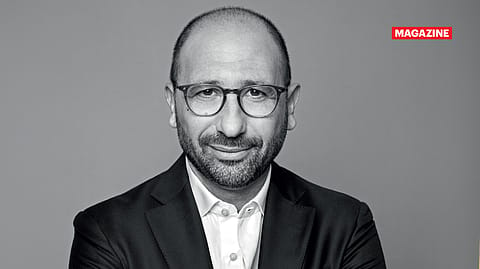
Jonathan Zrihen: “Listing reduces long-term focus... The performance that drives the stock value is mainly based on a short-term appreciation.”
This story belongs to the Fortune India Magazine august-2026-40u40-indias-brightest-young-business-minds issue.
You are part of a 70-year-old family business, and you have spent a lifetime here. How has it been to work for a business where the family is quite involved in day-to-day operations?
I started as an intern, and I have participated in the international expansion of Clarins. Today, only 5% of our business is in France. I started with the founder, Jacques Courtin, and then worked with his son, Christian Courtin, who organised the global expansion. He took me into his team, and I opened many markets, including India and China. Then I moved to the U.S. I also launched the business in Canada. I have worked a lot on international expansion before becoming the CEO and president, 11 years ago, to work alongside the family.
I have two members of the [Courtin] family who are in the executive team. So, the family is very much involved even now. On the one hand, they incarnate the values that are very important for Clarins. They also show all employees the company’s long-term view. At the same time, they take business decisions. While Clarins is the flagship business, some family members take care of investments outside of Clarins. The family also runs hospitality and wine businesses. Within Clarins, we have one son of the founder, who is a managing director, but he’s [also] a researcher and a doctor, so he’s very much involved in R&D.(1) We also have Virginia Courtin, who is the granddaughter of the founder. She’s also a managing director, who oversees HR and CSR. For everything about business or brand development, they report to me. It’s an interesting way of managing the business.
Many family-run businesses find it difficult to professionalise as the family members are hesitant to let go. How has your experience been?
I would say that they selected a CEO whose first job was as an intern in the company and who has worked with them for 33 years. So, they surely trust me. I think for a family-run company, there comes a time, especially when the second or third generation comes in, [when] they need someone who can make an arbitration. Otherwise, one starts to negotiate emotionally with other members. So, having a professional CEO who you trust is important because he/she will be the one going to the family and saying, “Look, we have these two options, which one do you want to go for?” So, the two words that I have in mind when you ask me this question are trust and alignment. As a CEO, my role is to ensure that I align [with] the family. I keep them informed. I am involved in decision-making.
If you go to the tombstone of Clarins’ founder in Paris, you will find a quote: “Here lays a man who always surrounded himself with people cleverer than him.”
It is the culture of the company. So, the family has this humility to say, “I am going to make sure the values of the company stay the same, the long-term course of the company stays the same, that there are no negotiables on the quality of ingredients,(2) but I am going to take experts in that domain who might not be members of the family but can help to grow”. So, as long as I am aligned with the company and the family, and as long as the family wants to have an external professional manager, it would work. If the professional doesn’t share the long-term values, then there is a danger.
More Stories from this Issue
Clarins listed itself on the Paris Stock Exchange in 1984 and remained listed until 2008. Why did you choose to delist?
The stock market helped us to expand globally. But since 2000, we have been seeing more and more short-term interests of the stock market. And, we didn’t need that much capital to keep developing ourselves. We realised that earlier, the stock market used to be at the service of the company, but eventually we were at the service of the stock market. We wanted to invest in China, the United States, and India. Our vision was long-term, but by being listed, we were only chasing quarters. By delisting, we have more independence and freedom.
So, are you saying that being listed on the stock exchange impaired long-term thinking?
Listing reduces long-term focus; you get an outsider’s judgement about your performance on the wrong KPIs. Basically, the stock value becomes an indicator of the performance. [But] the performance that drives the stock value is mainly based on a short-term appreciation. Then people will appreciate the company based on KPIs. I personally appreciate the company on NPS (net promoter score).
{{#most-powerful-women-snapshot-individual.slug}} {{/most-powerful-women-snapshot-individual.slug}} {{^most-powerful-women-snapshot-individual.slug}} {{/most-powerful-women-snapshot-individual.slug}} {{#showRanking}} {{current-rank}} {{/showRanking}} {{#photo.0.url}}
{{name}}
Moreover, Clarins has never been a promotional brand. We don’t like to oversell to a retailer because we have a quarter to achieve. We don’t like to offer huge discounts to consumers because we want to make sure we don’t miss our Christmas period. Therefore, by avoiding the quarterly judgement of our performance, you free yourself from telling yourself in November, “Oh, we have one month left; why don’t we do something?”
How is the beauty market shaping up globally?
Around a third of our business comes from Asia and Europe each. America contributes 20%, while 15% is travel retail. But when I look at the trend and evolution, there has been a slowdown in Europe for several years now. Economic maturity, geopolitical impact of what has been happening in Russia and the Middle East, political uncertainties (in the U.K., Germany, France and Spain) and budget difficulties have created a confidence crisis. So even though only one-third of our business is in Europe, we are still by far the number one prestige skincare brand there. Over the years, we have really tried to develop a more balanced business between the U.S. and APAC. China has become our number one market because we invested for the long term. We are one of the top skincare brands in China. We really wanted to reduce our dependence on Europe, which was slowing [us] down. The U.S. is catching up now.(3)
In fact, we are also seeing a certain maturity in China. Even though we have been growing well to catch up on market share, the market itself hasn’t grown for two or three years. It’s plateauing. There are too many brands there, and the economic situation is also complicated. Despite China talking about 5% GDP growth, there’s a real estate bubble, unemployment, [and] an ageing population. So, it’s reaching maturity.
What’s your India strategy?
We launched in India way back in 1999. To be honest, for 15 years, we waited for the infrastructure to come, for consumers to have disposable income. And, what we’ve seen over the past five years is an enormous build of locations, infrastructure and distribution that can now create a point of rendezvous between emerging consumers and the brands.(4)
We have been dependent on the China story for a long time now. We now believe that we cannot build a gigantic business that lives totally on the China ecosystem. What I found very fascinating about India is that it will definitely develop and accelerate in the next 10 years. It will be in an ecosystem that is open to our world. We see it as a way of reducing dependence on China and adding another huge country to our balance [sheet]. That would also help reduce the dependence on Europe. We don’t see growth in Europe anymore. So, between the size, the long-term perspective, and the openness to the Western world, we believe that India will eventually be a Top 10 market first. And eventually, it will be among our Top 5 markets. We believe a lot in India.
So, now, we are going to really invest in India. In fact, I have a special fund that was approved by the family to accelerate in India. There are several emerging markets (such as Brazil and Indonesia), but I believe that the real one is India and I don’t want to disperse ourselves. I tell the team, look, we have China and the United States; we have to protect France and the U.K., too, but I want a special fund for India to make sure that in 5-10 years it will be one of our biggest markets. That’s what we did in China 20 years ago, and today, it is our number one market.
Now that India is a promising market for Clarins, are there any plans to set up a fully owned subsidiary?
No. We will continue to distribute through GSSBB (Global SS Beauty Brands Limited), the distributor company of Shoppers Stop. We are using GSSBB as our partner and as our distributor.
Clarins has been built around the world with local partners. Everywhere, I have always found good partners. It’s important for Clarins to find a local partner, because I think Clarins is a brand that has always been in proximity with its customers. You cannot invent local relevancy.
We have never been a brand that says, this is our vision of beauty. We say we have high-quality products. Let’s make sure it enters your routine. Let’s make sure it resonates with you. For that, local partnerships make sense for us.
You also have to navigate through the difficulties of each market. We can’t understand the local taxation system and other nuances. Finally, scale matters. We only have one brand. So, for us to reach the scale of having a full investment in a subsidiary, with only one brand, is really difficult. We have found in GSSBB a strong partner.
Follow Fortune India
Sign in to read full story
To access our exclusive magazine content, sign in to your Fortune India account.
Sign In NowNEXT STORY