Iran conflict set to add to India’s woes
/ 3 min read
From oil prices and shipping routes to defence supplies and an Indian diaspora-rich Middle East, the U.S.-Israel-Iran conflict could have a cascading effect on New Delhi.
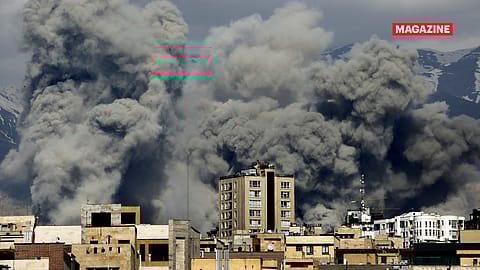
Smoke rises after a series of explosions in Tehran on March 1. | Credits: Getty Images
This story belongs to the Fortune India Magazine march-2026-indias-biggest-unicorns issue.
AS TENSIONS ESCALATE in the Middle East after coordinated U.S. and Israeli strikes on Iran, global markets may see extended instability in one of the most critical energy hubs. The killing of Ayatollah Ali Khamenei has dramatically escalated the crisis. For India, deeply intertwined with the Middle East through energy imports, trade flows, diaspora links, and strategic partnerships, the unfolding conflict poses a layered and potentially disruptive risk, as the ripple effects could extend well beyond the battlefield.
The most immediate tremors were felt in the energy markets. On March 2, Brent crude futures surged 13.76% to $82.37 per barrel — the highest since January 2025 — on supply disruption fears. A sustained crisis may further push oil prices to $90-100, according to estimates. For India, which imports nearly 85% of its crude requirements, this would inflate the import bill, widen the current account deficit, weaken the rupee, and stoke domestic inflation.
Financial markets are another casualty. Geopolitical shocks typically trigger equity corrections, capital outflows from emerging markets, and a shift towards safe-haven assets such as gold. Oil-sensitive sectors, such as aviation, logistics, and energy-intensive manufacturing, could face earnings stress if crude prices remain higher. Gold, meanwhile, has defied its safe-haven image.
The Strait of Hormuz, the narrow maritime corridor between Iran and Oman that handles roughly one-fifth of global crude trade, will be a chokepoint for India. An extended closure of the strait could disrupt tanker traffic and trigger panic buying in global markets. According to Rishi Shah, partner and economic advisory services leader at Grant Thornton Bharat, the conflict introduces meaningful near-term macro variability for India through two distinct transmission channels. “First, the physical route. With nearly 50% of India’s crude imports transiting the Strait of Hormuz, any sustained disruption elevates import costs, freight premiums, and insurance burdens,” he tells Fortune India. Iraq, Saudi Arabia, the U.A.E., and Kuwait — India’s oil sources in the Middle East — have been caught in the crossfire. Even temporary interruptions could carry disproportionate economic consequences.
The second is the financial channel, Shah says. “Risk-off investor sentiment typically precedes the physical impact, triggering portfolio outflows and currency pressure before supply is actually affected.” Historical episodes suggest a sustained disruption could shave around 0.2% off GDP growth in affected quarters, he adds. “What’s different today is India’s structural positioning. This conflict makes every non-Hormuz barrel more strategically valuable. India’s sophisticated refining capacity, built to process diverse crude slates, allows meaningful supply-side flexibility. The medium-term growth trajectory remains sound. The near term calls for careful macro management, not alarm.” Yet the structural dependence on imported energy makes India vulnerable to prolonged external shocks.
Then comes the maritime risks of India’s export economy. Shipping arteries through the Red Sea and the Suez Canal are critical for trade with Europe and North America. If hostilities spread, vessels may reroute around Africa’s Cape of Good Hope, adding 10-20 days to transit. Higher freight and insurance costs, delivery delays, and working capital strain could hit sectors such as textiles, engineering goods, and machinery.
New Delhi’s strategic investment in the Chabahar Port will also see India walking a diplomatic tightrope, balancing the Iran ties with U.S.-Israel relations while prioritising regional connectivity. The port offers India access to Afghanistan and Central Asia by bypassing Pakistan. Any deterioration in Iran’s internal stability, tightening sanctions or infrastructure damage could disrupt operations and complicate India’s geopolitical outreach.
More Stories from this Issue
Tehran’s strategy of targeting the Gulf hosts of U.S. forces may, in turn, hit India where it hurts the most. New Delhi’s bilateral trade with the Gulf Cooperation Council countries runs into tens of billions of dollars. Gulf sovereign wealth funds have emerged as key investors in Indian infrastructure and technology. But the Gulf exposure extends beyond business, as more than 8.7 million Indians live in the Middle East, largely concentrated in the U.A.E. and Saudi Arabia. In FY25, India received a record $135.46 billion in remittances, with the Gulf accounting for nearly 38%.
On the defence front, India’s expanding strategic partnership with Israel carries operational sensitivities. Israel is a key supplier of advanced defence platforms, surveillance systems, and precision technologies. A prolonged conflict could affect production schedules, potentially delaying India’s military modernisation.
Hence, for India, the conflict is an intersection of energy security, trade resilience, and fiscal and strategic preparedness. The economic impact may be contained if tensions de-escalate. If not, India could confront a complex mix of expensive oil, disrupted trade routes, inflation, and financial volatility.
Follow Fortune India
Sign in to read full story
To access our exclusive magazine content, sign in to your Fortune India account.
Sign In NowNEXT STORY