Iran War Impact: India has navigated the oil shock better than other nations. Here’s how
/ 8 min read
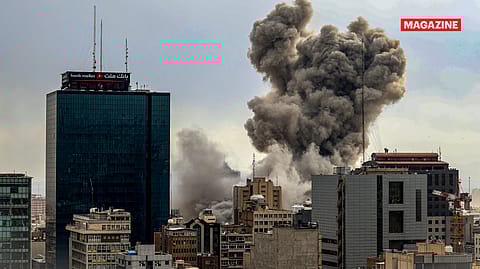
A general view of Tehran with smoke visible in the distance after explosions were reported in the city on March 2, 2026. | Credits: Getty Images
Iran War Impact: India has navigated the oil shock better than other nations. Here’s how
India has weathered the Iran-triggered Gulf energy shock better than many peers by swiftly tapping strategic oil reserves, diversifying crude, LNG and LPG suppliers, and ramping up Russian and U.S. imports. Tax cuts on fuels, export support via the RELIEF scheme, and emergency LPG measures helped shield households, industry and exports while longer-term supply deals and tenders stabilise fertiliser and petrochemical chains.
This summary is AI-generated, and Fortune India is not responsible for its content or any associated copyright issues.
India has dealt with the oil crisis with a blend of short-term initiatives and long-term planning.
A general view of Tehran with smoke visible in the distance after explosions were reported in the city on March 2, 2026. | Credits: Getty Images
This story belongs to the Fortune India Magazine april-2026-the-emerging-100 issue.
EIGHTY KILOMETRES north-east of Doha, Qatar, where the desert meets the steel-blue waters of the Persian Gulf, lies Ras Laffan Industrial City (RLIC), managed by state-owned QatarEnergy. It is an engineered colossus — 4,500 hectares of pipelines, storage tanks, refineries and petrochemical complexes stitched together into what is widely regarded as the world’s largest artificial harbour.
Over decades, QatarEnergy partnered with global giants such as ExxonMobil and Shell, pouring billions into building a sprawling export machine. The result: the world’s largest liquefied natural gas (LNG) hub, with an annual capacity exceeding 77 million tonnes (MT), powering everything, from LNG to petrochemicals and gas-to-liquids output. Expansion plans were also underway to nearly double the capacity to 142 million tonnes per annum (MTPA) by 2030.
Then came February 28, and global energy dynamics went haywire, following the outbreak of a wider Middle East conflict involving Iran and the U.S.–Israel alliance.
In early March, Iranian drones struck the complex. Production was halted almost immediately. Force majeure was declared on LNG shipments.
The situation escalated sharply on March 19. Missile strikes damaged two LNG trains with a combined capacity of 12.8 MTPA — roughly 17% of Qatar’s exports. Collateral damage spread across the industrial ecosystem.
Attacks on the Pearl GTL (gas-to-liquids) facility — one of the world’s largest — saw disruptions across product streams. Production damages affected condensates (24%), LPG (13%), naphtha (6%), sulphur (6%), and helium (16%) of Qatar’s total exports. Each of these products plays a critical role in global supply chains, from fuel blending to electronics and healthcare. “Estimated losses are around $20 billion in annual revenue. Damage sustained by the LNG facilities will take between three to five years to repair,” says Saad Sherida Al-Kaabi, president and CEO of QatarEnergy, who is also the minister of state for energy affairs, Qatar.
And then there’s the Strait of Hormuz, whose closure has triggered a supply shock of historic proportions. This narrow channel, connecting the Persian Gulf to the Arabian Sea, typically carries around 20 million barrels per day of crude and refined products — over 30% of the world’s seaborne oil trade — and roughly one-fifth of global LNG flows. Nearly 90% of these volumes are destined for Asia — around 50–55% of India’s crude imports were transiting through the Strait of Hormuz before its closure.
More Stories from this Issue
Energy markets reacted with predictable ferocity. Global oil prices surged over 50% average in March; India spent 60% more for spot natural gas to run fertiliser plants; global coal prices climbed over 40% in a month, while Asian naphtha prices hit a four-year peak.
“Asian countries have high economic exposure to the crisis — China is 72% dependent on oil imports (with 47% coming from the Middle East), India (88%, 45%), South Korea (98%, 70%) and Japan (99%, 80%),” say analysts with Wood Mackenzie, a global energy analytics firm.
Back home, rising LNG prices, shipping vulnerabilities, and tightening chemical supply chains converged to create a complex risk environment for India — a triple whammy situation.
In response, the government moved swiftly to implement measures aimed at stabilising supply chains and cushioning the impact on key industries. It leaned on the country’s strategic oil reserves as a key buffer. India, the third-largest global consumer of oil, has strategic petroleum reserves (SPR) of 5.33 million metric tonnes (MMT), around 39 million barrels, across three locations — Visakhapatnam, Mangaluru, and Padur, adequate to provide cover for about 10 days. The government is now looking to expand it beyond 6.5 MMT. In addition, it has diversified crude, LNG, and LPG imports from 27 to over 40 countries, boosted sourcing from Russia, increased purchases from the U.S., Australia and Canada, and worked to streamline fertiliser demand.
{{#most-powerful-women-snapshot-individual.slug}} {{/most-powerful-women-snapshot-individual.slug}} {{^most-powerful-women-snapshot-individual.slug}} {{/most-powerful-women-snapshot-individual.slug}} {{#showRanking}} {{current-rank}} {{/showRanking}} {{#photo.0.url}}
{{name}}
On March 19, the Central government also announced the launch of the Resilience & Logistics Intervention for Export Facilitation (RELIEF) scheme with an outlay of ₹497 crore, to cushion exporters from rising freight and insurance costs amid the crisis in the Middle East. The relief package will fall under the Export Promotion Mission and will be implemented through the Export Credit Guarantee Corporation of India. The commerce ministry has described the RELIEF package as “a calibrated support package to stabilise India’s export flows and protect India’s market share during the crisis”.
To cushion the impact on consumers, the government also cut the excise duty on petrol and diesel by ₹10 per litre (from ₹13 to ₹3 in case of petrol, and from ₹10 to nil on diesel). Besides, the Centre has constituted seven empowered groups of officials and experts, besides an informal group of senior Cabinet ministers, to handle the fallout of the war to mitigate the short and long-term consequences.
India’s refiners and oil marketing companies (OMCs), meanwhile, have a commercial inventory of crude oil and refined products, including petrol and diesel, which can last for two months.
“All refineries are operating at high capacity, with adequate crude inventories in place. The country is also maintaining sufficient stocks of petrol and diesel,” says the Ministry of Petroleum & Gas.
QatarEnergy has been a long-term supplier to India. Two years ago, it renewed a contract with Petronet LNG — a JV between Oil & Natural Gas Corp. (ONGC), Indian Oil Corp. Ltd (IOCL), GAIL (India) Ltd (GAIL), and Bharat Petroleum Corp. Ltd (BPCL) — to supply 7.5 MMT per year from 2028 to 2048, following the expiry of the existing contract in 2028. Petronet has served force majeure notices to downstream off-takers, mostly OMCs and public sector utilities, leading to curtailed supplies. So far, Ras Laffan facilities supplying to India have not been hit by Iran.
Sources say Indian refiners have aggressively purchased Russian crude — over 60 million barrels by the end of March and similar bookings for the next one to two months — following the U.S. waiver on Russian oil purchases. Around 200 Russian tankers were in the seas closer to India when the Hormuz crisis erupted.
India consumes about 5.3-5.5 million barrels per day of crude oil, but domestic production is only around 0.6 million barrels per day, making the country more than 85% dependent on imports. Petroleum imports account for 25-30% of India’s total imports, making oil prices a key driver of the country’s external balance.
What’s cooking?
INDIA IMPORTS half of its natural gas requirements, heavily relying on LNG from countries like Qatar, followed by the U.A.E. and the U.S. Qatar supplies 10–11 MTPA of LNG to India, around 45% of the country’s imports. Of the total natural gas consumption, industries such as fertiliser production use 28%, City Gas Distribution 24%, industrial units 13%, refineries 8%, and petrochemicals 6%.
“If supply tightness persists, consumers may seek alternative fuels, such as LPG, furnace oil, or naphtha and the extent of this feedstock diversification will be a function of the cost-benefit math,” says Sehul Bhatt, director, Crisil Intelligence.
Cooking gas is the main concern, as India relies on the Gulf region for about 60% of its LPG consumption.
To meet the crisis, India prioritised LPG production at refineries and intensified diplomatic efforts to get cargoes moving through Hormuz, while New Delhi stepped up efforts to ensure the flow of cooking fuel to millions of households, as well as priority sectors, such as hospitals and educational institutions. Commercial and industrial customers underwent rationing. The government also invoked emergency powers to prevent cooking gas shortages, directing refiners to maximise LPG production from propane and butane, leading to a 40% rise in output. It also incentivised households to shift to PNG, ensured alternative fuels like kerosene and coal, and enforced strict action against black marketing.
“India is increasingly turning to the U.S. for LPG now. If the Middle Eastern conflict continues for a long period, there is a chance for North American LPG to gain a stronger foothold in the Indian import mix. Recent trade patterns show rising U.S. volumes moving into India,” says Anmol Bhushan, associate director for LPG at S&P Global Energy CERA.
To put things in context, OMCs have secured a term tender for 2.2 million MT of U.S.-origin LPG for 2026, equivalent to four Very Large Gas Carriers (VLGCs) per month. India imported nearly 480,000 MT of U.S.-origin LPG in the first two months of 2026, or around 11 VLGCs.
India’s weekly LPG imports fell to 265,000 MT in the week to March 19, from 322,000 MT on March 5. Middle East inflows to India fell to 89,000 MT, representing 34% of total imports, the lowest share since January. Alternative regional supplies, meanwhile, rose to 176,000 MT in the week to March 19, up from zero the previous week when the Middle East accounted for 100% of imports, says S&P Global Energy.
The Strait of Hormuz carries roughly one-fifth of global LNG flows.
The downstream strain
THE MOST immediate and visible impact of the crisis is unfolding much closer to home. Chemical and fertiliser companies were the first to feel the impact on natural gas supplies — primarily the shortage of ammonia, as gas allocation was diverted for homes and vehicles. Natural gas is the backbone of ammonia production, methanol synthesis, and a wide range of gas-based chemicals. India imports nearly 2.5 million tonnes of ammonia annually, largely from Saudi Arabia, Bahrain, Indonesia, and Oman — accounting for around 90% of total imports.
Gas-dependent chemical processes — from chlor-alkali to industrial gases to petrochemical intermediates — are operating at suboptimal levels or have been temporarily halted. As feedstock supplies tighten, prices are spiralling across the petrochemical chain.
‘‘Plastic granule prices had gone up by 40-45% within two weeks of the conflict,’’ says Anand Kabra, chairman and MD, Kabra Extrusiontechnik. These granules form the backbone of industries ranging from packaging films and pipes to cables and industrial components.
Nitrogenous fertilisers — urea, ammonium nitrate, and ammonium sulphate — are at the centre of the crisis, given their dependence on ammonia derived from natural gas. Gas-based methanol production and downstream products such as formaldehyde, DMF, and acetic acid are also significantly impacted, Ramya Bharathram, president, Indian Chemical Council, and MD and CFO, Thirumalai Chemicals Ltd, tells Fortune India.
“Chlor-alkali products — caustic soda and chlorine — and downstream products like PVC, epichlorohydrin, chlorinated solvents, agrochemical intermediates, surfactants, and detergent intermediates that rely on ethylene oxide and propylene oxide are also under pressure,’’ she adds.
‘‘Petrochemical companies keep an inventory for one to two months. If supply disruptions continue, the crisis for petrochemical companies will deepen’’ says Stuti Chawla, associate director, chemicals pricing, Middle East and India, S&P Global Energy.
But the supply constraints are easing, with the government taking measures to manage the crisis.
In a move that will bring relief across sectors, the government granted full customs duty exemption on critical petrochemical products. The waiver will benefit sectors dependent on petrochemical feedstock and intermediates such as plastics, packaging, textiles, pharmaceuticals, chemicals, automotive components, and other manufacturing segments.
Efforts are also underway to stabilise supplies of key raw materials such as sulphur and LNG for chemical units. Sourcing is being diversified across multiple countries, including Russia, Morocco, Australia, Indonesia, Malaysia, Jordan, Canada, Algeria, Egypt, Finland, and Togo, in coordination with 16 Indian Missions abroad. Gas supplies to industrial and commercial consumers connected to the gas grid, which were earlier capped, have now been restored to 80% of their average consumption.
Basic feedstock issues are also being addressed. Gas supply to urea plants, initially reduced to around 60%, has been progressively increased to 65% and further augmented to 75-80% through alternative arrangements, helping to increase urea production by 12,000-15,000 tonnes per day. Supply arrangements include the import of around 28 lakh tonnes from Russia via the Cape of Good Hope route.
With a long-term view, a global tender for the import of 13.07 lakh tonnes of urea is progressing. Arrangements have also been made for 31.10 lakh tonnes of DAP (di-ammonium phosphate) supply annually from Saudi Arabia for five years. Additional supplies include 10 lakh tonnes of urea annually from Oman India Fertiliser Company SAOC (OMIFCO) and 7 lakh tonnes from SABIC (Saudi Arabia) up to October 2026.
As the global LNG crunch tests energy markets, India is taking careful steps — balancing immediate measures with long-term planning — to keep its energy future steady.
Follow Fortune India
Sign in to read full story
To access our exclusive magazine content, sign in to your Fortune India account.
Sign In NowNEXT STORY