Iran War Impact: The energy shock that ripples through India, writes Vishal Kampani
/ 4 min read
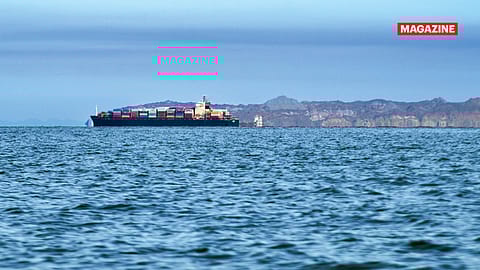
A cargo container ship in the Strait of Hormuz. | Credits: Getty Images
Iran War Impact: The energy shock that ripples through India, writes Vishal Kampani
The Strait of Hormuz has been weaponised amid Iran–Israel–U.S. tensions, choking vital oil and LNG flows and sending Brent crude above $100. India faces a rising import bill, rupee pressure and higher inflation, yet its larger, more diversified, less oil‑intensive economy and stronger reserves leave it structurally better placed than in past oil shocks, though not immune to pain.
This summary is AI-generated, and Fortune India is not responsible for its content or any associated copyright issues.
A prolonged closure of the Strait of Hormuz may impact India’s growth, inflation, currency, and fiscal arithmetic.
A cargo container ship in the Strait of Hormuz. | Credits: Getty Images
This story belongs to the Fortune India Magazine april-2026-the-emerging-100 issue.
The Strait of Hormuz, the key artery of global energy supply, has become the key battleground of the Middle East conflict involving Iran, Israel, and the U.S. As Iran has weaponised the strait, the geopolitical consequences of that development cascaded quickly into energy markets. Tanker operators suspended voyages through the Persian Gulf, war-risk insurance premiums surged, and shipping activity through the Strait of Hormuz came almost to a standstill.
The knock-on effects across global commodity markets were immediate and severe. Brent crude breaching the $100-per-barrel mark in March marks the fourth such instance in the past 25 years. Each of the preceding three oil shocks—in 2008, 2012, and 2022—inflicted real damage on India’s external balances and currency, but the degree of harm progressively moderated. That trend offers a degree of reassurance even as the current shock unfolds.
In the September 2008 quarter, India’s trade deficit deteriorated to -14.4% of GDP. By December 2012, during the next significant spike, the damage moderated to -11.7%. And in the September 2022 shock, the trade deficit came in at -9.7%—still painful, but materially less so. The current account deficit told a similar story: it peaked at -6.8% of GDP in December 2012, but moderated to -3.8% in September 2022. The rupee, too, took a significant blow in 2012, depreciating 12.5% against the dollar.
As a percentage of GDP, oil import costs have halved—from 8.9% in 2013 to nearly 4.3% in 2025. India’s economy has diversified, improved its energy productivity, and grown large enough that the same dollar volume of oil imports represents a proportionally smaller burden. Total oil imports are expected to hold broadly flat at around $183 billion in FY26E, reflecting improved efficiency in the economy.
The growth and inflation calculus
The arithmetic of an oil shock is straightforward for India: every $1 rise in crude oil prices increases the country’s annual import bill by approximately $2 billion, exerting direct pressure on the trade balance. If crude oil sustains above the $100-per-barrel-mark for a significant period, say more than a quarter, the macroeconomic impact becomes more serious. Under such a scenario, GDP growth could be shaved by approximately 0.5 percentage points, bringing full-year growth closer to 6.5%.
Inflation, currently in comfortable territory and unlikely to breach the Reserve Bank of India’s 4% target in the near term, would face broader pressures across categories such as food, transport, and manufactured goods.
The rupee faces near-term depreciation pressure. It had already depreciated 2.57% since the start of 2026 before the latest escalation; in the 16 days following the U.S.–Israel strikes on Iran, it depreciated a further 1.38% against the dollar. Emerging market economies, net importers of energy that tend to attract portfolio outflows when risk appetite falls globally, are typically the hardest hit when crude remains elevated. The RBI has the firepower to intervene through its foreign exchange reserves, but sustained intervention carries its own costs.
More Stories from this Issue
The LNG dimension
While the crude oil shock commands the most immediate attention, the disruption to India’s natural gas supply chain may prove to be more operationally damaging in the near term. The Strait of Hormuz is not only a critical conduit for oil. Nearly 55–65% of India’s LNG imports transit through this corridor. Qatar alone accounts for 35–40% of India’s LNG imports and roughly 20% of the country’s natural gas demand.
Following Iranian strikes on the Ras Laffan complex, Qatar Energy declared force majeure on LNG deliveries on March 3. Gas marketing companies have informed industrial customers that supplies may fall by 10–50%. Domestic LPG cylinder prices were raised by `60 on March 7, and delivery delays of two to eight days are being reported across metros.
What does it mean for the Indian markets?
The Indian equity markets entered this crisis already navigating a complex macro environment. The shift from earnings-driven to oil-driven trading that oil shocks historically produce is now firmly underway. The sectoral playbook is familiar: upstream oil producers such as ONGC and Oil India stand to benefit from stronger crude realisations; defence names, including HAL and BEL, attract sentiment interest as geopolitical premia rise.
On the other side of the ledger, oil marketing companies face margin compression if the government continues to absorb price increases at the retail level. Paints, tyres, aviation, chemicals, fertilisers, and ceramics all face input cost headwinds. Internet companies with food delivery exposure may see food delivery volumes affected by restaurant closures.
{{#most-powerful-women-snapshot-individual.slug}} {{/most-powerful-women-snapshot-individual.slug}} {{^most-powerful-women-snapshot-individual.slug}} {{/most-powerful-women-snapshot-individual.slug}} {{#showRanking}} {{current-rank}} {{/showRanking}} {{#photo.0.url}}
{{name}}
For the rupee, the combination of a wider current account deficit, portfolio outflows in a risk-off environment, and elevated inflation expectations creates a clear depreciation bias. Bond markets will watch the trajectory of crude closely—sustained prices above $90–100/bbl would put upward pressure on yields, compressing equity multiples across rate-sensitive sectors.
The path forward
Oil shocks, history suggests, are ultimately self-correcting. But the timeline matters. Gas prices, in particular, are highly volatile relative to crude oil, given concentrated supply sources and limited storage, and can correct sharply once supply concerns ease and trade flows normalise. An early resolution of even a part of the disruption—particularly the re-opening of the Strait of Hormuz shipping lanes—would be significantly more consequential for emerging market economies than any individual policy response.
India enters this shock in a structurally better position than in 2008 or 2012. Its economy is larger, more diversified, and less oil-intensive. Its external reserves provide a meaningful buffer. The government has demonstrated, across successive cycles, a willingness to use fiscal tools to cushion the domestic economy from acute external price shocks.
Having said that, if Hormuz remains effectively closed, if Ras Laffan stays offline, and if Brent crude holds above $100 per barrel through the June quarter, the cumulative impact on India’s growth, inflation, currency, and fiscal arithmetic will be meaningful.
The fourth oil shock of this century may prove more manageable than its predecessors. But it will not be painless.
(The author is Vice Chairman and Managing Director, JM Financial Ltd. Views are personal.)
Follow Fortune India
Sign in to read full story
To access our exclusive magazine content, sign in to your Fortune India account.
Sign In NowNEXT STORY