Iran War Impact: The risks to the economy and how the government is dealing with them
/ 7 min read
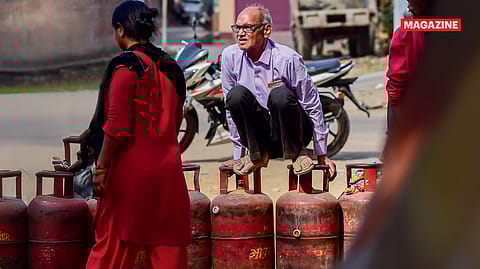
The scene outside an LPG outlet in Lucknow on March 19, 2026. The closure of the Strait of Hormuz led to tightening of energy supplies, including LPG, in India. | Credits: Getty Images
Iran War Impact: The risks to the economy and how the government is dealing with them
Donald Trump’s disruptive economic policies and the U.S.-Israel war on Iran have triggered a severe global energy shock, with Brent crude spiking to $117. India faces soaring oil import costs, macro risks to growth, inflation and current account, and micro disruptions across sectors like fertilisers, autos and exports, even as the government cuts fuel excise and vows a multi-pronged response.
This summary is AI-generated, and Fortune India is not responsible for its content or any associated copyright issues.
Escalating tensions in the Middle East are reverberating through the global economy. If the crisis continues, the story could play out the same in India.
The scene outside an LPG outlet in Lucknow on March 19, 2026. The closure of the Strait of Hormuz led to tightening of energy supplies, including LPG, in India. | Credits: Getty Images
This story belongs to the Fortune India Magazine april-2026-the-emerging-100 issue.
AMERICAN PRESIDENT Donald Trump’s capricious and whimsical ways of dealing with the global economic order in the past one year have had tempestuous consequences on global trade. The U.S.-Israel joint attack on Iran, which has entered the second month, is a big blow for the global economy. The world is on the brink of a vicious loop of energy and oil shocks leading to firming up of prices and interest rates, and a colossal dent on global growth.
As missiles and drones wreak havoc on the refineries and critical oil infrastructure of both the sides — America’s allies in the Middle East (Saudi Arabia, the U.A.E., Qatar, Bahrain, and Jordan), and Iran itself — crude oil prices have soared, with benchmark Brent crude touching a high of $117 per barrel on March 19, registering a 67% jump over the pre-conflict average price of $70 per barrel in February.
This has sent prices of the Indian crude oil basket soaring. Price of crude oil (Indian basket) stood at $142.69 per barrel as on March 16 against an average of $69.01 in February.
To cushion the impact, the government has cut excise duty on petrol from ₹13 to ₹3 per litre, and on diesel from ₹10 per litre to nil.
India’s diplomatic interventions and subsequent safe passage to its oil and LNG tankers, via the Strait of Hormuz — which remained closed for everyone initially — came as a respite.
In his address to the Lok Sabha on March 23, Prime Minister Narendra Modi said the current crisis is a challenge for economies worldwide, and the government is working on a comprehensive short-term, medium-term, and long-term strategy.
That said, economists say that in the wake of a continued war, macroeconomic risks will only deepen. Economist Gita Gopinath has said that global growth could shrink by 0.3-0.4 percentage points if crude averages at $85 per barrel in 2026. The Reserve Bank of India estimates that every 10% increase in crude oil prices can reduce growth by 15 bps.
More Stories from this Issue
Economists believe the Indian economy, too, will have to brace for impact in case the war stretches for long. Macro risks, including the impact on GDP growth, inflation, exports, current account and currency, and remittances are some of the key challenges to watch out for, depending on the duration of the war. This may also impact Budget calculations, though the government may try to salvage the fiscal deficit given the ratings upgrade this year, say economists.
Crisil chief economist Dharmakirti Joshi says this is a very big shock. “There are multiple dimensions — energy, gas, freight cost, and insurance, etc. If this prolongs, there will be a downside to the global economy. It will also create a downside to us,” he tells Fortune India, adding that Crisil expects the Indian economy to grow at 7.1% in FY27. “There will be a downside to this and upside to inflation if the war continues.”
On March 28, chief economic adviser V. Anantha Nageswaran said there will be a “considerable downside” to the GDP growth projection of 7-7.4% for FY27 due to the crisis.
Rajni Thakur, chief economist at L&T Finance, says the impact on GDP, if the war persists for two months or so, could be in the range of a couple of basis points. “But if it carries on for more than two to three months, and the oil prices remain at $90 per barrel, then we may expect a major impact in the range of 0.5-0.6 percentage points. GDP growth may come down in the range of 6-6.2%,” she says.
{{#most-powerful-women-snapshot-individual.slug}} {{/most-powerful-women-snapshot-individual.slug}} {{^most-powerful-women-snapshot-individual.slug}} {{/most-powerful-women-snapshot-individual.slug}} {{#showRanking}} {{current-rank}} {{/showRanking}} {{#photo.0.url}}
{{name}}
If this happens, it will mean that India’s trend line growth, now expected to be around 7%, will retreat to the 6-6.5% levels. But it depends on the longevity of the crisis, say economists, even as some point out that the situation may not immediately go back to normal. “If it (the war) ends today, it will take three to four months to build back the infrastructure and get the confidence on the supply lines, etc. So, the first quarter is anyway gone,” Indranil Pan, chief economist, YES Bank, tells Fortune India, adding that 7% GDP growth with a downside bias could be a probability.
Apart from the headline numbers, one of the deep concerns is the micro disruption across segments. “Tiles, plastic industry, and other oil-derived industries are suffering... from that perspective, there could be smaller implications that may aggregate into bigger problems,” says Pan.
Given the size of the economy, the macro impact may not be as significant as the micro impact, says Madan Sabnavis, chief economist, Bank of Baroda. “[The] micro impact on various industries which are getting impacted on the account of the supply issues is actually the more significant challenge. For example, the automobile industry is facing problems in painting vehicles due to challenges in gas supply. Fertiliser industry is also under pressure, especially urea. Glass industry uses gas for production,” he tells Fortune India, adding that at some point, it may impact employment and income generation. It is likely to affect 10–15% of domestic urea and complex fertiliser production, while the subsidy bill may rise by ₹20,000-25,000 crore, says a Crisil report.
Sabnavis points out yet another aspect that may play out into both consumption and current account — remittances. According to the RBI, the Gulf Co-operation Council countries — the U.A.E., Saudi Arabia, Kuwait, Qatar, Oman, and Bahrain — together accounted for 38% of the total remittances in 2023-24. “The impact on remittances will automatically affect consumption. The dependants and the family back here will not be able to spend that much due to shortfall in the remittances,” he says.
Inflation watch
ON THE OTHER impact, Thakur of L&T Finance points out that the fertiliser segment needs to be watched and vulnerabilities in certain export and import segments have also come into play, which will lead to micro developments adding up to the macro challenges. “Oil price is a short-term impact. Food and fertiliser have a larger impact on inflation and macros,” she says, pointing out that the micro picture may have more serious concerns as exporters across commodities such as basmati rice (mostly in Punjab), banana (Jalgaon, Maharashtra), and spices (Kerala) were stuck. But they are finding alternative markets.
Joshi points out that rationed quantity of gas at a probably higher price will have an economic impact. “When oil prices increase, transportation cost goes up. It hits you in two ways. On gas, I think price will go up and there will be shortage for the industry. Households and transport are protected but for the industry, the cuts have already begun.”
Joshi says one needs to watch how this plays out in agriculture and fertilisers. While fuel inflation also went up in the wake of the Russia-Ukraine war, the complexity of the current situation is far greater, he says. “And this is coming on the back of the tariff turbulence. So, there was some supply chain disruption from tariff; this adds another layer to that if it continues.”
But Sabnavis points out that India may not see any impact on inflation given the design of the weights in the new series, unless the government increases fuel prices. “It looks unlikely in the next few months. But the government will also assess in case of a deep-rooted war, lasting longer. Right now, adjustments can be done through the oil marketing companies.”
Thakur believes that if the situation continues for three months, inflation could touch an upper level of 5.5%, despite being in a low inflation scenario at present. “We were looking at a softer first half and then getting to 4% in the second half of the financial year. That will change,” she says.
More than inflation and growth risk, the challenge is more on the external sector front and how much the RBI will be willing to manage the forex situation, says Pan. The rupee has already breached 94 to a dollar and may surpass 98, according to research and brokerage firm Bernstein. If the crisis prolongs, the current account deficit will be the worst impacted in FY27, says a Standard Chartered report.
Meanwhile, experts are of the view that the government will stick to the fiscal deficit target of 4.3% even if the situation worsens. But since an expansionary fiscal policy may not be opted for, there may be some cuts in capex. “Suppose we absorb the cost fiscally. But then, recently we have had [an] S&P upgrade, and may not want to be seen in a negative fiscal light. Then you have to curtail your expenditure somewhere. The axe has to fall on capital expenditure,” says Pan.
Sabnavis says since the government has cut excise duty, it can also cut back some expenditure. “With the Budget running into ₹50 lakh crore, loss of revenue to the tune of ₹1 lakh crore can be compensated by cutting expenditure,” he says, adding it is easier to curtail capex as it is discretionary.
Joshi says one has to watch out for the capex, although the government is fiscally prudent and does not compromise on capex. “But it depends how long it continues; small amounts can be digested.”
Undoubtedly, the crisis has come as a spanner in the wheel for the Goldilocks phase of the Indian economy. The global and the Indian economy may be in for further shocks as the geopolitical disruption does not seem to be abating anytime soon given the cryptic message of Israeli Prime Minister Benjamin Netanyahu on March 19. “We have got more work to do and we are going to do it,” he had said.
Follow Fortune India
Sign in to read full story
To access our exclusive magazine content, sign in to your Fortune India account.
Sign In NowNEXT STORY