How Mastercard is tapping into India
/ 6 min read
After resetting its strategy post the RBI ban, Mastercard is now doubling down on its India bet.
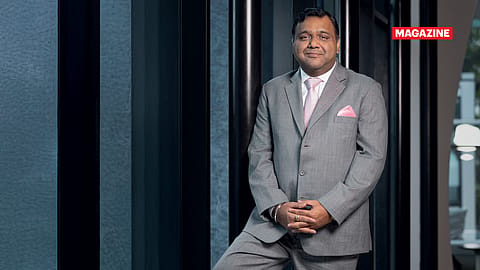
Gautam Aggarwal, division president, South Asia, and country corporate officer, India, Mastercard | Credits: Sanjay Rawat
This story belongs to the Fortune India Magazine may-2026-biocon-next issue.
SOMETIMES, sailing out alive from a perfect storm might not be a fairy-tale ending, as Mastercard’s India unit, part of one of the world’s largest payments networks, possibly thought. The Reserve Bank of India (RBI) had, in June 2022, lifted a nearly ten-and-a-half-month ban on Mastercard, allowing it to sign up new debit, credit, and prepaid customers.
Mastercard had to plug the leaks in its hull and mend its tattered sails to catch up with rivals such as Visa, which had avoided the storm. Mastercard and its smaller rivals, American Express and Diners International, had attracted the RBI’s ire for failing to comply with regulations issued in 2018 requiring foreign card networks to store their Indian payment data locally. In July 2021, the central bank had banned Mastercard from issuing new debit-, credit- or prepaid cards to domestic customers. It lifted the ban on June 16, 2022.
Mastercard made a new beginning in January 2023. To modify its famous tagline, there are some things that money can’t buy; for everything else, there’s… Gautam Aggarwal, the man brought in to head its India operations from January 1, 2023 as division president, South Asia and country corporate officer, India.
What did Aggarwal face? And how is he using artificial intelligence (AI) to fix Mastercard India?
In 2020, before the pandemic, Mastercard held over a third of the Indian market by number of card transactions. Mastercard does not directly issue debit or credit cards; they are issued by its member banks and financial institutions.
Prior to the RBI action in 2021, Visa held a 55% market share, followed by Mastercard at 35% and the local card network RuPay at 10%. Following the ban, its market share is estimated to have fallen to around 26%. Visa gained by default. Cut to 2026, the government-backed RuPay is gaining strength, reaching a 25% share. Visa’s 50% market share is believed to be twice that of Mastercard, according to an industry source. In the same six-year period, UPI, the unified payments interface developed and operated by the National Payments Corporation of India, has emerged as the leader in retail payments with 90% of transaction volumes, according to a PwC India study. Pertintently, RuPay is the only card network whose credit cards can be linked to UPI, giving the domestic network a significant edge over the foreign card networks as more consumers route everyday spending through UPI QR codes.
Before Aggarwal took charge of the India operations, he had been working out of Singapore as Mastercard’s chief technology officer in the Asia-Pacific. Aggarwal assisted his predecessor Nikhil Sahni, who had been heading India operations and was also the division president, South Asia, since mid-2021. The RBI had imposed the ban a month after Sahni had taken over.
More Stories from this Issue
During the ban, Mastercard started losing market share because it had no option but to release its earlier commitments made to banks. “Market share takes time to come back,” Aggarwal tells Fortune India. Currently, Mastercard works with over 55 banks and supports more than 16 million online platforms, merchant and ATM centres across India.
Aggarwal says before Covid-19, Mastercard had a larger market share in India, but at that time the market was the size of a coin compared with what it is today. “Now, though our market share might be steady, the market is like ‘a football field’. There is actually a huge runway in India; it is not about competing with UPI or RuPay.”
With digital payments growing alongside credit cards, Mastercard must work on value-added card solutions, while continuing to try to build trust among stakeholders, according to experts.
Says Mihir Gandhi, partner and leader, payments transformation and fintech, PwC India: “The credit card market is growing rapidly in India, at approximately 19-20% in volume and value terms each year. But only about 5-6% of the population have access to credit cards, even while there are approximately 117 million active credit cards in circulation as of February 2026.”
{{#most-powerful-women-snapshot-individual.slug}} {{/most-powerful-women-snapshot-individual.slug}} {{^most-powerful-women-snapshot-individual.slug}} {{/most-powerful-women-snapshot-individual.slug}} {{#showRanking}} {{current-rank}} {{/showRanking}} {{#photo.0.url}}
{{name}}
India had one billion debit cards and 110 million credit cards in circulation as on March 31, 2025.
What is Aggarwal doing to streamline operations? “The first is to build trust, whether it is related to merchants, consumers, card issuers, regulators, government, and employees. This is being done by ensuring the safety and security of card payments in the ecosystem, tap and pay, and education of the product,” Aggarwal says.
The second strategy is to focus on innovation. The Indian payments ecosystem is starting to understand that the OTP (one-time password) is a clunky technology. The RBI has mandated that from April 1, all digital payments above ₹15,000, including UPI and card payments, will require two-factor authentication. Customers will need to register once for the e-mandate using additional factor authentication (AFA). After this, payments within the prescribed limits can be processed without using OTP authentication each time.
Mastercard has begun tapping AI. “We believe the next structural shift in commerce is the rise of agentic commerce,” Aggarwal says.
In fact, in February, at the India AI Summit in New Delhi, Mastercard unveiled what it claimed to be India’s first-ever ‘fully authenticated agentic commerce transaction’. This was done through the Mastercard Agent Pay, where AI agents securely initiate and complete an e-commerce transaction — using stored payment credentials — on behalf of the user. Agent Pay is an AI-powered payments framework that enables verified AI agents to securely make purchases on behalf of consumers or businesses. It will help banks by providing transparent visibility into agent-led transactions, preventing fraud using advanced tokenisation, and allowing issuers to maintain strict security and control over autonomous purchases. “Through capabilities such as tokenisation, trusted agent identity, and frameworks like Agent Pay, we are ensuring AI-driven transactions are secure and scalable,” Aggarwal says.
Mastercard had completed a similar transaction in Australia, earlier in January 2026.
In the coming years, Mastercard India will scale up AI-driven decisions, authentication and strengthen developer enablement through Agent Pay, so that banks can build and deploy next-generation payment experiences.
Besides trust and innovation, inclusion is the third part of Mastercard’s strategy in India. Through the Mastercard Strive initiative, more than 900,000 MSMEs — over half of them women-owned — are being supported with access to capital, digital tools and business networks.
Here, Aggarwal quotes Mastercard’s global CEO, Michael Miebach: “If it is not inclusive, it doesn’t scale. If it doesn’t scale, it doesn’t matter”.
“Mastercard has the opportunity to introduce innovative products at scale, which can be adopted by consumers in India,” a senior executive with a private sector bank says on the condition of anonymity.
India’s digital payments ecosystem continues to evolve rapidly through UPI on credit, which allows RuPay credit cards to be linked to payment applications such as Google Pay and PhonePe.
PwC’s Gandhi says, “UPI on credit is helping the market to grow, led by RuPay credit cards on UPI, which now has a 35-40% market share in terms of new issuances.” RuPay on UPI is gaining popularity for smaller payments.
Over the past few years, the credit card industry has seen a decline in the ‘revolver’ segment, where customers used to carry forward a portion of their outstanding balance and pay interest, which is reducing.
“It is now less than 20%, against 30% pre-Covid. Customer habits are shifting from revolving transactions to EMI-based transactions, with cardholders increasingly choosing structured EMIs or settling their dues in full at one go instead of carrying balances,” Gandhi says.
“UPI has changed behaviour by removing friction from everyday payments. People now expect instant, free, and seamless transactions. That makes credit cards less necessary for daily expenses,” adds Anuj Das, senior market research consultant at IMARC Group, a global market research firm.
But UPI is still primarily a debit-led system, and even with credit-on-UPI emerging, it hasn’t fully replicated the structured credit ecosystem that cards offer. “Where credit cards remain strong is credit underwriting, risk management, and high-value consumption,” Das says.
Mastercard’s Aggarwal will need to work with banks beyond the top 10 private lenders, including PSBs and small-finance banks. March 2026 data from Asit C. Mehta Investment Intermediates shows high competition from mid-cap banks in card issuances (Federal Bank grew 88% and IDFC First Bank grew 28% year-on-year in cards in force). That trend will help in building not just a long tail, but a “thick” long tail. As revenues for players such as Mastercard and Visa grow, they will need to create space for the denominator to expand, thereby capturing a larger market share.
In large economies, digital payments account for a substantial share of GDP. For India, it accounted for 11.7% of GDP in FY23, indicating significant growth potential.
One of the important shifts in the digital ecosystem could be Apple Pay’s entry into the Indian market, expected sometime in 2026. After being widely available across the Americas, Europe, the Middle East, and the Asia-Pacific, it is expected to enter India soon. India’s leading private sector banks, including ICICI Bank, HDFC Bank, and Axis Bank, and players such as Mastercard and Visa, are said to be in talks with the iPhone maker, even as Apple is in discussions with the regulator on data localisation norms.
Ajay Awtaney, founder, LiveFromALounge.com, an Indian credit cards analysis platform, says, “As biometric authentication [Face ID, Touch ID] gains popularity in India, the acceptability for Apple payments will improve.”
For Mastercard, success will depend on which element of its strategy clicks first: building trust (read: a secure network), innovation (where AI plays a role), or inclusion (the population numbers are mouth-watering). Aggarwal will hope it is all three, together.
Follow Fortune India
NEXT STORY