MNC 500: Why edible oil major AWL Agri is transforming into a food giant
/ 7 min read
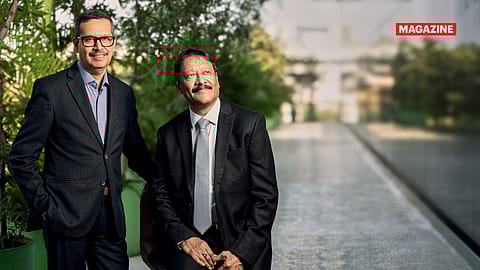
(From left) Shrikant Kanhere, MD & CEO, AWL Agri Business, and Angshu Mallick, executive deputy chairman, AWL Agri Business | Credits: Narendra Bisht
MNC 500: Why edible oil major AWL Agri is transforming into a food giant
Wilmar International, through its subsidiary AWL, is transforming into a food giant by expanding its staples business. With a focus on branded commodities like rice, dal, and atta, AWL aims to reduce its reliance on edible oil. The company plans to increase its food segment to 30-35% of its volumes, enhancing margins and de-risking from oil price fluctuations.
This summary is AI-generated, and Fortune India is not responsible for its content or any associated copyright issues.
From a predominantly edible oil company, the ₹64,753-crore AWL Agri Business, ranked 10th on the list, aspires to become a food conglomerate by 2027, ensuring every Indian consumes Fortune-branded atta, dal or rice.
(From left) Shrikant Kanhere, MD & CEO, AWL Agri Business, and Angshu Mallick, executive deputy chairman, AWL Agri Business | Credits: Narendra Bisht
This story belongs to the Fortune India Magazine february-2026-mnc-500-indias-largest-multinationals issue.
AT A TIME when most FMCG CEOs are talking about premiumisation, micro-segmenting consumers, and offering specialised solutions, Angshu Mallick refuses to shed his commodity mindset. “We are a commodity player by nature, and we like to play in commodities,” says the executive deputy chairman of AWL Agri Business (the makers of Fortune edible oil).
In the past 25 years, Mallick has built a mammoth business selling branded edible oil, which is extremely vulnerable to global oil price fluctuations. In recent years, he has also built brands out of commodities such as rice, dal, soyabean, and atta. While the bulk of AWL’s revenue of ₹64,753 crore (as of FY25) comes from edible oil, its staples business — built over the last five years — generated ₹6,000 crore in revenue; the plan is to scale this into a ₹10,000-crore business by 2027.
While Mallick can’t stop talking about staples, his lieutenant Shrikant Kanhere, recently elevated to MD & CEO from CFO, is clearly the numbers man. “Food currently contributes 18-19% of our volumes and the rest is oil and industry essentials. We want to make food 30-35%, as that will significantly help us de-risk from oil and improve margins,” he says. “In edible oil, your gross margin can be 12-13%, but in food it can go up to 25%. In edible oil, you can get 4-4.5% Ebitda margins at the most; in food, it can go up to 8-9%,” Kanhere explains.
The astounding growth story (which is not necessarily profitable) of D2C brands has shaken most legacy FMCG firms. Since launching their own D2C brands was not the best option, they did the next best thing: acquire D2C brands — a playbook followed by many, including HUL, ITC, and Tata Consumer Products. In contrast, AWL has beefed up its digital brands by launching e-commerce- and quick commerce-friendly products such as biryani mixes and ready-to-cook khichdi.
“We have not acquired a D2C brand because our DNA is volume. D2C is a business where you are directly connecting with the consumer, therefore it’s a small volume business... We do 6.5 million tonnes every year. We don’t want to fix something in our culture where there is no fit. We are a mass player, every third kitchen has one or other product of ours,” says Kanhere.
The ‘A’ in AWL Agri
In November 2025, the Adani Group completely exited its 44% stake in the FMCG major, then called Adani Wilmar Ltd, by selling a chunk of it to Wilmar. This made AWL a subsidiary of Singapore-based Wilmar International. With Adani out of the picture, what does ‘A’ in AWL stand for? “It doesn’t stand for anything,” smiles Mallick. “AWL is what we are called in the trade, even in the stock market. Our chairman felt that since AWL is close to heart, we should stick to it.” Wilmar had been driving the business from 2010 onwards. “Therefore, there is no strategy change or process change or structural change. The overall thought process of Wilmar remains unchanged,” says Mallick. The Singapore-headquartered firm operates in 90+ countries in oleo chemicals, sugar, wheat, specialty rice, and edible oil.
The business of staples
For AWL, the strategy is clear: reduce dependence on oil by becoming a formidable food firm. The intent is to play in staples and not in categories such as biscuits or snack foods. Biscuits, says Mallick, has large players such as Britannia, Parle, and ITC, and hence, there is not much room for growth. Snacks, he says, is more a regional play.
More Stories from this Issue
“In India, 90% of staples is sold loose,” says Mallick. The conversion from loose to packaged staples has been hastened because of e-commerce and the pandemic, he says, adding that the incremental market for packed food is so big “that for companies such as ours that have brand, distribution, and manufacturing in place, it is easy to grab the incremental market”. More than 80% of the edible oil market is packaged and branded, but the staples market is predominantly unbranded.
Mallick explains the opportunity in the staples business. “When you look at sugar, hardly 5% or 7% is branded; atta is highest at 12-15%, dal is 2-3%. Branded basmati rice is 30-40%, but non-basmati is 8-12%. So, this category is unbranded, fragmented and people are not sure what they are buying, but slowly, are getting brand conscious.”
“Also, [per capita] edible oil consumption is only 17 kg per annum, but sugar is 24 kg, atta is 50 kg, rice is 60 kg and dal is 22 kg. If you look at the entire staples basket, it is much bigger than edible oil. So, all this, after 5-15 years, if 40-50% of the food basket is branded, just imagine the size of the business,” Mallick adds.
The food business is also a game of logistics, says Mallick. The better your logistics, the more you will grow. “The price of sugar is ₹40 a kg, transport cost is ₹3-4 a kg, 10-15% is freight, packaging is another 5-6%, so, you must be smart in packaging and logistics costs. A sugar-only player will find it difficult to take sugar packed in Pune or Baramati to the Northeast or Kolkata, but if you have a range of products like oil, sugar, flour, you can take them together,” says Mallick. He explains that an integrated approach will support logistics, it will support easy dispatches, and the entire basket is the kitchen basket. “My brand fit is there, manufacturing fit is there, distribution fit and my consumers are there.”
{{#most-powerful-women-snapshot-individual.slug}} {{/most-powerful-women-snapshot-individual.slug}} {{^most-powerful-women-snapshot-individual.slug}} {{/most-powerful-women-snapshot-individual.slug}} {{#showRanking}} {{current-rank}} {{/showRanking}} {{#photo.0.url}}
{{name}}
In 2022, AWL acquired basmati rice brand Kohinoor through which it is tapping into premium consumers — essentially on quick commerce and e-commerce platforms — with ready-to-cook products such as biryani, Thai rice, and Chinese fried rice.
While it has significant market share in soya chunks, it has also forayed into atta, besan, dal, sugar, sooji, roasted rava for the southern markets, and poha. “We are selling 900 tonnes a month of branded poha. We are also exporting poha to China, the Middle East, Dubai and Australia,” he claims.
The company has also launched wheat as a product. The rationale is that only 15% consumers buy branded atta; the rest (85%) buy wheat and get it processed at a chakki (mill) nearby. “We are currently selling 1,500-2,000 tonnes a month [of wheat], but this has potential to grow,” says Mallick.
Entering adjacencies
The aspirational Indian may not cook staples every day. Some days, they’d prefer noodles or pasta — and they’ll need the right condiments. With that in mind, AWL acquired G.D. Foods (owner of Tops, a popular brand in the North for ketchups, sauces, pickles, and jams) in April 2025 for an enterprise value of ₹600 crore. “This company has a top line of ₹500 crore with an Ebitda margin of 10-15%. It is a logical expansion for our food business. It is a high-margin business,” says Kanhere.
G.D. Foods has a longtail of products that are ready-to-cook, such as gulab jamun mix, dhokla mix, and idli mix. “Our objective is to leverage our distribution and make it 2x in the next three years. Right now, it is a ₹500-crore business; the plan is to scale it to ₹1,000 crore,” Kanhere adds.
More recently, AWL acquired the ₹100-crore Omkar Specialty Chemicals, which Mallick says would be an addition to its oleo chemicals business. “If we want to become a big oleo player, we need to be in specialty chemicals and hence our acquisition. We are the largest oleo chemicals player in the country today, and oleo chemicals are an extension of our palm oil business.”
The plan is to be a part of the entire food value chain. AWL’s intervention in palm begins from the plantations. “We process crude palm oil and make refined palm oil which goes to the biscuit industry and baking industry. If you further process it, you get palm-olein, used as frying oil by institutions. The palm-olein gets converted into glycerine, which goes into soap noodles. We are the largest seller of soap noodles in the country,” says Mallick.
In fact, AWL’s dominance in soap noodles (which it sells to the likes of HUL and Godrej) led to its personal care business. Its soap brand, Alife, at a ₹10 price point, claims Kanhere, is establishing dominance in the rural markets. “We sell close to 1,200 tonnes of soap per month. We are a ₹100-crore brand only in soaps.” It is also in the handwash space and utensil cleaners.
In soyabean, it crushes soya seeds, makes soyabean oil, soya meal for cattle feed, soya nuggets, and soya flour.
The institutions
Around 30% of AWL’s business comes from B2B and institutional sales. It also supplies specialised flour to burger and pizza chains and makes products like bakery shortenings.
The contribution of B2B and institutions to the business, says Kanhere, will increase due to its focus on specialty products. AWL, for instance, has a significant presence in rice bran oil. “The more you go to the tail of the value chain, it is niche and specialised. We are not there as yet, but these are potential business opportunities for us. From the hash that you get when you burn the bran, you can get silica, which goes to the rubber and tyre industry. This is called agri-based silica. Auto companies want this silica as a part of their strategy to be more environment friendly,” explains Mallick.
What excites AWL in the immediate future is its ability to offer an entire basket of products. The vision is to have a prominent presence in the home of the Indian middle class.
Follow Fortune India
Sign in to read full story
To access our exclusive magazine content, sign in to your Fortune India account.
Sign In NowNEXT STORY