Radico Khaitan is banking on a cocktail of legacy and luxury to drive future growth
/ 6 min read
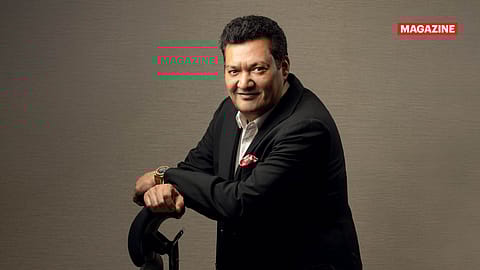
Abhishek Khaitan, MD, Radico Khaitan | Credits: Sanjay Rawat
Radico Khaitan is banking on a cocktail of legacy and luxury to drive future growth
Radico Khaitan is reshaping its identity from bulk supplier to premium and luxury spirits powerhouse, leveraging mass brand 8PM and ultra-luxury Rampur Signature Reserve to ride India’s premiumisation wave. With double-digit growth in prestige-and-above, aggressive innovation across whisky, gin, rum, vodka and liqueurs, and a focus on high-margin markets, it is targeting stronger Ebitda and global relevance.
This summary is AI-generated, and Fortune India is not responsible for its content or any associated copyright issues.
Driven by premiumisation, Radico Khaitan is blending legacy with luxury to script its next phase of growth.
Abhishek Khaitan, MD, Radico Khaitan | Credits: Sanjay Rawat
This story belongs to the Fortune India Magazine april-2026-the-emerging-100 issue.
IN AN INDUSTRY where premiumisation is the trend, Radico Khaitan is emerging as a formidable force, blending legacy (8PM whisky) with luxury (Rampur Signature Reserve).
The price range couldn’t be wider: 8PM, one of the world’s best-selling whiskies, retails for ₹500 per 750ml bottle in Delhi. Rampur Signature Reserve is a single malt whisky priced at ₹5 lakh for a limited-edition 750ml bottle.
Radico reported a robust performance in Q3FY26, with a 26% surge in volumes in its prestige-and-above portfolio and a 33% year-on-year growth in the regular segment.
For Radico Khaitan’s MD Abhishek Khaitan, this momentum is no accident but the fruit of a transformation spanning over a decade.
“What we have built over the last 10–15 years is now paying off,” he says, pointing to a carefully curated premium portfolio that has steadily gained consumer traction. “We launched Rampur (Indian single malt whisky) in 2016, followed by Jaisalmer (gin) in 2018.”
“In 2022 and 2023, we launched Royal Ranthambore and Sangam, respectively. In 2024, we launched Kohinoor, and in 2025, we launched a separate expression of Rampur,” Khaitan says. Royal Ranthambore is a blend of Scotch and Indian whiskies, while Sangam is a blend of European/ New World whiskies with Indian whisky. Kohinoor is a premium Indian dark rum.
Khaitan says Indians love Indian whiskies. “Last year, [sales of] Indian single malts outnumbered Scottish malts. People in India love Indian stuff. It is not that they are priced cheaply; Indian single malts are priced higher than their Scottish counterparts,” he says.
More Stories from this Issue
“Single malt is a niche category. So a person who drinks a single malt understands the malt; he is well-educated and aware. The Indian single malt started as a mystique; there was a mystery behind it. But eventually, people loved the taste. In the end, it is the taste that will drive demand for your product. We are the only Indian single malt for Air India’s business and first class, I might add,” Khaitan says.
As consumer preferences in post-pandemic India tilt towards experiences and higher quality offerings, Radico Khaitan is betting big on premiumisation, global ambitions, and innovation-led growth to capture high margins. Gone are the days when it was called Rampur Distillery Company, a bulk supplier of spirits and a bottler for big brands. The Khaitans bought the distillery and launched its first branded product, 8PM whisky, in 1999. Radico is derived from that Rampur name.
“The company launched Spirit of Kashmyr (vodka). We had been doing single malts, which start at ₹8,500 and go up to ₹5 lakh a bottle for [Rampur] Signature Reserve. To celebrate 10 years of Rampur and commemorate our history, we are coming out with Rampur Virasat in the affordable luxury segment,” he says. This “very unique offering” would be priced at ₹3,000-4,000 a bottle.
The company plans to grow the prestige and above segment by 15% year-on-year. “So, all our brands have started gaining traction. Royal Ranthambore grew by 50% last year. And it would be the only Indian whisky to be priced higher than a scotch bottled in India,” says Khaitan. So, all our brands are doing very well.”
{{#most-powerful-women-snapshot-individual.slug}} {{/most-powerful-women-snapshot-individual.slug}} {{^most-powerful-women-snapshot-individual.slug}} {{/most-powerful-women-snapshot-individual.slug}} {{#showRanking}} {{current-rank}} {{/showRanking}} {{#photo.0.url}}
{{name}}
Luxury as a portfolio is expected to touch ₹500 crore, and Khaitan is bullish on growth. “The luxury side should grow at least 30%-plus year-on-year for the next three years,” he says. The company is confident that at this rate of growth in this segment, Radico Khaitan as a whole will become a 20% Ebitda company in the short-to-medium term, “unless some havoc plays out, like the Russia-Ukraine war when grain and glass prices went through the roof.”
According to Khaitan, the market has also evolved post-Covid, with premiumisation and experientialism emerging as trends. “People want to consume the best, and they want to spend on experiences. The days when people would lock money away in bank accounts are gone,” Khaitan says.
The company is bullish on its strategic mix of premium offerings and deep distribution channels to tap the growth opportunities and is also eyeing new segments at home and abroad. In the domestic market, Radico Khaitan plans to expand its vodka business. In India, vodka accounts for just 4.3% of the alcoholic beverages market, compared with nearly 28% globally.
Also, the company is looking to tap into tequila in domestic and overseas markets through a joint venture with Shah Rukh Khan and Zerodha founder Nikhil Kamath. “On the luxury side, a lot is going on. We have formed a JV with Shah Rukh Khan and Nikhil Kamath to create an international brand, with Indian owners,” he says. The JV, D’Yavol Spirits, will produce premium, internationally sourced, and bottled-in-origin tequila. Khan and Radico hold 47.5% each, and Kamath holds 5%.
Radico also has its eye on the global travel retail business — alcohol sold in airport duty-free shops. “GTR will be our big focus areas. We will expand quite a lot in this area,” Khaitan says.
How does the company view the incoming competition following the recent trade deals, especially the one with the European Union, which makes it easier for foreign liquor to be sold in India?
“Competition will always be there. Every player is already here. Eventually, it will be the distribution and the brand. Even if you see Rampur at ₹8,500, it is between Glenfiddich 12 and 18. But still, people want Rampur. India is not a dumping ground, as people know their brand,” Khaitan adds.
The domestic market is a complex cocktail of excise that varies from state to state, with a dash of prohibition in some states. “Radico chooses to sell only in the states where margins are good,” Khaitan says.
“The 33% volume growth is witnessed in the regular side because of the Andhra Pradesh factor, but going forward, the growth in the segment may stabilise to single digits at around 8%,” he says. “The numbers in the regular segment may see some change if Bihar opens up or Delhi’s rules and regulations change.”
Liquor sales in Andhra Pradesh skyrocketed last year after the state rolled out a policy in 2024 that privatised retail shops and introduced low-cost brands. Pent-up demand emerged after the relaxation of the erstwhile regulations, contributing to the surge in consumption.
Then there is prohibition. Bihar imposed prohibition on the sale and consumption of liquor in 2016, joining Gujarat, Nagaland, and Mizoram.
In Delhi, liquor vends are controlled by four government corporations after the private participation policy was rolled back. The retail prices are controlled by the government with restrictions on deep discounts and pricing.
Nitin Gupta, senior research analyst, Emkay Global Financial Services, is upbeat about the company’s volume mix and consumer trends.
“The right state-volume mix and alignment with consumer trends are crucial, and Radico is well placed in this regard,” says Gupta. “The Q3 top line performance (+20% YoY) was 2% ahead of our estimate, while Ebitda margin at 17.3% (+300bps YoY) surprised positively, leading to a 10% Ebitda beat (+45% YoY).”
“On a stable regulatory setting, we expect Radico to clock a low-teens top line and a high-teens Ebitda CAGR over FY26-28E,” says Gupta.
Radico’s sustained investments in premium and luxury offerings, coupled with a resilient performance across both high-margin and regular segments, reflect a structurally strong and diversified business model.
The company’s focus on expanding its prestige-and-above portfolio, entering new categories such as tequila and after-dinner beverages, and growing duty-free business signals a clear intent to drive margin accretion and global brand recognition, say analysts.
“When it comes to after-dinner drinks, there is a very interesting concept — the untold stories of India through our soon-to-be-launched brand Ankahi. We are the only Indian company to have products in every category. Single malt, vodka, whisky and now liqueur,” says Khaitan.
“This is our take on the liqueur category, and through Ankahi, we are starting this series with Zaffran, which is infused with saffron…we are launching in the next couple of months. We are targeting the first half of the next fiscal year in India and the export market in April,” Khaitan says.
While geopolitical disruptions, regulatory shifts, and intensifying competition remain, Radico Khaitan’s strong distribution network, evolving product mix, and alignment with shifting consumer preferences toward experiential and premium consumption provide a firm foundation for sustained growth.
If executed effectively, this strategy is likely to support its aspiration of becoming a high-margin, globally relevant spirits player in the medium term.
Follow Fortune India
NEXT STORY