Shanghvi’s audacious bet with $11.75-billion Sun-Organon deal
/ 6 min read
The acquisition of the U.S.-based Organon & Co. reflects Dilip Shanghvi’s long-term philosophy—staying rooted in the business he understands best.
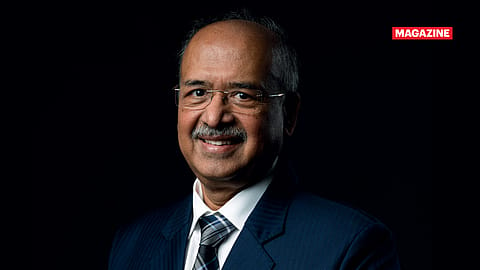
Sun Pharma’s Dilip Shanghvi | Credits: Padmini B
This story belongs to the Fortune India Magazine may-2026-biocon-next issue.
WHEN DILIP SHANGHVI started his pharmaceutical venture in 1983, few could have anticipated that Sun Pharmaceutical Industries would emerge as India’s largest drugmaker, clocking over ₹50,000 crore in annual revenues by FY25. In an era where business leaders chase diversification to build sprawling conglomerates, Shanghvi has taken a markedly different path — staying rooted in the business he understands best.
When Fortune India, in an exclusive interview a few months ago, posed the question: why not diversify? His response was characteristically precise. “There are two models of diversification: either you stay in the same business and expand into global markets, or you stay within one country and learn to build multiple businesses in that system. I chose the first, rather than trying to learn many businesses,” noting that India is only 2% of the world’s pharmaceutical market and there are huge opportunities for Sun Pharma.
That clarity of thought has shaped one of the most audacious deals in Indian pharma’s history: Sun Pharma’s $11.75-billion all-cash acquisition of the U.S.-based Organon & Co. Announced on April 27, the deal stands as the second-largest overseas acquisition by an Indian firm, after Tata Group’s buyout of Corus for $12 billion in 2007.
The acquisition is transformative in ambition and scale. It will nearly double Sun Pharma’s revenues to $12.4 billion, positioning it among the top three global players in women’s health, and the seventh-largest in biosimilars or reverse-engineered versions of patented biotech drugs. It also opens doors to markets across 140 countries — an expansion that aligns with Shanghvi’s global-first philosophy.
Yet, Organon is no easy prize. Its performance over the past five years has been subdued, weighed down by patent expiries, flat revenues, rising competition, shrinking margins, and a debt burden of $8.6 billion. Sun Pharma itself will take on $9.3-9.8 billion in debt and deploy $2-2.5 billion in cash to fund the deal.
Still, the markets cheered. In a rare show of confidence, Sun Pharma’s stock rose 7% on the day of the announcement, defying the typical investor scepticism that greets large acquisitions. It reflects a deep-seated belief in Shanghvi’s reputation as an acquisition strategist — someone who has repeatedly demonstrated the ability to buy troubled assets and turn them around — though some analysts attribute less-than-expected valuation and no stock dilution as reasons for the optimism shown by the Street. Sun’s market cap, as on April 27, was ₹4.17 lakh crore.
“We believe this is a reasonable valuation for a declining business, which has multiple products entering the loss of exclusivity (patent) phase,’’ say analysts at Equirus Securities.
More Stories from this Issue
Rooted in history
The confidence is rooted in history. Over 42 years, Sun Pharma’s growth has been built on a steady cadence of acquisitions — about 24 in total. Its first international step came in 1987 with the purchase of Caraco in the U.S. Two decades later, it fought one of India’s fiercest cross-border corporate battles to acquire Israel-based Taro Pharmaceutical Industries. When Taro backed out of the deal, Sun pursued legal battles across U.S. and Israeli courts, eventually securing control after three years — and full ownership only in July 2024, after nearly 14 years of persistence.
Then came Ranbaxy Laboratories in 2014 — a $4-billion all-stock acquisition that reshaped Sun Pharma’s scale and global footprint. It wasn’t without pain either. Margins fell sharply from an industry-leading 30-35% to below 20%. But over time, through disciplined integration, profitability recovered. By FY25, the company reported a gross margin of 79.3%, Ebitda margin of 29%, and net profit margin of 22.8% — a testament to its long-game approach.
Philosophically, Sun Pharma doesn’t look at conventional business metrics to become successful, says Shanghvi. “The goal is to create what patients need and doctors expect, and design processes around that. Our strategy revolves around improving efficiency and reducing costs wherever possible, to ensure it continues growing faster than both the market and the broader industry.”
{{#most-powerful-women-snapshot-individual.slug}} {{/most-powerful-women-snapshot-individual.slug}} {{^most-powerful-women-snapshot-individual.slug}} {{/most-powerful-women-snapshot-individual.slug}} {{#showRanking}} {{current-rank}} {{/showRanking}} {{#photo.0.url}}
{{name}}
His acquisition strategies also have a clear vision. “First, the acquisition opportunity needs to be strategic; at the same time, we need to see that it is not a short-term bet, but one that helps us continue to grow in the long term. Another is whether we can run that business better than the current owners,” Shanghvi says.
Filling the gap
That thinking is central to the Organon bet. ‘’Organon’s growth has been flat in recent years, and some investments, and focus on improving processes and tools can reignite the growth trajectory of that company,’’ Shanghvi said while announcing the deal. He points to Organon’s steady Ebitda margins of over 30% in the past five years and its ability to generate more than $1 billion in annual free cash flows as underlying strengths waiting to be unlocked.
Analysts estimate a seven-eight year payback period — reasonable for a business facing near-term headwinds, but with significant long-term upside, particularly possible in specialty therapies.
Once part of Akzo Nobel, Organon was first sold to Schering-Plough in 2007, then absorbed by Merck & Co. (known as MSD outside North America), and eventually spun off as an independent entity in 2021. Today, it is a global leader in women’s health, with over 70 products spanning multiple therapies, established products and biosimilars.
For Sun Pharma, this fills a crucial gap. While it has built strengths in dermatology, oncology, ophthalmology, and neurology, women’s health has remained an underrepresented segment. Organon changes that equation overnight.
The company has a leading position in the U.S. contraceptives and fertility segment, and is globally second in hormonal contraceptives and third in fertility. Sale of women’s health medicines netted $1.8 million in revenues, with contraceptive Nexplanon alone contributing $921 million. Other major products include fertility drug Follistim ($264 million), contraceptive Marvelon/Mercilon ($127 million), and fertility injection Ganirelix Acetate ($101 million). About 22 such products contribute 33% of Organon’s total revenues.
The global women’s health market is worth around $35 billion, growing at a 6-10% CAGR, according to industry estimates.
Equally significant is biosimilars — the next frontier in the world of medicine sales. With a global market exceeding $20 billion (growing at 15% CAGR), and nearly $320 billion worth of patented drugs set to lose exclusivity by 2035, the potential biosimilar opportunity is about $70 billion. So far, Sun Pharma has had no presence in the segment. Organon, on the other hand, is the seventh-largest player, with revenues of $691 million in FY25, growing at 13% CAGR over the past five years. Two of its products — Renflexis and Hadlima (used for treating autoimmune diseases such as rheumatoid arthritis) — recorded sales worth $251 million and $228 million, respectively, in FY25.
About 55% of Organon’s revenues come from established brands, which are growing at a CAGR of 6-10%. These products raked in $3.7 billion in revenues in FY25, of which cardiovascular products contributed the maximum, $1.1 billion. Sun reckons it can leverage its extensive branded generics portfolio to rejuvenate Organon’s products. Almost 19-20% of Sun’s revenues come from innovative medicines, and Organon’s portfolio is a big boost in all its markets, as the combined entity will have 27% revenues from these products.
‘’Future growth will depend on in-licensing deals and cross-selling of Sun’s portfolio. Sun is [also] looking to achieve $350 million in synergies through procurement and supply chain over the next two-four years,” say analysts with Equirus Securities.
Another deal clincher is the expansion of Sun’s global footprint and less reliance on the U.S. market. Sun currently operates in about 100 geographies, with 30-32% of its revenues coming from the domestic and the U.S. market, 19% from the emerging markets and 17% from the rest of the world. Post merger, the combined entity will have 27% revenues from the U.S., 29% from emerging markets, 17% from the domestic market and 28% from the rest of the world.
The merged entity will have a footprint in about 150 countries and 18 markets with $100 million-plus in revenues, a 24,000-strong commercial front-end team and a significant presence in the E.U., China, Korea, Mexico and Thailand. Of this, China will be a major market for Sun Pharma, where its presence is currently negligible. It can sell its products in that market rather than relying on partners and entering into in-licensing deals.
‘’Organon’s portfolios, capabilities and global reach complement our capabilities,’’ says Shanghvi.
If there is one consistent thread in Shanghvi’s four-decade journey, it is patience. Shanghvi and his team are now readying for a long battle to merge, integrate, and bring Organon back on a flat-to-high growth trajectory. That may take another three-four years, catapulting Sun Pharma into the big league of pharma firms.
Follow Fortune India
NEXT STORY