Fortune India Exclusive: Succession and the road ahead at Biocon
/ 12 min read
The biotech major embarks on a future-focussed vision, with the succession plan in place ensuring seamless leadership continuity and growth.
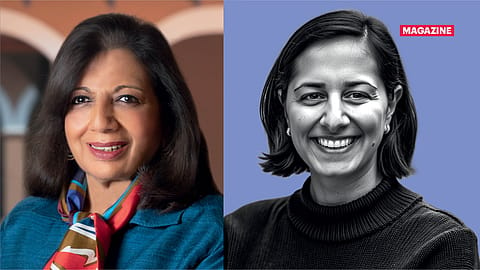
Kiran Mazumdar-Shaw (L) and Claire Mazumdar, founder-CEO of Bicara Therapeutics.
This story belongs to the Fortune India Magazine may-2026-biocon-next issue.
IF I FOUND A POT OF GOLD, I would give it to my aunt for her company to make new medicine for very bad diseases,” wrote a six-year-old Eric.
It was a child’s drawing — a simple cutout of a pot brimming with gold coins, words scrawled on the pot with earnest clarity. Years later, that message would stay with his aunt, Kiran Mazumdar-Shaw. “This is my nephew Eric’s beautiful message at age 6 that has inspired me to do what I do,” she posted on social media in November last year.
Today, the “aunt” is the founder and executive chairperson of Biocon, among the world’s Top 10 biotech employers, and a defining force behind India’s rise in biotechnology. In over four decades, she built India’s biggest biopharmaceutical business with over $2 billion in revenues and a market cap of over ₹70,000 crore.
That boy, Eric Mazumdar — son of Kiran’s brother Ravi Mazumdar — is now a professor of artificial intelligence (AI) at the California Institute of Technology (Caltech), and also serves on Biocon’s board. “I am very happy that I have a board member, and a family member, who is considered globally as one of the rising stars of AI,” Kiran says with unmistakable pride.
From her aesthetically designed and serene green campus office in Electronics City, Bengaluru — the nerve centre from which she built a global biotech empire — Kiran speaks with disarming candour. Emotions come unfiltered: frustration, anger, satisfaction, and joy. Her journey, which began in a garage in 1978, has been a constant struggle, marked by overcoming challenges in a negative environment.
She recalls the early years — chasing capital for ideas few understood, navigating a policy ecosystem that barely acknowledged biotechnology, and contending with markets obsessed with short-term profit metrics. “Nobody supported me until I became a success,” she says, matter-of-factly. Yet, alongside that struggle sits a quieter achievement: building an innovation-led biotech ecosystem in India. “Biocon itself has created almost 100 startups, if you count the number of companies started by former Biocon employees. I am not saying we started it, I am saying Biocon is like the old incubator.’’
In business and drug discovery, reinvention was her operating principle. Every decade brought a pivot. The first focussed on industrial enzymes — a business she eventually exited in 2007. The next saw Biocon focussing on insulin and later becoming one of the world’s Top 3 insulin manufacturers. Post 2009, it doubled down on biosimilars — reverse-engineered versions of patented biologic medicines — to become India’s only global biosimilar player and among the world’s Top 5.
More Stories from this Issue
The last decade has also been about scale and futuristic business opportunities. Biocon invested over ₹10,000 crore in research and development (R&D) for biosimilars, and another ₹10,000 crore in manufacturing capacity to meet future demand. Those bets are beginning to pay off.
But Mazumdar-Shaw is already looking ahead. The next phase is taking shape around high-value biotech innovation, powered by emerging technologies such as AI. In recent months, Biocon has simplified its corporate structure, merged its generics and biologics businesses, and reduced debt. From April 1, Shreehas Tambe — whom Mazumdar-Shaw personally recruited as a management trainee in 1997 to develop Biocon’s enzyme business, and who later climbed up the ladder in various roles — has taken over as CEO and MD of the combined entity. She also reminisces that in her early years, she found it very difficult to recruit people to join Biocon.
Through it all, one constant was her late husband, John Shaw — a Scotsman and former chairman and MD of textiles firm Madura Coats — who passed away in 2022. Since 1999, he had been on Biocon’s board as vice chairman, bringing financial rigour and governance discipline to complement Kiran’s scientific ambition. “My wife is scientifically aggressive, but I am financially very prudent, he would joke. I think we made a fantastic team. He supported me like crazy — ‘Kiran, go and do it, go and take this risk’,” the 73-year-old’s voice softens and eyes well up a bit. The couple has no children.
Dr Devi Prasad Shetty, founder and chairman of Bengaluru-based Narayana Health, says Mazumdar-Shaw is a visionary who didn’t just build a company, but pioneered an entire ecosystem for biotech R&D and high-end manufacturing in India when few believed it was possible. “Her relentless pursuit of innovation has transformed India into a credible global hub for life sciences, making her an enduring inspiration for every entrepreneur striving to bridge the gap between science and large-scale social impact.”
{{#most-powerful-women-snapshot-individual.slug}} {{/most-powerful-women-snapshot-individual.slug}} {{^most-powerful-women-snapshot-individual.slug}} {{/most-powerful-women-snapshot-individual.slug}} {{#showRanking}} {{current-rank}} {{/showRanking}} {{#photo.0.url}}
{{name}}
Agrees Rajesh Jain, chairman and MD, Panacea Biotec. “My first interaction with Kiran Mazumdar-Shaw in 1997 revealed her rare ability to see around corners,” he says. “She has consistently paired bold scientific vision with disciplined long-term execution. She remains a defining force in India’s biotech R&D and manufacturing landscape, inspiring entrepreneurs to build enterprises that are both innovative and globally relevant.”
The successor
Who will carry her legacy forward? Mazumdar-Shaw has already decided, and shares with Fortune India how she chose the successor to the Biocon empire.
About 15 years ago, Mazumdar-Shaw started her research to develop bi-specific antibodies that can simultaneously kill and shrink cancerous tumours. Biocon scientists in Bengaluru successfully developed the molecule, but due to regulatory delays and a lack of capital in India for further development, Mazumdar-Shaw decided to take it to the U.S. for clinical trials. She launched Bicara Therapeutics, a Boston-based biotech startup. Though development work was being done from India, the startup initially had a few employees in Boston to coordinate the trials.
Mazumdar-Shaw wanted a CEO to head Bicara and zeroed in on Eric’s sister and niece — Claire Mazumdar — who had a Bachelor of Science degree in Biological Engineering from MIT, an MBA from Stanford, and a PhD in cancer biology from Stanford School of Medicine. At that time, Claire was working with venture capital firm Third Rock Ventures as a senior associate and led business development and corporate strategy at Rheos Medicines. Initially, she was reluctant to join Bicara, then a Biocon subsidiary based in the U.S., citing more time required to transition to entrepreneurship. “I was younger than you when I started Biocon,’’ Mazumdar-Shaw tried to convince her reluctant niece.
Eventually Claire agreed and joined Bicara as its founder-CEO. Her experience in working with the VC community in the U.S. helped her attract capital, and Bicara got listed on NASDAQ in 2024 with a valuation of over $800 million. The company’s market cap is currently over $1.6 billion, though its new biotech medicine under development to treat head and neck cancer is still in the clinical trial stage. Bicara investors are enthused by the results shown by the promising molecule.
Mazumdar-Shaw says she wants her successor to have three qualities — ability to take risks, and be a strategic thinker and value creator. “I am the sole owner of Biocon, and I need to make sure that I put it in good hands. I have seen my niece Claire as my successor, because I think she has proved to me that she can run a company. I would never give it to anyone who doesn’t know how to follow me.”
Though no date has been fixed for Claire to take charge, she is expected to join in the foreseeable future.
Apart from Claire, a successful biotech entrepreneur, and Eric, an AI expert, Kiran also has her eyes set on Claire’s husband and renowned oncologist Thomas Roberts, who is now working with the Massachusetts General Hospital in the U.S., to be a part of the team of family members to lead Biocon in the future. Married to Claire in 2018, he has also been on the board of Biocon Biologics since 2021.
The biosimilar bet
Beginning as a joint venture with an Irish firm to produce enzymes for the brewing industry, by 1990, Biocon evolved into a leading manufacturer of green bio-enzymes to replace chemicals used across textiles, paper, leather, and starch processing. Mazumdar-Shaw says she was among the first to develop enzymes to make bioethanol and several others, building India’s largest enzyme firm by 2000.
In 2007, Biocon exited the enzyme business, selling it to Novozymes for $115 million, pivoting decisively towards biopharmaceuticals.
The shift had been seeded earlier. In 1994, Biocon set up Syngene, a listed R&D services company for the global pharmaceutical and biotech industry, aiding its transition into biologics. Collaboration, says Mazumdar-Shaw, has always been central to Biocon’s strategy — from its early joint venture with Cuba’s CIMAB to its partnerships with Viatris (then Mylan) and Pfizer to develop biosimilars.
The big pivot came with biosimilars — an opportunity as complex as it is promising.
Biocon is betting on biosimilars for its next phase of growth, targeting blockbuster biologics that will lose patent protection over the next decade. As Tambe notes, of the 55 biologics with annual sales above $1 billion expected to lose exclusivity between 2022 and 2032, a significant portion will come towards the latter half of the decade. The cumulative market opportunity is estimated at $270 billion.
“If you just look at cancer drugs [among the list of blockbuster drugs going off patent], the value is $75 billion. That is the portfolio we are targeting [to introduce biosimilars],” he adds.
The competition is intensifying. On April 27, India’s largest drugmaker Sun Pharmaceutical Industries acquired U.S.-based Organon. With $6.2 billion in cumulative revenues, Organon is the seventh-largest player in biosimilars, globally.
‘Patent Dance’ through settlement or litigation is part of the terrain, says Tambe. “Negotiation is a key ‘art’ in this business. Of the 12 products we have launched in biosimilars, we have negotiated, settled and then launched most of them. We have fought only one litigation, which we won.”
In insulin, Biocon is among the few challengers to the global triopoly of Novo Nordisk, Sanofi, and Eli Lilly, which together dominate with 90% of the market by value and 96% by volume. As high-margin, modern diabetes (GLP-1) and weight-loss drugs come in, big players are scaling down their focus on insulin. And that is the opportunity for Biocon.
Biocon’s presence dates back to 1994, when it developed Insugen, the world’s first Pichia pastoris-derived recombinant human insulin — a type of synthetic insulin produced by genetically engineering a specific yeast — making diabetes therapy more affordable for millions, much like Yusuf Hamied of Cipla did with HIV drugs.
The company has steadily scaled up since. Its insulin, Glargine, became the first ‘Made in India’ biosimilar to be approved and commercialised in Japan in 2016, and in 2025, it launched the first interchangeable biosimilar insulin Aspart in the U.S. Interchangeable is when pharmacists can substitute a product for the original brand without consulting the prescriber, since it has the same clinical results and safety profile as the original insulin.
Today, Biocon’s insulin revenues exceed $250 million annually, with nearly 10 billion doses supplied globally. Its Malaysia facility — built with over $350 million — is the largest integrated insulin manufacturing site in Asia, and capacity expansion is underway. It also makes insulin in large volumes from its Indian facilities.
The company’s oncology push has been equally significant. In 2014, Biocon became the first Indian company to launch a biosimilar for Trastuzumab (Roche’s blockbuster breast cancer drug Herceptin). Today, the product commands over 23% market share in the U.S. and Europe.
Its Pegfilgrastim Fulphila — biosimilar for Amgen’s brand Neulasta used for controlling infection during chemotherapy — has captured around 25% share in these markets.
“Until last year, Biocon had only two cancer drugs in the U.S., both commanding over one-fourth of the market, causing bigger players like Amgen and Pfizer to cut prices [to compete],” says Tambe. The oncology portfolio now includes around 18 molecules, including pipeline assets. In all, Biocon now has 12 biosimilars in the global markets and about 20 in the pipeline, with its biosimilar arm, Biocon Biologics, valued at over $5.5 billion in 2025.
In fact, the Biocon-Viatris (then Mylan) partnership since 2009 happened because Mylan wanted to get into biosimilars, and Biocon was already developing them. On its own, Biocon would have developed fewer molecules, but the partnership — where costs were shared — saw the development of a bigger portfolio. Biocon Biologics acquired Viatris’ global biosimilar business in November 2022 for $3.3 billion and later bought out the remaining shareholders, including Serum Institute of Life Sciences.
The recent integration of Biocon Biologics as a wholly owned subsidiary is aimed at leveraging a global commercial infrastructure and simplifying the corporate structure for flagship Biocon Ltd — positioning the company strongly in diabetes, oncology, and immunology segments. With capabilities spanning biosimilar insulins and complex peptide generics, including GLP-1s, Biocon is also targeting the fast-growing “diabesity” market.
Analysts expect Biocon to unlock value in its growing biosimilar business, which contributes around 58% to the overall revenues, the rest coming from generics (19%) and services (23%).
Reinforcing this outlook, market watchers highlight similar growth drivers across its core segments.
“Biocon has built considerable capacity across major segments. The operational cost is largely baked in. Product launches and commercial traction remain key. We expect 39% earnings CAGR over FY26-28,” analysts from broking firm Motilal Oswal said in a note to investors on February 13.
“Its [the company’s] strong biosimilar portfolio, led by insulin and the recently launched oncology products, is poised to drive growth, while the generic business is expected to gain momentum in H2 FY26 through new product launches,” add analysts with Geojit Investments Ltd.
Mazumdar-Shaw, who once faced criticism for high R&D spending, sees validation.
“I was crucified [by investors and the media] because my R&D cost for biosimilars was too high. Today, we are the only biosimilar company out of India with a huge presence in the U.S. and Europe. The validation of our competence is not just in India alone, but also abroad.”
Her approach, she says, has always been clear: being world-class and high-quality, at the lowest cost. “Maybe people thought I was doing it wrong, but I knew what I was doing, and I was willing to take that risk.”
Future forward
Tambe is the man of the moment for Mazumdar-Shaw, as she steers Biocon into its future. Unlike professional CEOs who arrive with diverse and global corporate experience, Tambe is a home-grown leader.
A technocrat at heart with over 60 patents, Tambe has been central to Biocon’s evolution — setting up early project-scale bioreactors, driving the global expansion of its insulin business, establishing the Malaysian manufacturing facility, and building the biosimilar vertical. Under his leadership, Biocon Biologics has emerged as one of the world’s Top 5 biosimilar companies by revenue, with a valuation of $5.5 billion in 2025. He also led the transformational acquisition of Viatris’ biosimilar business and its integration with Biocon Biologics. On April 1, he took charge as the first CEO of the combined entity.
Meanwhile, Syngene International will also have an Indian MD and CEO at its helm from July 1. Old Biocon hand Siddharth Mittal is set to succeed outgoing CEO Peter Bains.
Tambe outlines three clear priorities to execute Mazumdar-Shaw’s vision. First, consolidating technology platforms to drive efficiency and economies of scale; second, deploying what he calls “augmented intelligence” — a blend of AI and human expertise — to drive faster innovation, operational excellence and smarter decision-making, and third, reshaping the company’s go-to-market strategy as Biocon transitions from a largely B2B player to a global, market-facing organisation.
“We are pursuing AI on two complementary fronts. The first is productivity-led AI to achieve clear, measurable productivity gains across functions such as regulatory, finance, procurement, supply chain, and manufacturing. The second is more transformational and focussed on R&D, where AI helps connect fragmented data and knowledge, enabling scientists to identify patterns and insights that can accelerate development timelines and improve outcomes,” Tambe explains.
He believes the next phase of value creation will come from innovative and differentiated biosimilars, capable of competing with patented blockbuster biologics in key therapeutic areas.
To power this shift, Biocon has set up an ‘Office of Augmented Intelligence’ to drive internal transformation. “Two years back, we set out to digitise all our data networks. All the data we have goes into one central repository… the idea is to filter the data to do analysis and connect the dots,” says Tambe. AI is already improving productivity across functions and is increasingly being used to screen molecules and design clinical trial protocols. “Have we reached where we want? Not yet. But we have started,” he adds.
With most capital investments in place, the focus is on re-skilling talent — making the workforce AI-ready for the next phase of growth. At the same time, Tambe is clear about maintaining financial discipline. “We are not going to take break-the-bank kind of bets. We are an Indian firm, very conscious about how you spend money.”
The contours of Mazumdar-Shaw’s long-term vision are now sharper. Technology will be the engine of innovation, and Biocon must align its people and platforms accordingly. That perhaps explains her intent to bring in next-generation expertise — from AI specialist Eric to well-known cancer specialist Thomas Roberts — into the future family-led management, helmed by ‘the proven and successful’ biotech entrepreneur Claire Mazumdar.
Today, Biocon holds only a 10% stake in Bicara Therapeutics, following its U.S. listing. Whether Mazumdar-Shaw and Claire will bring Bicara back into the Biocon fold remains to be seen.
But with a sharpened strategy, scaled capabilities, and a clear innovation agenda, Biocon appears poised to leapfrog into the ranks of the world’s leading innovation-led biotech companies — delivering advanced therapies to millions globally.
Follow Fortune India
NEXT STORY