The Emerging 100: AstraZeneca is betting on innovative medicines and greater reach to drive growth in India
/ 5 min read
The global pharma major, ranked 18th on the list, has seen growth on the back of newer products, a wider patient base, and more affordable, accessible medicines.
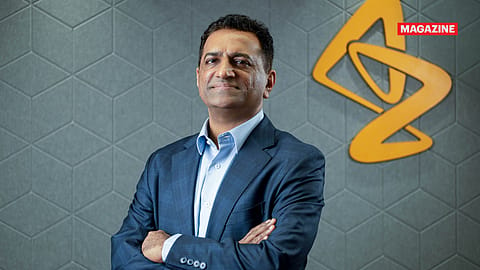
Praveen Rao Akkinepally, country president & MD, AstraZeneca Pharma India | Credits: Nishant Ratnakar
This story belongs to the Fortune India Magazine april-2026-the-emerging-100 issue.
ASTRAZENECA, the U.K.-based global pharmaceutical major, completed its sapphire anniversary — 45 years — in India in FY25. In recent years, it has introduced some innovative medicines to India. Take for instance, cancer therapies. In October 2024, it launched Tremelimumab, which in combination with Durvalumab is indicated for the treatment of patients with unresectable hepatocellular carcinoma (uHCC). This combination of two immunotherapies, globally considered as a standard of care, was not available in India until then. Similarly, in breast cancer, Trastuzumab Deruxtecan for HER2-positive metastatic breast cancer was launched in January 2024. The medicine saw adoption in indicated patient segments and became one among the Top 10 oncology brands in India within the first year of launch.
All this has led to the oncology division in India — AstraZeneca’s biggest business segment in the country — growing more than 69% year-on-year to generate income of ₹1,117 crore in FY25. In fact, AstraZeneca reported stellar financial performance in that fiscal. Its listed subsidiary, AstraZeneca Pharma India Ltd, achieved a 33.4% YoY growth in product sales (against the Indian pharma market’s single-digit growth) to cross ₹1,608 crore. And if the trailing 12 months’ (TTM) net sales of ₹2,177 crore till December 2025 (estimated by Fortune India using Capitaline data) is any indication, the celebration continues.
The reason, Praveen Rao Akkinepally — country president and MD of AstraZeneca Pharma India Ltd — says is that a global bet, which AstraZeneca took as a research-centric MNC in terms of innovative science many years ago, is beginning to pay off.
“AstraZeneca’s overall organisational purpose is about pushing the boundaries of science to deliver life-changing medicine. But this is an industry with long cycles, and you could have a purpose, but for that to realise, it could take many years of consistent investment in R&D,” says Akkinepally, adding that this journey, which started globally a decade ago, is now playing out in terms of innovative medicines. “We have been very committed to bring that innovation to serve patients in India. Historically this would have taken much longer, but we have accelerated this process.”
Between AstraZeneca’s three key therapeutic categories — oncology, biopharmaceuticals, and rare diseases — 14 new medicines and indications got regulatory approval since 2023, signalling the speed with which it has been getting its global products into the domestic market.
“Oncology has certainly been a key growth driver for us. It’s been a space where we have seen dramatic transformation of what some of these new medicines can do in terms of outcomes for patients. We have been able to bring some of our global oncology medicines to India and that has been a really big growth driver,” he says.
Biopharmaceuticals, the second biggest component of its business, including cardiovascular, renal, metabolism, respiratory, immunology medicines and some bit of vaccines, accounted for over 30% of overall revenues in FY25. “The biopharmaceutical portfolio has continued to be steady. It continues to be a foundation of our presence in the country,” says Akkinepally. The company’s rare diseases portfolio also has good growth potential in the country as there is a lot of unmet needs. “Given AstraZeneca’s global presence, we were able to bring some of the rare diseases portfolio to the emerging markets including India. That is still early days, but it is beginning to start,” says Akkinepally.
More Stories from this Issue
Given its strong presence in oncology and of late, rare diseases, the government’s tax relief for life-saving drugs has also helped it make its medicines accessible and affordable to a bigger number of patients, thereby driving volume and value.
The growth path
According to MarketsMojo, an Indian AI-driven, algorithmic stock research and portfolio advisory platform, an analysis of AstraZeneca’s Q3FY26 results indicates a steady growth in quarterly net sales. “The company reported net sales of ₹611.57 crore, reflecting a sequential growth of 9.39% from the previous quarter and a substantial YoY increase of 38.90%. This marks the seventh consecutive quarter of revenue growth, indicating strong demand across its therapeutic portfolio, which includes oncology, cardiovascular, respiratory, and diabetes segments,” it said.
AstraZeneca’s current growth has come from newer products, a wider patient base, and programmes and plans to make the medicines more affordable and accessible. Its future growth plans are also rooted in the expansion of the scope of the same strategy. For instance, speeding up the shift from conventional medicines that treat late-stage cancers to newer medicines that are best suited for patients diagnosed early could open up newer markets. Partnerships with governments and private entities could be one way of reaching out to more such potential patients.
“We definitely think that as we move forward, we have an opportunity to continue to work with the state governments as well to enable transformational care initiatives. A good example is the collaboration we had with the government of Goa in partnership with Qure.ai to enable early detection of lung cancer. And what we have learnt in the process is it really helped us understand what it will take to enable comprehensive cancer care in the context of a state government sort of medical setting. We also did something similar in Karnataka, and we are working with other states as well,” says Akkinepally.
{{#most-powerful-women-snapshot-individual.slug}} {{/most-powerful-women-snapshot-individual.slug}} {{^most-powerful-women-snapshot-individual.slug}} {{/most-powerful-women-snapshot-individual.slug}} {{#showRanking}} {{current-rank}} {{/showRanking}} {{#photo.0.url}}
{{name}}
Through this partnership, Goa had reviewed more than 100,000 chest X-rays using AI in public health system, which identified 18 lung cancer cases. Over 10,500 lung nodules were flagged through AI review of routine chest X-rays, reducing time to diagnosis by over 50%. “What makes Goa’s programme significant is its ability to deliver impact at scale using infrastructure that already exists within the public healthcare system,” says Ankit Modi, founding member and chief product officer, Qure.ai. “With AstraZeneca’s science, Goa’s public health leadership, and Qure.ai’s capability, we are bringing technology closer to patients, lowering barriers to care,” says Akkinepally.
AstraZeneca is also looking at partnerships with other pharma companies to make its medicines reach every nook and corner. “With Sun Pharma, a second brand of the newer product has been announced,” informs Akkinepally.
Innovative partnerships
In November 2025, AstraZeneca and Sun Pharma had announced a brand partnership for sodium zirconium cyclosilicate (SZC, to treat Hyperkalaemia, when potassium levels spike) in India. Under this exclusive agreement, both companies will promote, market, and distribute SZC in India under different brand names; AstraZeneca will market SZC as Lokelma, whereas Sun Pharma will promote and distribute the therapy as Gimliand.
“The addition of SZC to our portfolio underscores our unwavering commitment to improving the care of patients with chronic kidney disease,” says Kirti Ganorkar, MD, Sun Pharmaceutical Industries Ltd.
Incidentally, the listed entity is not the only subsidiary AstraZeneca has in India. AstraZeneca India Private Ltd runs the Global Innovation and Technology Centre in Chennai. “We are well over 4,000 people in overall employee strength, which makes India one of the top countries for AstraZeneca globally,” says the MD.
The parent entity had announced its plans to launch 20 new medicines by 2030. Given the trend of reducing the time lag between product launches in developed markets and developing markets like India, the Indian subsidiary is likely to introduce more products in the coming years.
“Given the context, we do believe that we will be able to continue to bring more innovation to India, and that innovation will be valued in our country as well. And given the foundation that we have built over the last few years, across oncology, biopharmaceuticals, and rare diseases, we are certainly quite committed to bringing our innovation to India and continuing to support and enable growth in the country,” says Akkinepally.
Follow Fortune India
Sign in to read full story
To access our exclusive magazine content, sign in to your Fortune India account.
Sign In NowNEXT STORY