The Emerging 100: How Chalet Hotels picks its portfolio for maximum returns
/ 6 min read
Chalet Hotels, ranked No. 11 on the list, is moving into brand ownership, ‘one box’ at a time.
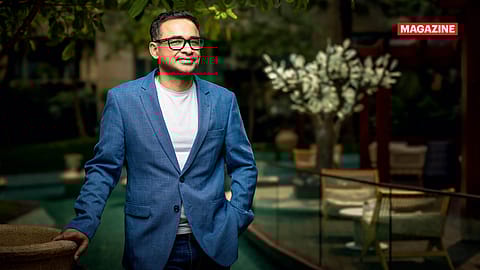
Shwetank Singh, MD & CEO, Chalet Hotels | Credits: Narendra Bisht
This story belongs to the Fortune India Magazine april-2026-the-emerging-100 issue.
INDIA’S HOTEL BUSINESS runs on a paradox. For an industry built on occupancy, it is still structurally undersupplied. Fewer than 200,000 branded rooms (compared to nearly 3 million unorganised rooms) serve a country where travel — business, leisure, weddings — has been compounding faster than infrastructure can keep up. In peak seasons, pricing power swings decisively towards the top end, where luxury and upscale hotels don’t just fill up, but dictate terms. Yet beneath the glamour, this is a capital-heavy, long-gestation business, where returns are measured not in nightly rates but in decades. According to ICRA’s November 2025 note, premium hotel room supply is projected to grow at a CAGR of 5-6% between 2024-25 and 2027-28, while demand is anticipated to expand at a faster pace of 8-10%.
That tension — between scarcity and scale, experience and economics — is where Chalet Hotels Ltd has built its playbook. It has stayed away from chasing volume for its own sake, instead doubling down on large, high-yield assets in dense urban clusters, while steadily building the capability to do more than just own them. Now, after years of operating behind global brands, it is stepping into unfamiliar territory — testing whether it can shape not just the asset and the operation, but the identity of the stay itself.
Landlord to operator
“We started off as a pure asset-owning company,” says Shwetank Singh, MD and CEO. The K Raheja Corp group company was incorporated in 1986, but its real push into hospitality began in the early 2000s with its first hotel opening in Mumbai.
Over time, it built a portfolio anchored around marquee global brands — JW Marriott, Westin, Novotel — largely in business-heavy markets such as Mumbai, Bengaluru, and Hyderabad.
That portfolio today stands at 11 hotels with 3,389 keys, with another 1,500 rooms under development. Alongside, Chalet has built a sizeable commercial real estate portfolio of about 2.4 million sq. ft, expected to expand to over 3.2–3.3 million sq. ft.
As analysts at Axis Securities point out, the company’s “double engine strategy” continues to be a key strength.
More Stories from this Issue
The brokerage’s latest report maintains “a highly optimistic outlook” underpinned by the sustained success of the core “double engine strategy” (hospitality and commercial real estate), which provides the solid financial foundation necessary to pursue growth, expansion with its premium lifestyle brand Athiva, and selective acquisitions.
But the bigger transition has been strategic. In 2009, the company entered the franchise model with Four Points by Sheraton in Mumbai — among the earliest Marriott franchise arrangements in India. That marked its first step towards operating hotels, not just owning them.
“Asset owning is a very capital-heavy business,” Singh explains. “But when you start operating, it’s about consistency, SOPs, training. And when you start owning a brand, it becomes about distribution, sales, and marketing.”
The shift, he says, has been gradual by design.
{{#most-powerful-women-snapshot-individual.slug}} {{/most-powerful-women-snapshot-individual.slug}} {{^most-powerful-women-snapshot-individual.slug}} {{/most-powerful-women-snapshot-individual.slug}} {{#showRanking}} {{current-rank}} {{/showRanking}} {{#photo.0.url}}
{{name}}
Chalet Hotels reported net sales of ₹1,718 crore in FY25, with total income at ₹1,754 crore, up from ₹1,437 crore in FY24. On a trailing 12 months (TTM) basis, net sales rose further to ₹2,734 crore.
Operating performance has strengthened meaningfully. Ebitda for the TTM period stood at ₹1,162 crore, against ₹736 crore in FY25, pointing to improved operating leverage. Profitability, however, has been less linear. Profit after tax came in at ₹143 crore in FY25, down from ₹278 crore in FY24, even as TTM PAT for FY26 rose to ₹606 crore. Return ratios remain stable, with RoCE at around 15.56%, with a three-year average growth rate of 13%.
“Chalet Hotels reported healthy revenue and Ebitda growth in 9MFY26. Hospitality business performance has been aided by a higher RevPAR (revenue per available room), led by healthy growth in ARR (average room rate),” says Arun Agarwal, vice president, fundamental research, Kotak Securities.
What this really reflects is a business still absorbing expansion, capital deployment, and cyclical factors — even as demand remains strong. According to Axis Securities, the industry is entering a sustained upcycle, with demand expected to grow at over 10% annually over the next three to four years, while supply continues to lag. Data from hospitality consulting brand Horwath HTL indicates that foreign tourist arrivals reached 9.2 million in CY24, even as corporate travel remains below pre-Covid levels, leaving further headroom for growth.
Enter Athiva
The move into brand ownership with Athiva is less a break from the past and more an extension of it. “We started as asset owners, and then became operators. This is the next step,” Singh says. “Right now, it’s an experiment for the next five, seven, maybe 10 years.”
Athiva is positioned in the upper-upscale segment, just below luxury — a space where Chalet believes it can exercise pricing power without competing directly with the most premium global brands. The first property, a resort in Lonavala, has already opened after a near-complete rebuild of The Dukes, at an investment of around ₹170 crore. Another city hotel is being rebranded under Athiva, and the pipeline stands at about 900 keys, including projects in Goa.
“We are brand-agnostic,” Singh says. “If a property is better suited to a Ritz-Carlton or a JW Marriott, we will go with that.” The flexibility reflects both experience and realism. Building a brand in hospitality is a long game, and Chalet is willing to test, refine, and, if needed, recalibrate.
Positioned in the upper-upscale segment, Athiva is designed to sit just below luxury, but without feeling like a compromise. “Luxury is well defined globally. Mid-market is largely about price. The interesting space is in between,” he says. “That’s where you can still shape perception.”
Wellness, and sustainability are not buzzwords for the company, which has climbed sharply on the gospel of sustainability measure — the Dow Jones Sustainability Index, moving from a score of 67 to 82 in just one year, and jumping from sixth place to second globally in the hospitality sector.
Much of it is anchored in three ambitious commitments. The first is EV100, transitioning all guest-facing vehicles to electric. What was originally a 2026 target was achieved a year early, covering everything, from in-house transport to logistics-linked mobility. Then comes EP100, focussed on energy productivity: doubling revenue generated per unit of electricity consumed. With 63% progress, Chalet is ahead of its 2028 goal. The third is RE100, a pledge to source all electricity from renewables; the company is already at roughly 73%, closing in on its 2030 target.
Beyond energy and emissions, the ESG story extends to governance and workforce. Women currently make up about 24% of the firm’s workforce.
Scaling, selectively
The current portfolio reflects a clear preference — large, high-yield assets in major markets. The JW Marriott Mumbai Sahar alone has 588 rooms, while its Powai campus combines two hotels with 777 rooms. In Bengaluru’s Whitefield, Chalet has expanded its Marriott property to over 520 rooms.
Cluster strategies have emerged as well. In Hyderabad’s Hitech City, two Westin properties operate within half a kilometre, sharing demand pools and operational efficiencies. One of them runs entirely as a captive training facility for Deloitte, generating fixed revenue regardless of occupancy.
“It’s a great model,” Singh says. “We don’t need sales/revenue management there, and we run GOPs (gross operating profits) in excess of 65–70%.” Even in leisure, Chalet has leaned towards scale via acquisition rather than greenfield development. Its purchase and redevelopment of The Dukes in Lonavala is a perfect example. “We are very India-centric,” Singh says. “We are not looking global.”
The company’s focus remains on “big boxes in big cities” in India and leisure destinations within driving distance of major airports. It avoids smaller markets unless the scale justifies management attention. “For us, return on management time is critical,” Singh says. “We don’t take city hotels below ₹25 crore in profit, or leisure hotels below ₹20 crore.”
Currently, 86-87% of Chalet’s revenue comes from business hotels, with resorts contributing 12-13%. The aim is to increase the leisure share to 20-25% over time, through acquisitions and selective development.
Navigating volatility
Recent geopolitical tensions in the Middle East and travel disruptions have tested the sector. With hotel and restaurant kitchens heavily reliant on LPG, the Iran conflict is squeezing operations even as it dents inbound tourism — a key revenue stream for Indian hotels, especially in major cities.
Singh acknowledges the volatility. The company has responded with cost discipline — deferring discretionary travel, optimising staffing, and tightening energy usage.
But right now, Chalet’s only ambition is to straddle two mindsets: that of an owner, and an operator.
“I tell my general managers: lead with heart like an operator, but think like an asset manager,” Singh says.
That dual lens becomes even more critical as the company moves into brand ownership, where it must now also think like a marketer, a distributor, and a technology platform.
Follow Fortune India
Sign in to read full story
To access our exclusive magazine content, sign in to your Fortune India account.
Sign In NowNEXT STORY